 AGreenNest
Low-Light Indoor Plants
I Metered Every Room for a Week: Lux Test Results
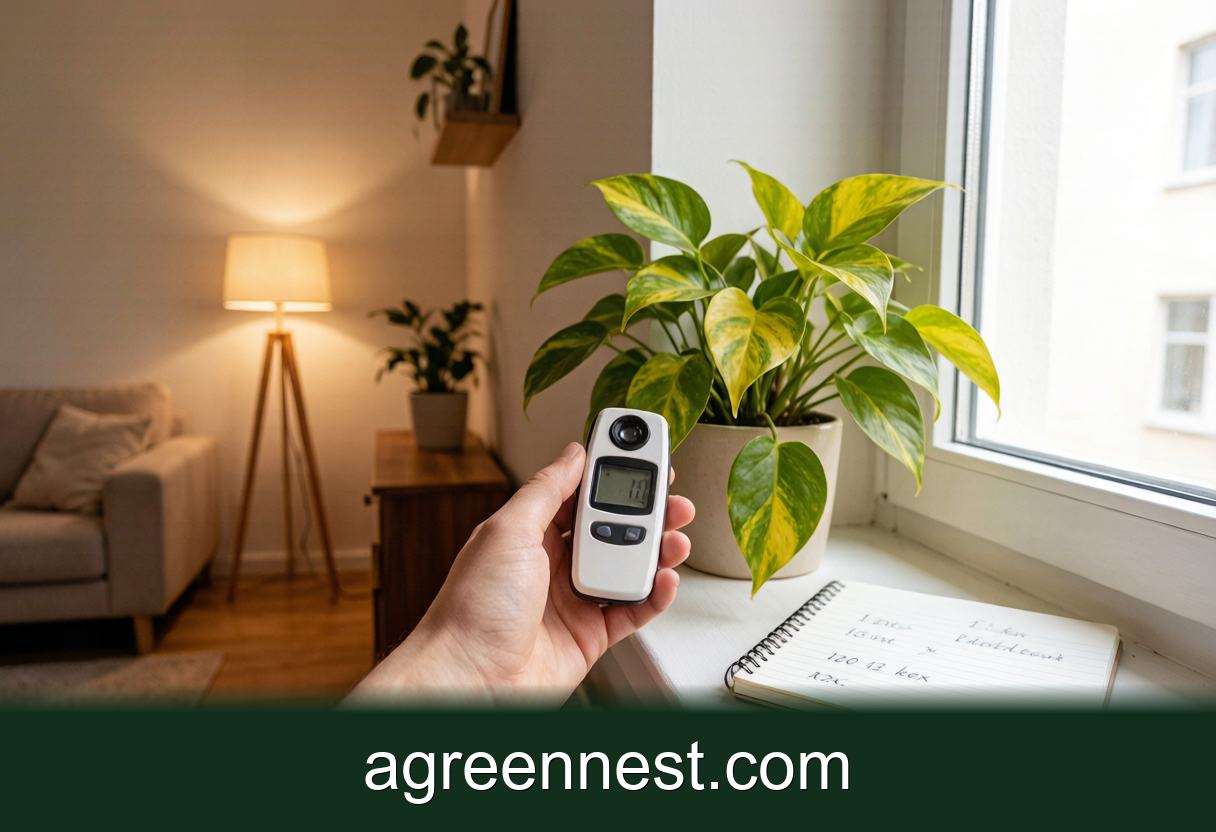
I metered my whole apartment for a week and the 'bright' corner where my pothos sulked measured just 180 lux, while survival for low-light plants starts near 500 lux and real growth near 1,000. Meter at noon and 4 pm before placing a plant; your eyes overestimate dim rooms badly.
For years I told visitors my living room corner was "pretty bright." Then I borrowed a lux meter from a photographer friend, held it where my sulking pothos sat, and watched the screen settle at 180 lux. Direct summer sun outside reads around 50,000. My "pretty bright" corner was getting less than half a percent of that. I owed the plant an apology.
So I did what any obsessive plant person would do: I spent a week metering every room in my apartment, morning, noon, and late afternoon, and wrote it all down. The numbers surprised me more than any care guide ever has, and they explain almost every low-light failure I have had in fifteen years of growing indoors.
How the Experiment Worked
Nothing fancy. One handheld lux meter (about $25), one notebook, and readings at 9 am, 12 pm, and 4 pm for seven days in a row. I held the sensor flat, facing the ceiling, exactly where a plant's topmost leaves would sit. That detail matters: pointing the sensor at the window can triple the reading and flatter a spot that is actually dim.
My apartment faces east and north, on the second floor, with a building across the street. In other words, an honest test bed for low-light growing, not a sunroom.
The seven-day average is what I report below, because single readings lie. A passing cloud dropped my east windowsill from 8,200 lux to 1,900 in under a minute.
How Dark Is a "Low-Light" Corner, Really?
Here are my averages, worst to best:
- Hallway with no window: 40 lux. Plant purgatory.
- Living room corner, 3 m from the north window: 180 lux.
- Middle of the living room, 2 m from the window: 420 lux.
- North windowsill: 1,900 lux.
- 1 m from the east window: 2,800 lux.
- East windowsill, morning: 8,200 lux, falling to 900 by 4 pm.
The pattern that jumped out is how savagely light falls off with distance. Stepping just 2 m back from my north window cut the reading by roughly 78 percent. My eyes registered almost no difference, because pupils compensate so smoothly that a room can lose three quarters of its light and still "look" the same. The meter does not compensate, and neither does a plant.
That living room corner, the one I defended as bright? At 180 lux it sits below the survival line for nearly everything except a plastic fern.
What Do the Numbers Mean for Your Plants?
Horticultural references usually talk in foot-candles; multiply by roughly 10.8 to get lux. Rounded for real life:
- Below 500 lux: most plants slowly decline. A Zamioculcas zamiifolia or Aspidistra elatior can hold for months by burning stored reserves, but it is coasting, not growing.
- 500 to 1,000 lux: survival zone for the tough crowd, including Dracaena trifasciata (the snake plant) and Epipremnum aureum. Expect little new growth.
- 1,000 to 2,500 lux: the honest "low light" band where those same plants actually put out leaves, and where a Spathiphyllum wallisii will flower reluctantly.
- 2,500 to 10,000 lux: bright indirect. Most foliage houseplants are happy here.
Two of my spots fell in the genuine growth zone. Two. Everything I had parked further into the room was slowly starving, which matched the stretched stems and small pale leaves I kept blaming on fertilizer. If your plants show that same reaching habit, the fix is light, and our etiolation guide walks through the recovery.
The north windowsill was the sleeper hit at 1,900 lux. Steady, no scorch risk, perfect for the north-window lineup I already recommend. My grandmother kept an Aspidistra in a Trondheim stairwell that probably never saw 800 lux, and it outlived two sofas, but it also never grew a leaf between October and April. Survival and thriving are different contracts.
Can a Phone App Replace a Real Lux Meter?
I tested three free apps against the dedicated meter, same spot, same minute. Results ranged from 20 percent under to 35 percent over the reference reading, and one app gave two different numbers thirty seconds apart in unchanged light. Phone light sensors are built to adjust screen brightness, not to measure photons for horticulture.
My verdict after a week: an app is fine for triage, meaning it will correctly tell you that a corner is dim rather than bright. It is not fine for borderline calls, like deciding whether a spot clears 1,000 lux. If the app says 700, the truth could be anywhere from 500 to 950. For $20 to $30, a basic meter removes the guessing, and it is the single most clarifying tool I have bought since my first moisture meter.
Why Afternoon Readings Changed My Plant Placement
The biggest lesson was not any single number. It was the daily swing. My east windowsill looked like premium real estate at 9 am, reading 8,200 lux. By 4 pm it had collapsed to 900. Averaged across the day, that windowsill delivers less usable light than a steady west or south exposure half its peak brightness.
Plants integrate light over the whole day, so a two-hour morning spike does not rescue eight dim hours. After the experiment I moved my Spathiphyllum from the flashy east sill to the boring, steady spot 1 m inside the north window, and it pushed out three new leaves in six weeks. The corner plants moved closer to glass, and the 40-lux hallway got a framed print instead of another doomed pothos. A small grow light on a timer, running 10 to 12 hours, now covers the one shelf I refused to give up; timing tricks are in our grow light timer guide.
One caveat: my numbers are July numbers. The same north windowsill in December will likely read a third of these values, which is why summer low-light care and winter care are different jobs. I plan to re-run the whole week in January and compare.
Frequently Asked Questions
Q: What lux reading is too low for a snake plant to survive?
A: Below about 500 lux a Dracaena trifasciata stops growing and slowly draws down its reserves. It can look acceptable for months at 200 to 300 lux, but it is declining. For actual new leaves, aim for 1,000 lux or more.
Q: Why does my room look bright but meter at only 200 lux?
A: Human eyes adapt automatically, so a room that has lost 75 percent of its light still looks normal. A meter reads the true level. Distance is the usual culprit: light drops off steeply within the first 2 m from a window.
Q: Should I point the lux meter at the window or at the ceiling?
A: Hold the sensor horizontal, facing the ceiling, at leaf height. Aiming it at the window measures the window's surface brightness, not the light landing on the plant, and can inflate the reading two to three times.
Q: What time of day should I take light readings for houseplants?
A: Take at least two, one near noon and one around 4 pm, and average them. A single morning reading overrates east windows badly; my east sill swung from 8,200 lux at 9 am to 900 by late afternoon.
Q: How many lux does a peace lily need to bloom indoors?
A: Mine only set buds once it moved to a steady spot above roughly 1,500 lux. Between 1,000 and 2,500 lux a Spathiphyllum wallisii grows well but flowers sparingly; below 1,000 it survives as a foliage plant.
A $25 meter and a week of scribbled readings taught me more about my apartment than a decade of guessing. Meter at leaf height, average a noon and a late-afternoon reading, trust nothing under 500 lux for living plants, and give the borderline shelves a timer-driven grow light. If you want to translate your own readings into plant choices, our free light calculator does the matching for you.
Sources & further reading
GreenNest authors research and write every guide independently. The external links below are reputable references we recommend for deeper reading — they are not the sources we copied from.
- Royal Horticultural Society — Houseplant care — RHS
- Missouri Botanical Garden — Missouri Botanical Garden
- NC State Extension Plant Toolbox — NC State Extension
Recommended Tools for Low-Light Indoor Plants Care
Free, no-signup helpers matched to this guide.
Free Ebooks to Explore
Downloadable handbooks — no email required.
Share Your Plant Story
Grown something tricky, or found a trick that finally worked? Tell us in the comments, or see what other readers are sharing on our Community page. The best reader tips get folded back into our guides.
Join the Conversation
Have a tip or a question about I Metered Every Room for a Week: Lux Test Results? Share it below — comments are saved on our server.