 AGreenNest
DIY Plant Projects
Build a DIY Moss Pole for Under $10 (Exact Specs)
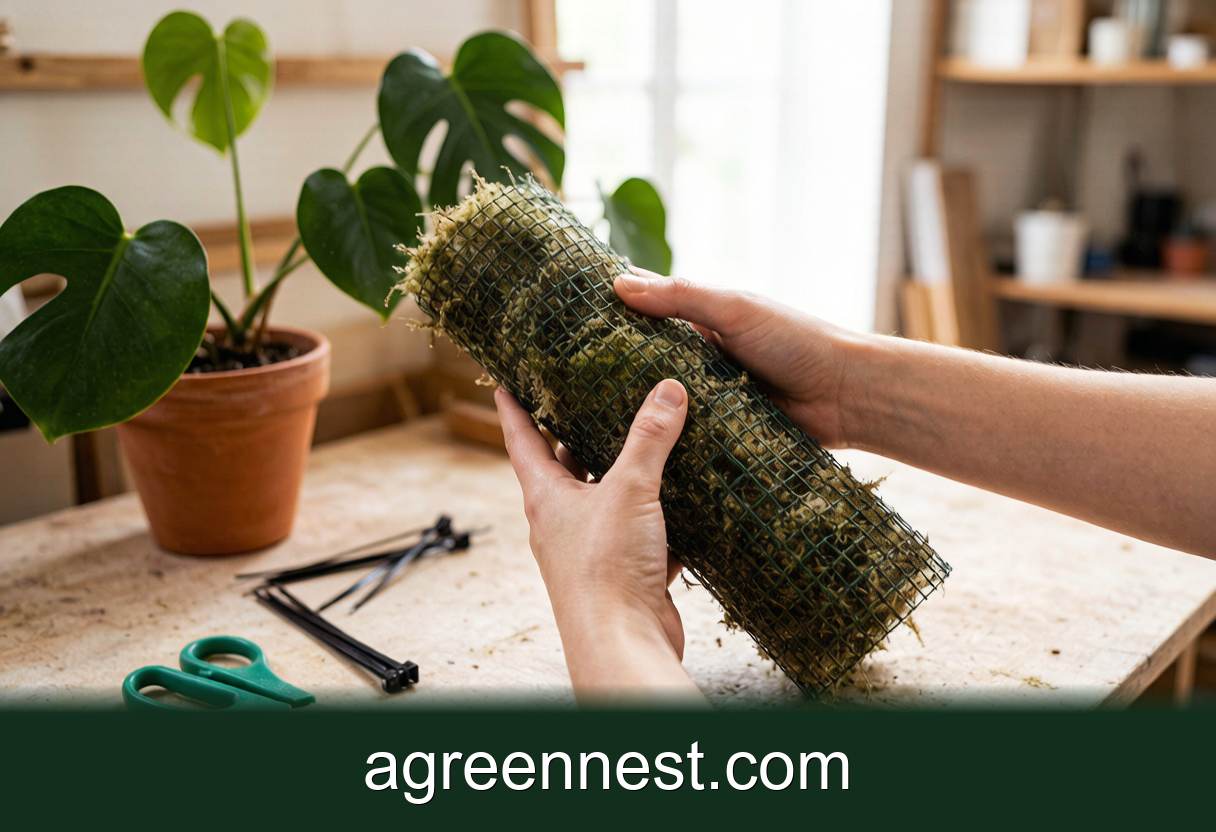
A DIY moss pole needs four things: 13 mm plastic mesh cut to 60 x 25 cm, 80 to 100 g of dry sphagnum soaked 20 minutes, eight cable ties, and 15 cm of pole buried in the pot. Total cost lands under $10 and the build takes about 30 minutes.
Store moss poles run $18 to $30 and most of them share the same flaw: a thin coir skin over plastic that aerial roots cannot penetrate. You can build a better one, a true sphagnum-core pole, for under $10 in about 30 minutes. I have built eleven of these over the past three years, broken two, and standardized the spec that follows. Measurements included, because "some mesh and some moss" is not a build plan.
If you are still deciding whether a moss pole is even the right support for your plant, settle that first with our moss pole vs coir pole vs trellis comparison. Moss poles earn their keep for aerial-root climbers: Monstera deliciosa, Epipremnum aureum, Philodendron hederaceum, Rhaphidophora tetrasperma. Twiners and shrubby plants want different hardware.
What You Need (Exact Materials and Costs)
- Plastic garden mesh or hardware cloth, 13 mm (half-inch) grid, 60 x 25 cm piece: $3 to $4. Skip anything with holes under 10 mm; roots need to reach the moss through the grid.
- Dried sphagnum moss, 80 to 100 g: $3 for this quantity from a 150 g bag. Long-fiber New Zealand sphagnum holds together best; the crumbly stuff sheds.
- Cable ties, 100 x 2.5 mm, 8 of them: under $1.
- Optional stiffener: a 70 cm bamboo stake or 16 mm PVC pipe, $1, only needed for poles over 60 cm or top-heavy plants.
- Gloves. Dry sphagnum is dusty, and rare cases of fungal infection from handling it are documented, so this is not optional in my shop.
Wire hardware cloth also works and holds shape better, but the cut ends are vicious. If you go that route, fold every cut edge back with pliers. For a first build, plastic mesh is the sane choice.
How Do You Assemble the Pole So It Doesn't Sag?
Sagging comes from underpacking. Every saggy DIY pole I have inspected was stuffed with fluffed, barely compressed moss. Pack density is the whole game.
- Soak the dry sphagnum in a bucket for 20 minutes, then squeeze each handful until it stops dripping. Damp and springy, not sopping.
- Lay the mesh flat. Spread moss across it in a strip about 4 cm thick, leaving the bottom 15 cm of mesh bare. That bare section anchors in the pot.
- Roll the mesh into a cylinder 8 to 10 cm in diameter, compressing the moss as you go. You want to fight it a little. If the roll closes without resistance, add more moss.
- Cinch a cable tie every 8 cm along the seam, eight ties for a 60 cm pole. Trim the tails flush so they do not slice leaves later.
- Push the bare mesh section 15 cm deep into the pot, against the side, before you position the plant's root ball. Installing into a finished pot tears roots.
A properly packed 60 cm pole weighs around 700 to 900 g damp. Lighter than that usually means loose fill, and loose fill dries out in a day.
How Do You Attach the Plant Without Snapping Stems?
Do not use bare cable ties on stems. They bite. Use soft plant tape, velcro strap, or strips of old t-shirt, tied at each node just below a leaf, snug enough to hold the node against the damp moss and loose enough to slide a finger under.
Aim the aerial roots at the pole; do not force mature stiff roots that grew in another direction, they will crack before they bend. New roots that emerge after mounting will find the moss on their own, typically rooting into it within 4 to 8 weeks at 20 to 26°C. On my kitchen Monstera deliciosa, leaves produced after attachment came in 30 to 40 percent wider than pre-pole growth, with the first fenestrations on a plant that had refused to split for two years. That size jump is the entire reason this build is worth half an hour. A philodendron responds the same way, just less dramatically.
Keeping It Damp Without Rotting the Pot
A dry moss pole is a decorative stick; roots ignore it. The maintenance contract:
- Water the pole from the top twice a week in summer, once a week in winter, until it darkens. A squeeze bottle takes 60 seconds.
- Roughly monthly, in the shower or sink, drench the whole pole and let it drain before returning the pot to its saucer. This also rinses accumulated fertilizer salts.
- Check pot moisture separately. Pole runoff trickles into the soil, so pots with mounted poles need direct watering less often. A cheap probe settles it; here is how to read a moisture meter properly.
Humidity above 50 percent stretches the interval between waterings noticeably. Inside a cabinet greenhouse, my test pole stayed damp for nine days straight without attention.
When the plant outgrows the pole, do not unwind it. Build a second pole, lash it to the first with two cable ties overlapping 10 cm, and extend upward. Roots already embedded in the old section stay put.
Three Mistakes That Kill DIY Poles
First: coir rope wrapped around a stake sold as a "moss pole" substitute. Coir sheds water instead of holding it, and aerial roots rarely penetrate a tight wrap. If you want zero-maintenance support, buy a coir pole knowingly; do not build one expecting moss-pole results.
Second: soaking the pole by pouring fertilizer solution over it at full strength. Moss holds concentrates against tender aerial roots and burns them brown. If you feed through the pole, dilute to quarter strength, and flush monthly.
Third: building tall on day one. A 100 cm pole on a 30 cm plant is a lever arm in a 15 cm pot; one bump and the whole assembly capsizes, shearing the rooted sections. Start at 60 cm, extend later. I learned this by picking a Rhaphidophora off the floor at 2 am.
Frequently Asked Questions
Q: What size mesh should I use for a moss pole?
A: A 13 mm (half-inch) grid is the sweet spot. Holes under 10 mm block aerial roots from reaching the moss; much over 20 mm and compressed sphagnum bulges out and dries fast. Plastic garden mesh in this gauge costs $3 to $4 per pole.
Q: How much sphagnum moss does one 60 cm pole take?
A: 80 to 100 g of dry long-fiber sphagnum, soaked 20 minutes and squeezed. If your finished damp pole weighs much under 700 g, it is underpacked and will sag and dry out quickly.
Q: Can I use sphagnum from a hanging basket liner instead of bagged moss?
A: Not worth it. Liner moss is compressed, often dyed, and frequently treated. Untreated long-fiber sphagnum is $3 for the quantity a pole needs and holds roughly 20 times its weight in water.
Q: Why won't my monstera's aerial roots grab the moss pole?
A: Almost always a dry pole or an old root. Mature aerial roots that hardened in the air rarely re-root; only new growth does, and only into consistently damp moss at 20 to 26°C. Keep the pole dark-damp for a month and tie each new node against it.
Q: Do moss poles attract fungus gnats?
A: A constantly sodden pole can. Keep it damp, not dripping, let the surface dry slightly between top-ups, and gnats favor the pot soil instead. If they show up anyway, treat the soil, not the pole.
Under $10, 30 minutes, four materials, and the payoff is measurably bigger leaves within two months on any aerial-root climber. Pack the moss tight, bury 15 cm of bare mesh, tie nodes with soft strap, and keep the core damp on a twice-weekly rhythm. If your climber is stretching toward a dim window instead of climbing, check the light before blaming the pole with our free light calculator.
Sources & further reading
GreenNest authors research and write every guide independently. The external links below are reputable references we recommend for deeper reading — they are not the sources we copied from.
- Michigan State University Extension — Michigan State University
- NC State Extension Plant Toolbox — NC State Extension
- University of Minnesota Extension — U Minnesota Extension
Recommended Tools for DIY Plant Projects Care
Free, no-signup helpers matched to this guide.
Free Ebooks to Explore
Downloadable handbooks — no email required.
Free Ebook
The AGreenNest Succulent Care Handbook
The complete, beginner-to-confident guide to growing fat, happy succulents — 10 chapters and a 20-plant directory.
Free Ebook
Haworthia & Haworthiopsis Care Handbook
A focused guide to the striped, forgiving Haworthia clan.
Share Your Plant Story
Grown something tricky, or found a trick that finally worked? Tell us in the comments, or see what other readers are sharing on our Community page. The best reader tips get folded back into our guides.
Join the Conversation
Have a tip or a question about Build a DIY Moss Pole for Under $10 (Exact Specs)? Share it below — comments are saved on our server.