 AGreenNest
Plant Care Accessories
Airflow for Indoor Plants: The Fan Setup That Works
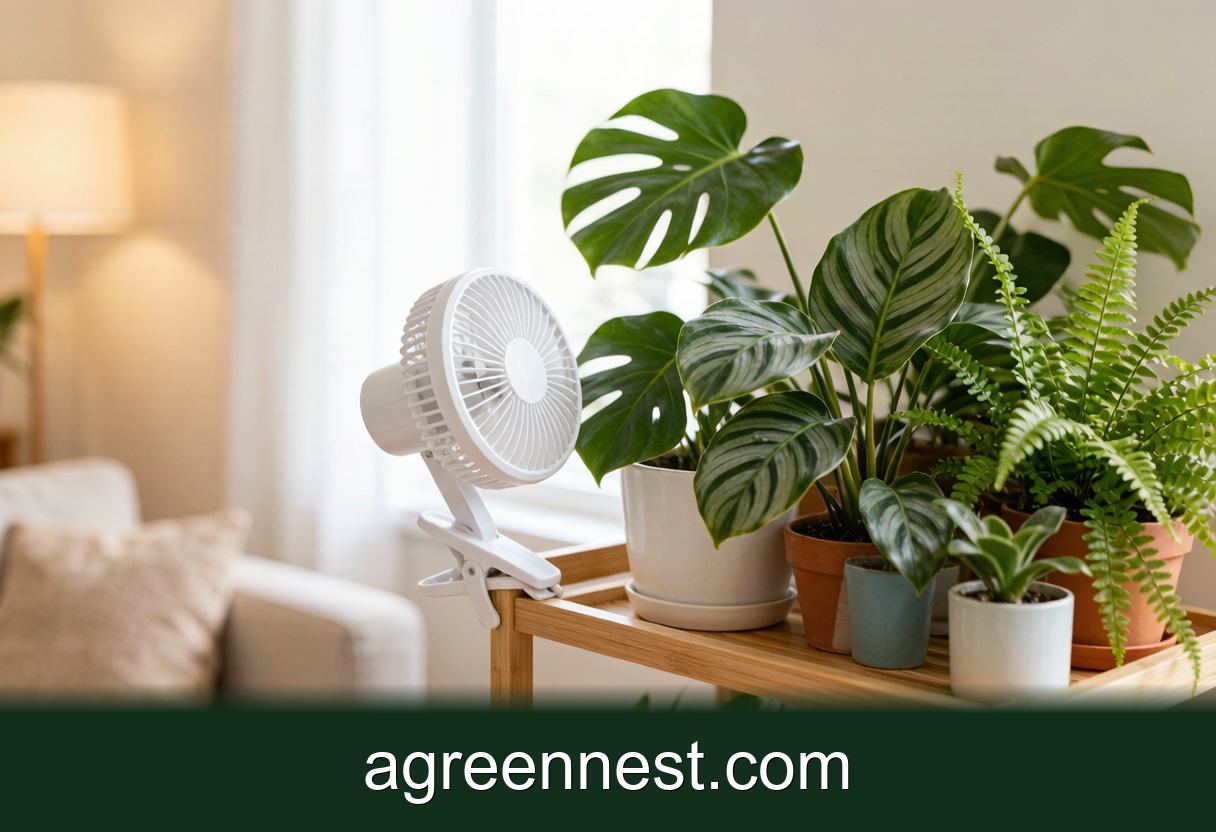
Houseplants need gentle constant air movement, about 0.3-0.5 m/s, enough to make leaves flutter slightly. A 15 cm clip fan on its lowest speed, placed 1.5-2 m away and aimed past the plants rather than at them, running 6-8 hours a day, prevents mould, botrytis, and weak stems in most rooms.
Every greenhouse on earth runs fans. Walk into any commercial operation and you will hear them before you see a single plant. Yet the average houseplant shelf sits in air so still that a sheet of tissue paper would not move on it. That gap explains a surprising share of the problems people blame on watering.
Still air is not neutral. It is a risk factor with a paper trail: fungal spores settle instead of dispersing, humidity pools around foliage after every misting, soil surfaces stay damp for days, and stems never face the mechanical stress that builds thickness. Fixing it costs about 20 dollars and draws less power than a phone charger. Here is the exact setup.
Why Do Indoor Plants Need Moving Air at All?
Four separate mechanisms, all documented in greenhouse practice.
First, transpiration. Each leaf carries a thin boundary layer of humid, still air clinging to its surface. In stagnant rooms that layer thickens, gas exchange slows, and the plant effectively breathes through a wet blanket. Air moving at 0.3 to 0.5 m/s strips the layer thin again and keeps water cycling.
Second, disease pressure. Grey mould (Botrytis cinerea) and powdery mildew both germinate on leaf surfaces that stay wet or humid for hours. A fan that keeps foliage dry is a stronger defence than any spray. Our guide to dealing with leaf spot disease treats the symptom; airflow treats the cause.
Third, fungus gnats. Their larvae need a moist, still soil surface to thrive. Moving air dries that top centimetre faster, which is one reason a breezy room has fewer gnats. Pair it with the drying routine in our fungus gnat elimination guide and the problem rarely starts.
Fourth, structure. Wind load triggers a plant to thicken its cell walls. A Ficus lyrata or Monstera deliciosa grown in dead still air develops long, floppy petioles that flop the moment you move the pot. Give those same plants a daily breeze and the stems stiffen within weeks.
What Fan Size and Speed Is Right?
You do not need a big fan. Oversized is worse than undersized, because a 30 cm floor fan on low still produces a hard directional blast that shreds delicate leaves and dries the pot to dust.
For most shelves and a few pots, a 10 to 15 cm clip or table fan is plenty. The number that matters is canopy speed, not the dial setting. Aim for the point where leaves flutter and stems sway a few centimetres, then back off one notch. That fluttering corresponds to roughly 0.3 to 0.5 m/s measured at the foliage, which matches the gentle movement commercial benches use.
A small USB clip fan draws 3 to 5 watts. Left on eight hours a day, that is under 2 cents of electricity a month. An oscillating model is worth the few extra dollars because it spreads the movement instead of hammering one corner.
How Long Should the Fan Run Each Day?
Six to eight continuous hours is the baseline for a shelf in a closed room. The goal is not a windstorm at noon, it is to never let the air fully stagnate.
If the fan runs while you are home and the room seals up at night, you have reintroduced 16 hours of dead air. Better to run it on a cheap timer through the day and leave a window cracked if safety allows. Seedlings are the exception that proves the rule: trays under constant high humidity with zero movement are where damping-off (Pythium) wipes out a flat overnight. Those want air moving every hour the lid is on.
In winter, when heating dries the room, you can drop to four hours and watch your plants closely. In summer, when humidity climbs, eight hours is the safe floor. A moisture meter becomes more useful here than you might expect, because moving air changes how fast the topsoil reads dry and you should water by the root zone, not the surface.
Don't Aim the Fan Straight at the Plants
The single most common mistake is clipping a fan two centimetres from a leaf and pointing it dead on. You get a constant hard stream on one plant and nothing on the rest, and the unlucky front-row leaf desiccates.
Point the fan across the shelf or past the plants so the air sweeps through the group. For a single large specimen, aim at the wall beside it so the bounce circulates. Distance matters: 1.5 to 2 m back, on the lowest speed, reliably produces the target flutter without a single leaf taking the full blast. If you currently rely on misting for humidity, read our mister versus humidifier breakdown first, because a fan and a daily misting can fight each other.
Which Plants Dislike Direct Airflow?
Most do fine. A few protest.
Thin-leaved tropicals with no cuticle to hold moisture are the sensitive group. Calathea, Maranta, Pilea, maidenhair fern (Adiantum), and anything recovering from transplant shock want the air kept moving but never blowing on them directly. Tuck them behind the sweep, not in front of it. A pebble humidity tray placed out of the direct stream gives them the local humidity they want without the drying they hate.
Succulents and cacti are the opposite end: they want all the breeze you can give, short of toppling. Cactus spines literally evolved to channel turbulent desert wind, so your living room fan is a holiday for them.
Frequently Asked Questions
Q: Can I just open a window instead of running a fan?
A: Only if that window faces a breeze and you are home to manage temperature swings. Most windowsills sit still, and an open window in January trades airflow for cold shock. A fan is controllable, which is the point.
Q: Will a fan dry my plants out too fast?
A: It speeds the topsoil, not the root ball. Water by depth with a meter and you will likely water a little less often, not constantly. The trade is usually healthier roots.
Q: Is a ceiling fan enough for a plant in the corner?
A: Rarely. Ceiling fans move air high up and leave corners dead calm. A small dedicated clip fan at the shelf is what actually reaches the leaves.
Q: Do seedlings need different airflow than mature plants?
A: Yes. Seedling trays need continuous gentle movement to avoid damping-off, while established plants tolerate a few still hours overnight. The younger the plant, the less still the air should be.
Q: How do I know the airflow is too strong?
A: Leaves curl at the edges, the topsoil bakes to a crust within a day, or a lightweight plant visibly leans away from the stream. Drop one speed setting or move the fan back a metre.
Airflow is the cheapest upgrade in indoor plant care, and the most overlooked. A 15 cm fan on low, pointed past the shelf for six to eight hours, prevents more mould, gnats, and floppy stems than any bottle in the cabinet. Start with one clip fan and measure the difference in two weeks. If you are building out a shelf system, our complete accessory guide maps the rest of the gear worth buying.
Sources & further reading
GreenNest authors research and write every guide independently. The external links below are reputable references we recommend for deeper reading — they are not the sources we copied from.
- Michigan State University Extension — Michigan State University
- University of Minnesota Extension — U Minnesota Extension
- NC State Extension — Plant Toolbox — NC State Extension
Recommended Tools for Plant Care Accessories Care
Free, no-signup helpers matched to this guide.
Free Ebooks to Explore
Downloadable handbooks — no email required.
Free Ebook
The AGreenNest Succulent Care Handbook
The complete, beginner-to-confident guide to growing fat, happy succulents — 10 chapters and a 20-plant directory.
Free Ebook
Haworthia & Haworthiopsis Care Handbook
A focused guide to the striped, forgiving Haworthia clan.
Share Your Plant Story
Grown something tricky, or found a trick that finally worked? Tell us in the comments, or see what other readers are sharing on our Community page. The best reader tips get folded back into our guides.
Join the Conversation
Have a tip or a question about Airflow for Indoor Plants: The Fan Setup That Works? Share it below — comments are saved on our server.