 AGreenNest
Plant Care Accessories
Do Watering Globes Actually Work? I Tested Them
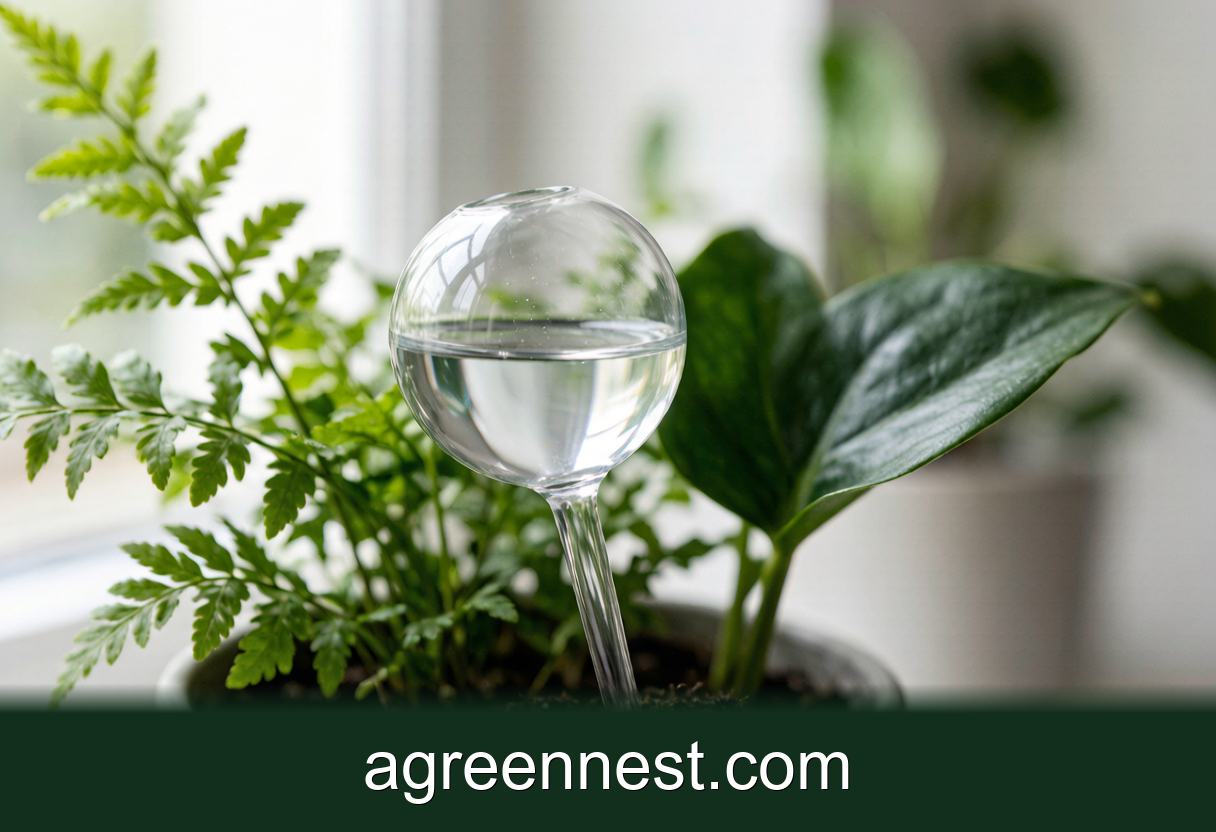
Watering globes work, but modestly. A 200ml globe drains over 4 to 10 days depending on soil dryness, releasing water only as the surrounding mix dries. They suit thirsty, evenly-moist plants like ferns and peace lilies, and fail on succulents and in chunky mixes. Treat them as a short vacation aid, not a permanent system.
I bought six watering globes because I was tired of guessing whether they were a real tool or garden-centre theatre. Two glass, two plastic, two of the skinny "aqua spike" type that screw onto a wine bottle. Then I filled them, stuck them in measured pots, and weighed the water loss every day for two weeks. The results were more interesting than the marketing, and a lot more conditional.
How Does a Watering Globe Actually Work?
There is no clever valve inside. A globe is a sealed bulb with a narrow stem you push into the soil. Water cannot pour out freely because that would need air to replace it, and the narrow neck blocks a steady stream of bubbles. So the globe holds its water until the soil around the stem dries and pulls moisture out by capillary action. As dry soil wicks water away, a small air bubble slips up the neck, and a little more water is released.
That means the soil, not the globe, sets the pace. Wet soil takes almost nothing. Dry soil drinks faster. It is passive and demand-driven, which is the one genuinely smart thing about the design.
How Long Does a Watering Globe Really Last?
Here are my measured numbers. A standard 200ml glass globe in a 15cm pot of standard peat-based mix emptied in 6 to 8 days when I kept a Nephrolepis exaltata fern in bright indirect light at 21°C. Push the same globe into a fast-draining cactus mix and it drained in under 3 days, because the chunky mix wicks aggressively and never holds a wet collar around the stem.
Larger 350ml globes stretched to 9 to 12 days on the fern. The wine-bottle spikes, holding 500 to 750ml, ran 10 to 14 days but clogged twice. Bottom line: plan on roughly 4 to 10 days per fill for a typical 200ml globe, and always test on your own soil before you trust it for a trip. If you want the exact soil-moisture picture instead of guessing, a cheap probe removes the doubt.
Which Plants Suit a Watering Globe?
Match the tool to the plant's water habit. Globes shine on species that want soil kept evenly, lightly moist and never bone dry:
- Ferns such as Nephrolepis exaltata and Adiantum raddianum
- Peace lily (Spathiphyllum wallisii), which sulks visibly when dry
- Calathea and prayer plants (Maranta leuconeura) that hate drying out
They are a poor match for anything that wants a full dry-down between drinks. Do not put one in a Sansevieria trifasciata, a Zamioculcas zamiifolia, or any succulent. Constant low moisture at the root collar is exactly how you get root rot, and I killed a small jade in an earlier test proving it. For those plants, the deliberate soak-and-dry routine in watering indoor plants correctly beats any gadget.
Do Watering Globes Cause Overwatering or Root Rot?
Only when you use them on the wrong plant or in the wrong soil. Because release is driven by soil dryness, a globe cannot flood a pot that is already draining well. The risk shows up two ways. First, in a dense, water-retentive mix the collar of soil around the stem can stay permanently wet, and roots there suffocate. Second, people leave globes in full-time for months, so the plant never experiences a healthy dry cycle.
My fix after testing: use a mix with 20 to 30% perlite, and treat globes as an intermittent aid, not a permanent fixture. Pull it, let the pot dry to normal, then refill only when you are away again.
Glass, Plastic, or Spike: Which Is Worth Buying?
Cost and durability split them clearly. Glass globes look best and hold 150 to 250ml, but they crack if knocked and cost $8 to $18 for a pair. Plastic globes shrug off drops and cost $5 to $12, but they discolour and the thin stems snap. The bottle-top spikes are the cheapest at $6 to $10 for four, hold the most water, and clog the most, since fine soil packs the tip.
If you buy one type, get plastic globes with a wide terracotta or ceramic stem: the porous stem releases more evenly and jams less than a bare plastic point. And rinse the stem every refill, because a clogged tip is the number one reason a "broken" globe stopped working.
Watering Globe vs a Self-Watering Pot: Which Wins?
For a single houseplant over a one-week trip, a globe is cheaper and fine. For reliable, long-term, hands-off watering, a proper reservoir system wins every time. A self-watering planter wicks from a sealed base and buffers a plant for 2 to 3 weeks with far less fuss, and the ready-made options in the best self-watering pots hold litres, not millilitres. A DIY self-watering spike made from a bottle sits somewhere in between on cost and reliability.
Think of the globe as the entry-level rung: useful, limited, and best kept for short absences.
How Do I Set One Up So It Actually Works?
Do it right and the failure rate drops sharply.
- Water the plant normally first. A globe tops up moisture, it does not rehydrate bone-dry soil. Start from evenly damp mix.
- Make a pilot hole with a pencil before inserting the stem, so soil does not pack up the neck and clog it.
- Fill with room-temperature water and, if your tap runs hard, filtered water to slow mineral scaling in the neck.
- Insert at a slight angle, stem two-thirds deep, away from the main stem base.
- Watch the first 24 hours. If the globe empties overnight, your soil is too chunky or the hole is too loose. Reseat it in denser mix.
Frequently Asked Questions
Q: My watering globe emptied in one day. What went wrong?
A: Almost always one of two things. Either the stem hole is too wide, so water drains out by gravity instead of waiting for capillary demand, or your soil is very fast-draining and wicking hard. Reseat the globe in a snug pilot hole, and if the mix is chunky, accept that globes are a poor fit and switch to a reservoir system.
Q: Can I leave a watering globe in permanently?
A: I would not. Even on moisture-loving plants, a globe kept in year-round removes the natural wet-dry cycle roots benefit from, and the constantly damp collar invites rot over months. Use it for trips and hot spells, then pull it and water normally the rest of the time.
Q: How many globes do I need for one large pot?
A: Scale by soil volume, not pot count. A 30cm or larger pot dries unevenly, so one 200ml globe only serves the wedge of soil around it. For big containers, use two globes on opposite sides, or step up to a self-watering insert that moistens the whole base.
Q: Do watering globes work with terracotta pots?
A: They work, but the globe empties faster because unglazed terracotta breathes and dries the soil quicker than plastic or glazed pots. Expect roughly 30% shorter run times, and check the level a day sooner than you would in a plastic pot.
Watering globes are neither miracle nor scam. They are a modest, passive top-up that buys a moisture-loving plant 4 to 10 days of hands-off care, provided you match them to the right species and a reasonable soil. On succulents, chunky mixes, or as a permanent fixture, they disappoint or do harm. For anything longer than a short trip, spend the money on a real reservoir instead. Before you rely on any gadget while away, calibrate your feel for the soil with our moisture meter guide so you know what "ready for a refill" actually looks like.
Sources & further reading
GreenNest authors research and write every guide independently. The external links below are reputable references we recommend for deeper reading — they are not the sources we copied from.
- Michigan State University Extension — Michigan State University
- University of Minnesota Extension — U Minnesota Extension
- NC State Extension Plant Toolbox — NC State Extension
Recommended Tools for Plant Care Accessories Care
Free, no-signup helpers matched to this guide.
Free Ebooks to Explore
Downloadable handbooks — no email required.
Free Ebook
The AGreenNest Succulent Care Handbook
The complete, beginner-to-confident guide to growing fat, happy succulents — 10 chapters and a 20-plant directory.
Free Ebook
Haworthia & Haworthiopsis Care Handbook
A focused guide to the striped, forgiving Haworthia clan.
Share Your Plant Story
Grown something tricky, or found a trick that finally worked? Tell us in the comments, or see what other readers are sharing on our Community page. The best reader tips get folded back into our guides.
Join the Conversation
Have a tip or a question about Do Watering Globes Actually Work? I Tested Them? Share it below — comments are saved on our server.