 AGreenNest
Plant Care Accessories
Digital vs Analog Hygrometer: Which One to Trust
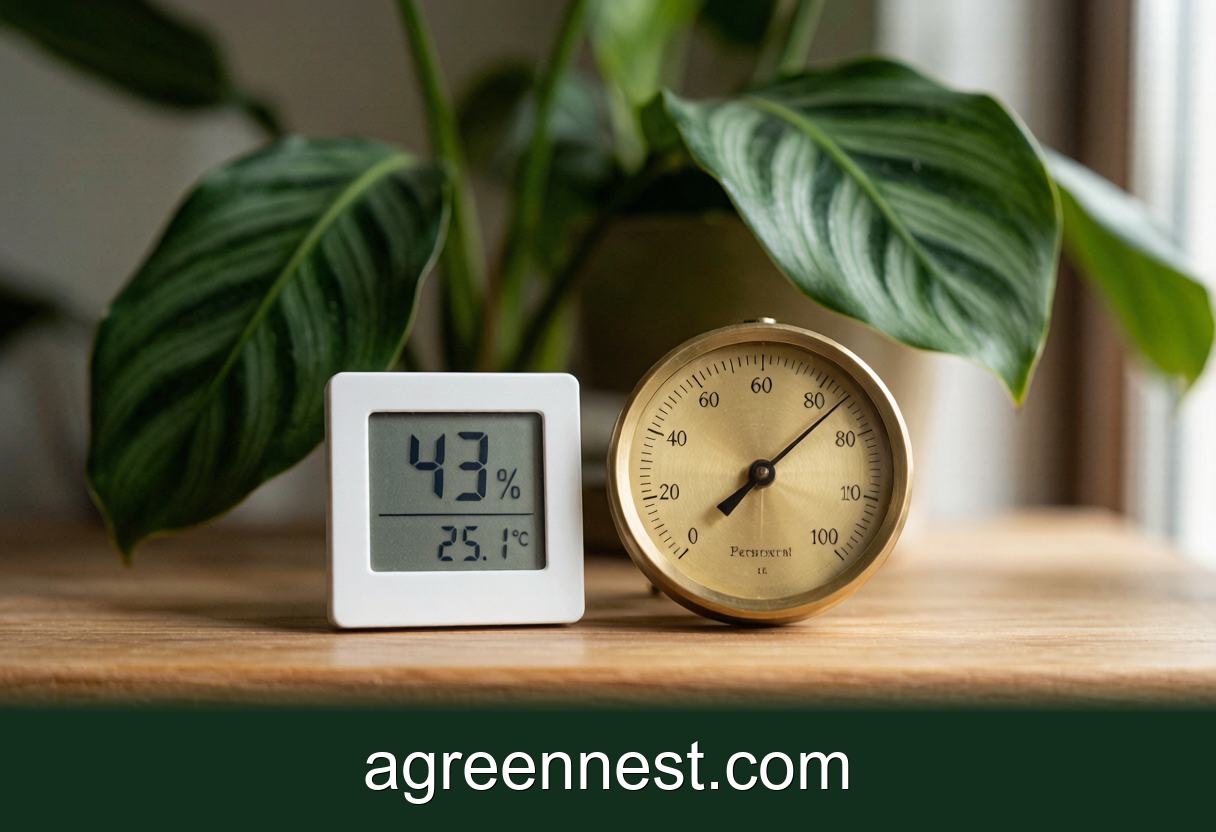
For plant rooms, buy a digital hygrometer: capacitive sensors read within 2 to 3 percent RH, while analog coil dials drift 7 to 10 points and rarely offer recalibration. Verify any unit with the salt test, a sealed bag of damp table salt reads exactly 75 percent RH after 8 hours.
I own eleven hygrometers. Three are brass-ringed analog dials, eight are cheap digital squares. Last winter I sealed all eleven in a box with a calibrated reference sensor overnight at a true 52 percent relative humidity.
The digital units read between 49 and 55. The analog dials read 38, 61, and 70.
That spread is the entire debate in one box. A reading that can be 18 points wrong is not a measurement, it is a decoration. And wrong numbers trigger wrong actions: humidifiers running for plants that did not need them, or a Calathea orbifolia crisping while its dial promises a comfortable 60. Here is how the two technologies differ, and how to check whichever one you own.
What Is Actually Inside Each Type?
An analog hygrometer contains a coiled spring of two bonded metals, or in older units a bundle of stretched synthetic hair. The coil absorbs moisture, expands, and rotates a needle. No battery, no electronics, and a manufacturing cost of about a dollar, which is why they get bolted into every 8-euro "vivarium combo" gauge.
A digital hygrometer uses a capacitive polymer sensor: the film absorbs water vapour, its capacitance shifts, and a chip converts that to a number. Decent sensors are specified at plus or minus 2 to 3 percent RH between 20 and 80 percent, the exact band plant growers care about, and a reliable unit sells for 10 to 15 euros.
The design difference drives everything downstream: coils respond to temperature swings and metal fatigue as much as to moisture; a polymer sensor mostly responds to moisture.
How Inaccurate Are Analog Dials, Really?
Out of the box, analog coil hygrometers commonly sit 5 to 10 points from truth, and the error is not consistent across the range. My brass dial that read 38 at a true 52 was nearly correct at 75 during its salt test. Coil fatigue makes things worse: after 2 to 3 years of seasonal cycling, drift of 10 points or more is normal.
Two more practical strikes. Response time: a coil needs 30 to 60 minutes to settle after conditions change, so it smears over the spikes and dips that matter, like the 20-point crash when radiators kick on in October. And resolution: a needle over a 4 cm dial cannot honestly show a 3 percent change even when the coil registers it.
Analog units keep two advantages: no battery, and a big dial readable from across a greenhouse. If those matter to you, buy one with a calibration screw, treat it as a trend indicator rather than a truth-teller, and verify it twice a year with the test below.
The Salt Test: Verify Any Hygrometer in 8 Hours
You do not need lab gear. Saturated sodium chloride solution holds the air above it at exactly 75.3 percent RH at 25°C. That is a physical constant, and it costs one tablespoon of table salt.
The procedure:
- Put the salt in a bottle cap and add water a few drops at a time until it looks like wet sand. No standing water.
- Seal the cap and the hygrometer in an airtight container or a zip bag with the air pressed out. The sensor must not touch the salt.
- Leave it 8 hours at stable room temperature, away from sunlight and vents.
- Read without opening the bag. The display should say 75; the difference is your correction factor. A unit reading 71 runs 4 points low everywhere that matters.
Digital units with a calibration button can be zeroed right there; analog units get their screw turned after opening. A unit off by more than 8 points with no adjustment goes in the bin.
Which Should You Buy for a Plant Shelf?
For 95 percent of growers: digital, and preferably two or three cheap ones rather than a single premium unit. Three 5-euro sensors that agree within a couple of points beat one 40-euro display, and you can station them at different spots. I keep one at soil level in the aroid corner, one at canopy height, and one across the room as a control; the 12-point spread between shelf and room centre is why the ferns live on the shelf.
Choose models with min/max logging and stated accuracy of plus or minus 3 percent or better. Min/max matters most, because damage happens at the overnight extreme, not at the 3 pm reading. If your unit says the room fell to 28 percent at 6 am, that explains crispy Maranta edges no midday check ever would.
Skip the combo gadgets that claim to read soil, light, and air humidity from one probe; the humidity function on those is a coil dial in disguise. A dedicated soil probe and a dedicated air sensor each do one job properly.
Analog keeps a narrow niche in unheated greenhouses, where sub-zero temperatures kill LCDs and batteries, and in sealed terrariums, where a mini brass dial fits and trend beats precision.
Placement Changes the Number by 15 Points
The most accurate sensor lies if you mount it badly. My rules:
- Hang it at plant height, not eye height. Humidity stratifies; my floor reading runs 8 to 10 points wetter than at 1.6 m in the same corner.
- Keep it at least 1 m from humidifiers, radiators, kettles, and exterior doors. My test unit read 89 at 30 cm from a mist outlet while the room average was 54; that is the plume, not the room.
- Out of direct sun. Solar gain heats the housing and drops the displayed RH by 10 points or more within minutes.
- Give it airflow but not a draught, the same logic as fan placement for plants.
Once you trust the number, match the fix to the size of the gap: a pebble tray buys 5 points in the pot's microclimate, a humidifier moves a whole room, and I break down that trade in mister vs humidifier. Some rooms need nothing but better plant assignments; a steamy bathroom already runs 60 to 70 percent, which is why humidity-loving species belong there.
Frequently Asked Questions
Q: My two digital hygrometers disagree by 6 points. Which one is right?
A: Possibly neither. Salt-test both and see which lands closer to 75. Apply the measured offset to the loser, or bin it if the error passes 8 points. Disagreement between units is normal; untested trust is the actual mistake.
Q: Is the hygrometer built into my humidifier accurate enough to run automation?
A: No. It sits inside the plume it creates, so it reads high and shuts off before the far side of the room catches up. Put an independent sensor 2 m away at plant height and set the target 5 points above what you want at the plant.
Q: Do I need the fancy Bluetooth logging models for houseplants?
A: No; a 10-euro unit with min/max covers most decisions. Logging models justify themselves for diagnosing overnight humidity crashes you are never awake to see, and for monitoring a grow tent remotely. The graphs are useful, the app subscriptions are not.
Q: How often should a hygrometer be recalibrated?
A: Salt-test digital units once a year and analog dials every 6 months, plus any time one gets dropped or reads suspiciously flat. Capacitive sensors age too; after 4 to 5 years, retest before trusting old numbers.
Q: My analog dial has no adjustment screw. Can it still be used?
A: Yes, as a labelled instrument. Salt-test it, write the offset on masking tape on the back ("reads 6 low"), and do the arithmetic at every glance. Workable for a terrarium ornament, a poor deal for the sensor guiding a humidifier purchase.
Buy digital, buy two, salt-test both, and mount them where the plants live. The exercise costs under 25 euros and one evening, and it turns humidity from a guess into a number you can act on. Then work out what your plants want with our free humidity calculator; matching species to the room you have beats fighting physics with a fogger.
Sources & further reading
GreenNest authors research and write every guide independently. The external links below are reputable references we recommend for deeper reading — they are not the sources we copied from.
- Michigan State University Extension — Michigan State University
- University of Minnesota Extension — U Minnesota Extension
- NC State Extension Plant Toolbox — NC State Extension
Recommended Tools for Plant Care Accessories Care
Free, no-signup helpers matched to this guide.
Free Ebooks to Explore
Downloadable handbooks — no email required.
Free Ebook
The AGreenNest Succulent Care Handbook
The complete, beginner-to-confident guide to growing fat, happy succulents — 10 chapters and a 20-plant directory.
Free Ebook
Haworthia & Haworthiopsis Care Handbook
A focused guide to the striped, forgiving Haworthia clan.
Share Your Plant Story
Grown something tricky, or found a trick that finally worked? Tell us in the comments, or see what other readers are sharing on our Community page. The best reader tips get folded back into our guides.
Join the Conversation
Have a tip or a question about Digital vs Analog Hygrometer: Which One to Trust? Share it below — comments are saved on our server.