 AGreenNest
Plant Care Accessories
Vacation Watering: 5 Systems Tested for 2 Weeks Away
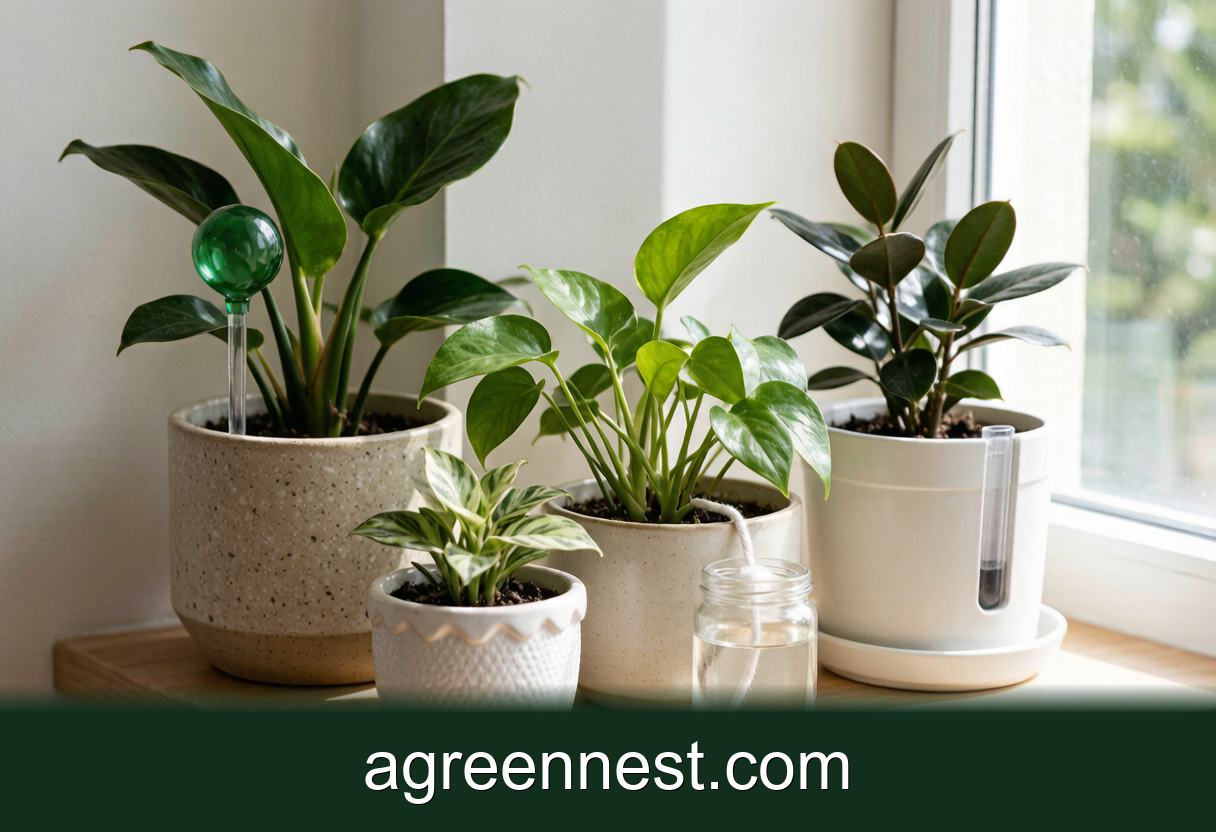
For a two-week trip, a wick system or a true reservoir self-watering pot is the only reliable choice for thirsty plants. Water globes empty in 3-6 days, inverted bottles are erratic, and ollas suit outdoor beds. Set up any system 10 days early and test it before you leave.
Last August I came home from 16 days away to one dead Calathea orbifolia and one drowned Peperomia obtusifolia. Same trip, same apartment, opposite failures. The Calathea sat under a water globe that had emptied by day five. The Peperomia sat over a wick I had cut too thick, pulling water it never asked for. Both systems came from the same "vacation watering" search results.
So this year I ran the test properly before booking anything. Five systems, three weeks, identical 15 cm nursery pots of Epipremnum aureum in the same east window, each pot weighed every evening on a kitchen scale. Here is what the numbers said.
How Much Water Does a Houseplant Actually Use in 2 Weeks?
Start here, because every system fails when its capacity is smaller than the plant's demand.
My test pothos in a 15 cm pot lost 40 to 70 ml per day in a 24 °C room, measured as weight loss between waterings. A Ficus elastica in a 25 cm pot ran 120 to 180 ml per day. A dormant Haworthiopsis attenuata barely moved the scale at 5 ml per day, which is why succulents need no system at all for two weeks; if yours do get thirsty, that is a watering-habit problem covered in our succulent watering guide.
Multiply your plant's daily draw by your days away, add 30 percent for a heat wave, and you have the reservoir size you need. For the pothos: 70 ml x 14 days x 1.3 = roughly 1.3 litres. Keep that figure in mind as you read the rankings.
Water Globes vs Inverted Bottles: Why Do They Run Out Early?
The glass globe is the prettiest option and the worst performer in my test. A standard globe holds 250 to 350 ml. Mine emptied into moist soil in 4 days and into dry soil in under 48 hours, because outflow depends on how much air leaks past the neck, not on what the plant needs. Two globes drained at completely different speeds in identical pots.
An inverted wine bottle with a spike adapter holds more, around 750 ml, and my DIY bottle spike build gets you there for a couple of dollars. But the flow problem is the same: soil contact at the neck controls the rate. In loose, chunky mix the bottle dumped 300 ml overnight. Packed clay-heavy soil slowed it to a useful trickle.
Verdict: globes cover a long weekend, not a vacation. Rated 3 to 6 days, and only after you have watched one full cycle in your own soil.
Wicks and Reservoirs: The Two Systems That Finished the Test
Wick watering won on cost. A 30 cm strip of cotton shoelace or 6 mm nylon cord, one end buried 5 cm deep in the pot, the other end sunk to the bottom of a 2-litre jar of water raised level with the pot base. My pothos drew 55 ml a day through a single wick, almost exactly matching its measured demand, and the jar still had 400 ml left on day 14. The principle is identical to a hydroponic wick system, just pointed at soil.
Two rules from my failures: use synthetic or tightly woven cotton cord, because fluffy craft yarn rots and quits by day 10, and use one wick per 15 cm of pot diameter. My dead Peperomia taught me the third rule: match wick thickness to the plant. Thin cord for anything that likes drying out.
True self-watering pots with a sub-reservoir and fill gauge performed just as well with zero visible hardware. A 1.5-litre reservoir under a 20 cm pot ran my test plant 16 days. If you are buying rather than building, our self-watering pot roundup covers models from 1 to 4 litre capacities, and the weekend version in our DIY self-watering planter build costs under 15 dollars.
Verdict: both rated 14 to 21 days for an average tropical. This is the tier to trust with plants you care about.
What About Ollas, Bathtub Camping, and Plastic Bags?
Ollas, the unglazed clay vessels you bury beside roots, release water only when surrounding soil dries. Clever physics, but a buried olla wants a wide planter or an outdoor bed. In a 15 cm houseplant pot there is no room for one, so I tested a mini 200 ml version: it kept up for 9 days, then ran dry. Fine for a medium planter box, wrong tool for single pots.
The bathtub method: 5 cm of water in the tub, pots stood on folded towels, no saucers. It works through capillary rise, and it kept three plants going for 12 days in my test. The costs are real, though. Zero drainage means root rot risk for anything sensitive, you lose all bathroom light behind a frosted window, and terracotta pots wick so hard the towels went bone dry by day 8 under mine.
Clear plastic bags tented over a pre-watered plant create a humidity loop that genuinely halves water loss. Useful as a booster on top of another system for thin-leaved plants like Calathea. Never bag a succulent, and keep any bagged plant out of direct sun unless you want steamed foliage by noon.
Set It Up 10 Days Early, Not the Night Before
Every system on this list failed at least once during testing. The globe that drained overnight, the yarn wick that rotted, the reservoir gauge that stuck at full. The difference between a mishap and a dead plant collection is a dress rehearsal.
Ten days out: install the system, water normally one last time, then let the system take over while you are still home. Weigh or probe the soil every two days. If moisture holds steady in the top half of the pot, you are cleared for takeoff. Also move plants 1 to 2 m back from bright windows before you go; cutting light cuts water demand by a third, and nobody is home to notice the temporary bad view.
Frequently Asked Questions
Q: My trip is 3 weeks. Is any passive system enough?
A: Only a large-reservoir self-watering pot (3 litres or more) or a wick running from a bucket rather than a jar. At 21+ days, also ask a neighbour for one mid-trip top-up of the reservoirs; that single visit doubles every system's range.
Q: Can I combine a wick with a water globe on the same pot?
A: You can, but you lose control. The globe dumps on its own schedule and keeps the topsoil wet, while the wick meters from below. If gnats or mould worry you, run the wick alone and let the surface dry.
Q: Do wicks work with chunky aroid mix full of bark?
A: Poorly. Capillary transfer needs fine particles touching the cord. Bury the wick end inside a fist-sized pocket of regular potting soil within the chunky mix and flow resumes.
Q: Will my landlord-beige radiator ruin the setup if a cold snap hits while I'm away?
A: Heating is the bigger threat, yes. A radiator cycling under the windowsill can double evaporation. Set the thermostat to 18-19 °C before leaving and move pots off the sill entirely.
Q: Should I fertilise before a two-week absence?
A: No. Skip the feed for the last two weeks before departure. Nutrients concentrate as reservoirs run low, and salt buildup with nobody around to flush it burns roots.
Match reservoir size to measured demand, choose a wick or a true self-watering pot for anything over a week, and rehearse the whole setup while you can still intervene. Do that and 14 days away is genuinely boring, plant-wise. Before you buy hardware, check how your soil actually holds water with our moisture meter vs finger test comparison.
Sources & further reading
GreenNest authors research and write every guide independently. The external links below are reputable references we recommend for deeper reading — they are not the sources we copied from.
- University of Minnesota Extension — U Minnesota Extension
- Michigan State University Extension — Michigan State University
- NC State Extension — Plant Toolbox — NC State Extension
Recommended Tools for Plant Care Accessories Care
Free, no-signup helpers matched to this guide.
Free Ebooks to Explore
Downloadable handbooks — no email required.
Free Ebook
The AGreenNest Succulent Care Handbook
The complete, beginner-to-confident guide to growing fat, happy succulents — 10 chapters and a 20-plant directory.
Free Ebook
Haworthia & Haworthiopsis Care Handbook
A focused guide to the striped, forgiving Haworthia clan.
Share Your Plant Story
Grown something tricky, or found a trick that finally worked? Tell us in the comments, or see what other readers are sharing on our Community page. The best reader tips get folded back into our guides.
Join the Conversation
Have a tip or a question about Vacation Watering: 5 Systems Tested for 2 Weeks Away? Share it below — comments are saved on our server.