 AGreenNest
Succulent Care
How to Re-Root a Succulent With No Roots
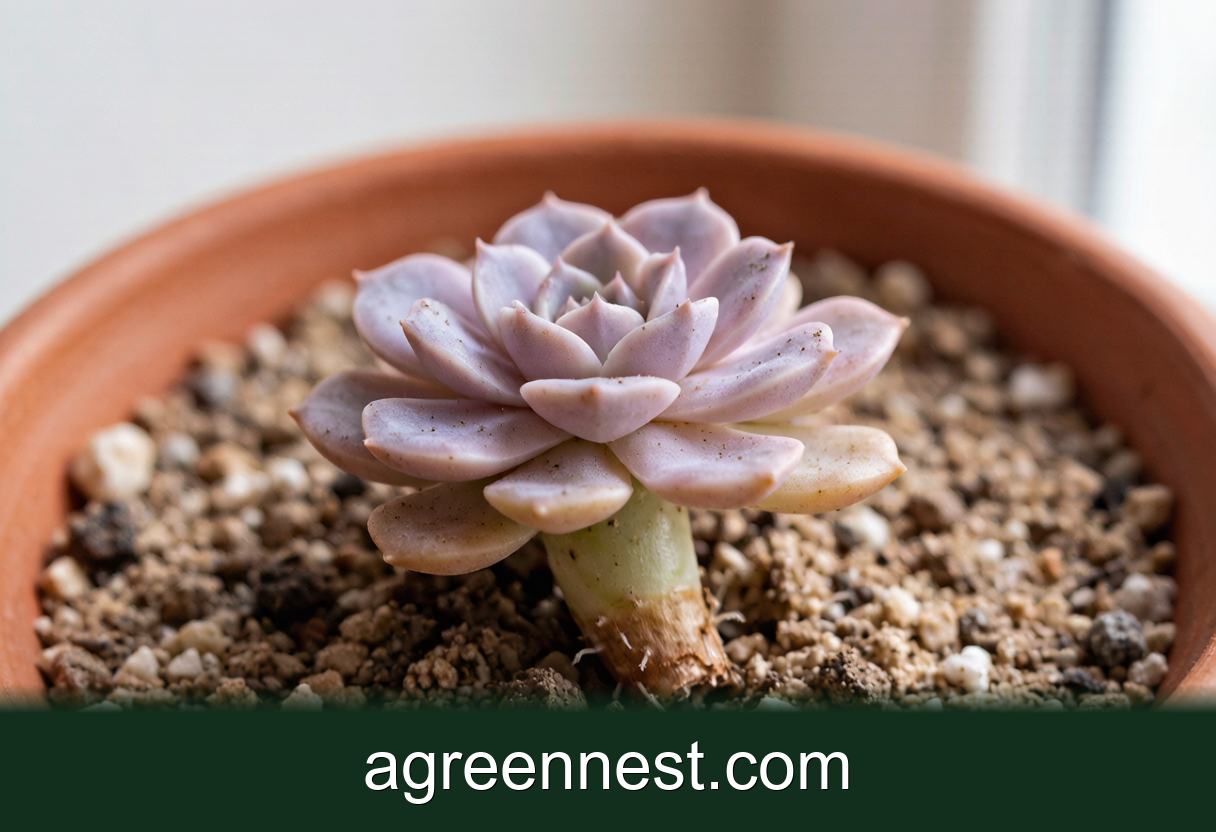
A rootless succulent rosette re-roots reliably if you let the stem callus for 3-5 days, then sit it on top of dry gritty mix in bright indirect light at 21-27°C. Do not water until new roots appear, usually 14 to 40 days. Water rooting works too but the roots must re-adapt to soil.
The parcel rattled. Inside, wrapped in newspaper, was the Echeveria 'Perle von Nürnberg' I had ordered, a lavender rosette the size of my palm, with a bare brown stub where the roots should have been. The seller called it standard practice. I called it alarming. Five weeks later that same rosette tugged back against my fingers, anchored by a fresh white root system it grew entirely on its own.
If you are holding a rootless succulent right now, from a mail order, a snapped stem, or a rot rescue that left you with a clean crown, this is the process I use every time.
Why Did My Succulent Lose Its Roots in the First Place?
It matters, because the cause decides your first step. Mail-order plants ship bare-root on purpose; damp soil in a dark box is a rot lottery, so sellers wash the roots off or trim them. Nothing to fix there.
Rot is the other big one. If you cut away a mushy base the way I describe in my week-by-week rot rescue, you end with a healthy rosette on a rootless stub. Check that stub before anything else: the cut face must be pale and firm. Any brown streak in the core means cutting higher, because rot left inside will finish the job later.
The third cause is physical. A cat, a curtain, an elbow. Graptopetalum paraguayense in particular snaps at a touch. A clean break is actually the easiest case of all three.
Let It Callus Before Anything Touches Soil
A fresh cut is an open wound, and wounds planted wet tend to rot instead of root. Set the rosette somewhere airy and bright, out of direct sun, and leave it alone for 3 to 5 days. Thick stems, 2 cm and up, get a full week from me.
You are waiting for the cut face to dry into a dull, papery seal. It should look like the skin on old scrambled eggs, not glossy or damp. The rosette will not mind the wait. A healthy Echeveria holds enough water in its leaves to sit rootless for a month or more without real harm. Slight wrinkling during this stage is normal and not the emergency it is when a rooted plant wrinkles from thirst.
Should You Root in Water or on Dry Mix?
Both work. I have done both dozens of times, and I now use dry mix for almost everything. Here is the honest comparison.
Water rooting is fast and fun to watch. Suspend the callused stem so its base hangs 5 mm above the waterline, not in it, and white roots often show in 10 to 14 days, reaching for the humidity. The catch comes afterward: water roots are brittle and adapted to liquid, and a fair share of them die back when you finally pot up, which sets the plant back two or three weeks.
Dry rooting skips that adjustment. Sit the rosette on top of a pot of barely damp gritty mix, roughly half mineral grit and half standard succulent soil, and let the base rest against the surface. The stem senses the mineral contact and pushes out soil-ready roots directly. Slower to start, usually 14 to 40 days, but nothing to convert later. My mail-order 'Perle von Nürnberg' took 23 days on dry mix; a chunky Sedum morganianum stem once took the full six weeks.
One rule for both methods: bright indirect light and temperatures between 21 and 27°C. Below about 15°C most succulents idle and rooting nearly stops.
How Do You Know New Roots Are Actually Growing?
Do not lift the plant every day to peek. I know, because I did, and every lift tears the first root hairs off at the tip.
Use the tug test once a week instead. Grip the rosette gently and pull upward with about the force you would use to pick up an egg. Resistance means roots have hooked into the grit. Movement means wait longer. Between tugs, watch the leaves: a rosette that stays plump and holds its colour is running on stored water and doing fine.
At the four-week mark with no resistance, inspect the stub once. Firm and pale means patience, some plants are just slow. Soft, brown, or sour-smelling means rot got in, and you cut back to clean tissue and start the callus again. The same triage applies to leaf and stem cuttings, which I cover in three propagation methods compared.
First Watering and the Move to a Real Pot
Once the tug test passes, water for the first time, and make it a light one. Dampen the top 2 to 3 cm of mix and stop. Young roots are threads; flooding the pot invites the exact rot you may have just escaped.
From there, settle into a cycle: water when the top 3 cm is dry to your finger, which in a bright window in summer lands around every 9 to 12 days. If the plant rooted in a nursery tray or shallow dish, move it to its final pot now, ideally unglazed clay for the evaporation bonus, something I go into in my terracotta guide. Handle it by the rosette, not the new roots, and do not bury the stem deeper than it sat while rooting. Buried stem tissue stays damp and invites trouble.
Skip fertiliser for the first six weeks. New roots burn on salts, and the plant has stored reserves to spend first.
Frequently Asked Questions
How long can a succulent survive with no roots at all?
Longer than seems reasonable. A plump Echeveria or Graptopetalum runs on leaf reserves for 4 to 8 weeks in bright indirect light. Thin-leaved types like Sedum have less storage, so start their callus and rooting sooner.
My rootless rosette is wrinkling while it waits. Should I water or mist it?
No water on the mix and no misting the cut. Mild wrinkling is the plant spending its reserves, which is exactly what those reserves are for. It replumps within a week or two of the first proper watering after roots form.
Can I dip the callused stem in honey or cinnamon to speed up rooting?
Cinnamon is a mild antifungal and does no harm, but neither speeds anything up in my trials. Commercial rooting hormone shaves maybe a week off stem cuttings. Warmth and bright indirect light matter far more than any powder.
The bottom leaves keep dying while it roots. Is the rescue failing?
Losing the lowest one or two leaves is normal fuel consumption. Failure looks different: softness spreading upward from the stub, translucence, or a sour smell. Firm centre, shrivelling skirt: keep waiting.
Do water-rooted succulents really have to switch to soil roots?
Mostly, yes. Roots grown in water lack the root hairs that mine moisture from soil, and a portion die back after potting. The plant regrows them, but expect a two to three week pause where nothing seems to happen.
A rootless succulent is not an emergency, it is a countdown running in your favour. Callus for 3 to 5 days, rest the base on dry gritty mix, keep it warm and bright, and let the tug test tell you when the waiting is over. If you want to track the window instead of guessing, our propagation timeline tool maps the expected rooting dates for common species.
Sources & further reading
GreenNest authors research and write every guide independently. The external links below are reputable references we recommend for deeper reading — they are not the sources we copied from.
- Royal Horticultural Society — Houseplant care — RHS
- Missouri Botanical Garden — Missouri Botanical Garden
- NC State Extension Plant Toolbox — NC State Extension
Recommended Tools for Succulent Care
Free, no-signup helpers matched to this guide.
Free Ebooks to Explore
Downloadable handbooks — no email required.
Free Ebook
The AGreenNest Succulent Care Handbook
The complete, beginner-to-confident guide to growing fat, happy succulents — 10 chapters and a 20-plant directory.
Free Ebook
Haworthia & Haworthiopsis Care Handbook
A focused guide to the striped, forgiving Haworthia clan.
Share Your Plant Story
Grown something tricky, or found a trick that finally worked? Tell us in the comments, or see what other readers are sharing on our Community page. The best reader tips get folded back into our guides.
Join the Conversation
Have a tip or a question about How to Re-Root a Succulent With No Roots? Share it below — comments are saved on our server.