 AGreenNest
Plant Care Accessories
How Far to Hang Grow Lights Above Plants
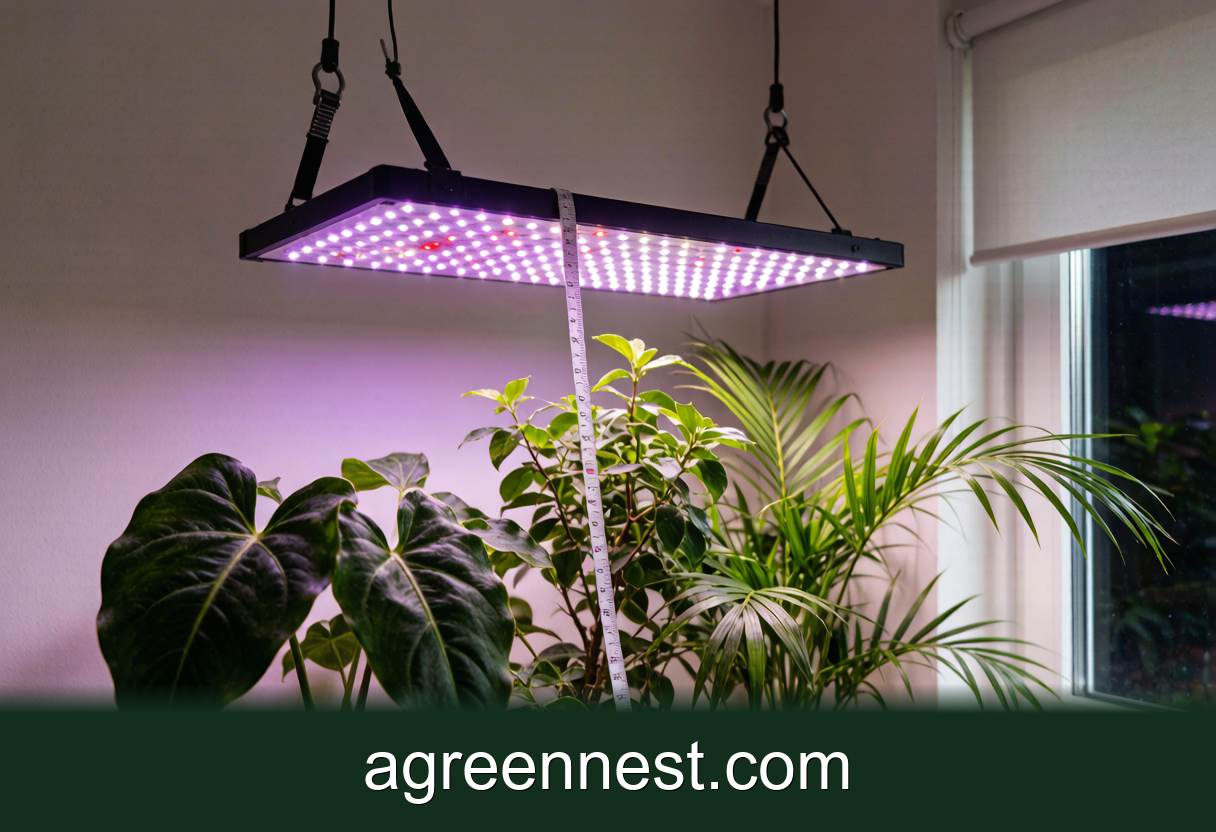
Most LED grow lights belong 15 to 30 cm above the leaf canopy for foliage houseplants, and 30 to 60 cm for high-power panels or sun-lovers. Seedlings want 5 to 15 cm. Light falls off with the square of distance, so raise the fixture if leaves bleach and lower it if plants stretch.
People spend 80 dollars on a good LED panel, then hang it wherever the shelf bracket happens to sit. Distance is the free dial that decides whether that panel does anything. Get it wrong by 20 cm and you either scorch the plant or grow a pale, stretched mess. Get it right and a cheap light outperforms an expensive one hung badly.
There is no single magic number, but there is a tight range for each situation. Here it is.
Start With the Inverse Square Law
One rule governs everything else: light intensity drops with the square of the distance. Double the gap between the fixture and the leaves and the plant receives roughly a quarter of the light, not half.
That is why small changes matter so much. Raising a panel from 20 cm to 40 cm does not cut the light by half. It cuts it to about a quarter. This is also why "just put it higher to cover more plants" backfires: you spread a weak, useless amount over a wide area instead of a useful amount over a small one.
The number that actually reaches the leaf is PPFD, measured in µmol/m²/s. Foliage houseplants like Epipremnum or a Ficus lyrata do well at 100 to 300 PPFD. Succulents, herbs, and flowering plants want 300 to 600. Distance is how you land in the right band, and our grow light PAR tool turns a wattage into a rough target height.
How Far Should an LED Grow Light Hang?
For a standard consumer LED over foliage plants, hang the fixture 15 to 30 cm above the top leaves. That range covers the bulb-style and small-panel lights most people own.
Scale it to power. A 9 to 20 watt LED bulb or bar sits close, around 15 to 20 cm. A 30 to 60 watt panel wants 30 to 45 cm. A high-output 100 watt-plus board belongs 45 to 60 cm up, because closer than that will bleach the canopy fast. The higher the rated output, the further back it goes.
Plant type shifts the same numbers. Low-light tolerant species such as Sansevieria trifasciata or a peace lily are happy at the far end of the range or even beyond it. Sun-lovers like Echeveria and most herbs want the near end, close enough to hit that 300-plus PPFD. If you are unsure which camp a plant sits in, our low light versus direct sun guide sorts them, and the grow light distance tool gives a starting height per plant.
Seedlings and Cuttings Are Different
Young plants are the exception that trips people up. Seedlings need intense light very close, or they stretch into weak, leggy stems within days.
Put a small LED 5 to 15 cm above seedling trays and cuttings. That sounds aggressive after the numbers above, but seedlings have no reserves and stretch toward any shortfall almost overnight. Watch them: if the first true leaves look pale or the stems lengthen, lower the light. Once they establish and put out a few sets of leaves, raise the fixture back to the normal 15 to 30 cm range.
Modern LEDs run cool enough for this. An old fluorescent or a hot incandescent could not sit 5 cm from a seedling without cooking it, which is one more reason LEDs won that argument in our LED versus fluorescent breakdown.
How Do You Know If the Light Is Too Close?
The plant tells you within a week or two. Learn these signals and you can skip the meter entirely.
Too close shows as bleaching: pale, washed-out patches on the top leaves that sit directly under the brightest part of the fixture. You may see crispy tan spots, leaf edges curling up or cupping away from the light, and in succulents a bleached or reddish stress colour on the crown. The lower, shaded leaves look fine, which is the tell that the problem is intensity at the top, not a watering issue. Raise the light 10 cm and watch the new growth.
Signs the Light Is Too Far Away
The opposite failure is more common and slower to notice. Too far, and plants stretch toward the source.
You get long bare stems with wide gaps between leaves, smaller new leaves than old ones, and a plant visibly leaning or reaching upward. Variegated plants fade toward plain green because they are scrambling for any light they can get. If you saw this pattern before adding a light and it has not improved after a few weeks, the fixture is too high or too weak. Lower it in 5 cm steps, or move to a stronger light. A cheap way to confirm the room was dark to begin with is the lux check in our how dark is your home test.
A Fast Setup Rule
If you want one starting point and no math: hang a medium LED panel 30 cm above the canopy, run it 12 hours a day on a timer, and adjust from there. Bleaching means raise it. Stretching means lower it. Two weeks of watching beats any spec sheet.
Keep the whole fixture level too. A tilted light throws that inverse-square falloff unevenly, so one side of the shelf gets double the other. For picking the light itself before you worry about height, start with our grow light buying guide.
Frequently Asked Questions
Q: My light says "hang 60 cm" but my plants are stretching. Who's right?
A: Your plants. Manufacturer distances assume high-light crops like tomatoes. For foliage houseplants, trust the plant's response over the box and lower the fixture until stretching stops.
Q: Does the distance change between the veg and flower stages?
A: For houseplants grown as foliage, no. For flowering or fruiting plants you generally move the light a little closer and raise intensity once buds set, staying alert for bleaching.
Q: Can I use a phone light meter to set the height?
A: As a rough guide, yes. Phone lux apps are approximate for white LEDs, but they show relative differences well, so you can find the height where readings land in your target zone. A dedicated PAR meter is far more accurate.
Q: Why do my top leaves bleach while the bottom ones look starved?
A: The light is both too close and too narrow. The canopy gets scorched while lower leaves sit in shadow. Raise the fixture and add a second light or reposition for even spread.
Distance is the cheapest, fastest lever on any grow light, and the one most people never touch after install. Start a medium LED at 30 cm, drop seedlings to 5 to 15 cm, and let bleaching or stretching tell you which way to move. For the full picture on choosing and running lights, see our guide to choosing and using grow lights, or dial in a target height with our light calculator.
Sources & further reading
GreenNest authors research and write every guide independently. The external links below are reputable references we recommend for deeper reading — they are not the sources we copied from.
- Michigan State University Extension — Michigan State University
- University of Minnesota Extension — U Minnesota Extension
Recommended Tools for Plant Care Accessories Care
Free, no-signup helpers matched to this guide.
Free Ebooks to Explore
Downloadable handbooks — no email required.
Free Ebook
The AGreenNest Succulent Care Handbook
The complete, beginner-to-confident guide to growing fat, happy succulents — 10 chapters and a 20-plant directory.
Free Ebook
Haworthia & Haworthiopsis Care Handbook
A focused guide to the striped, forgiving Haworthia clan.
Share Your Plant Story
Grown something tricky, or found a trick that finally worked? Tell us in the comments, or see what other readers are sharing on our Community page. The best reader tips get folded back into our guides.
Join the Conversation
Have a tip or a question about How Far to Hang Grow Lights Above Plants? Share it below — comments are saved on our server.