 AGreenNest
Plant Pests & Diseases
Mushrooms in Houseplant Soil: Harmless or a Warning?
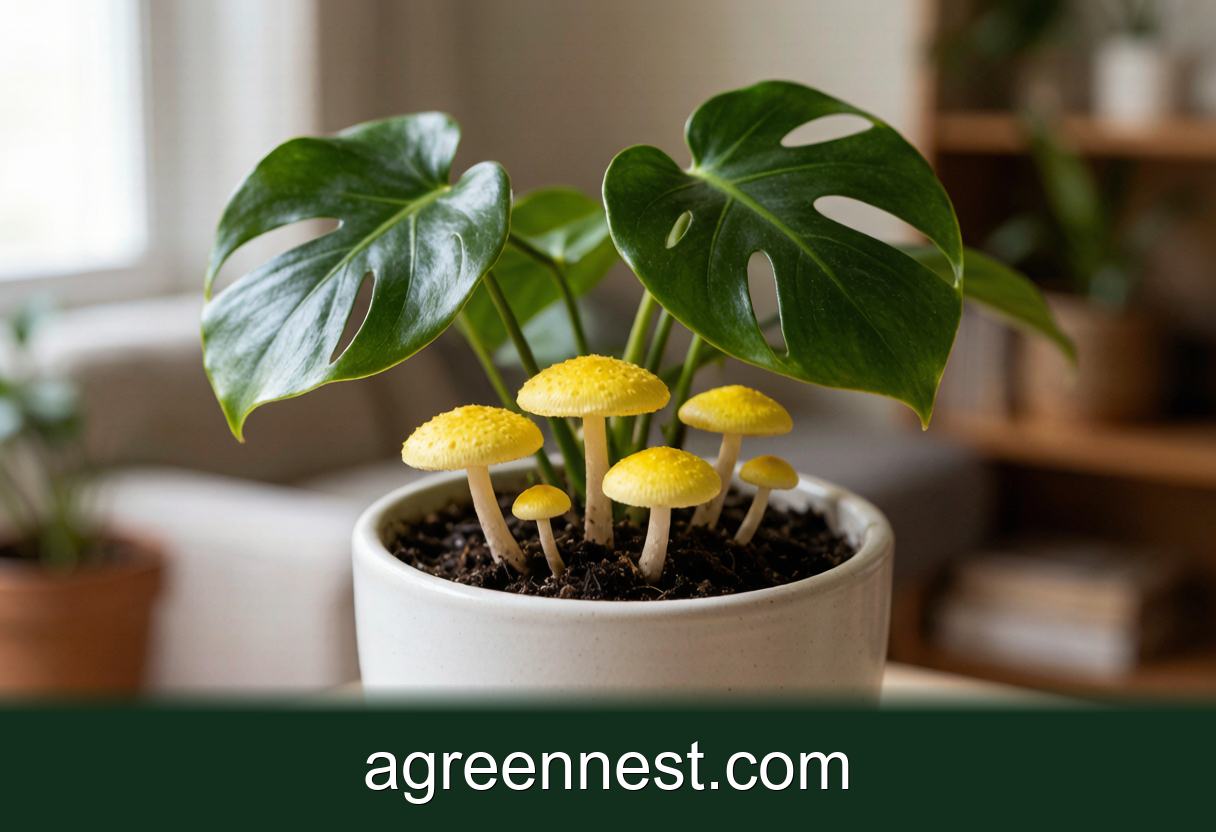
The yellow mushrooms in your houseplant pot are almost certainly *Leucocoprinus birnbaumii*, a harmless fungus that feeds on dead matter in the potting mix, not on your plant. Pick the caps, scrape off the top 5 cm of soil, and let the surface dry between waterings; keep pets and toddlers from eating them.
The photo that lands in my inbox every August is always the same: a cluster of small, lemon-yellow parasols poking out of a monstera pot, plus a one-line message somewhere between curiosity and panic. "Is my plant dying?" No. "Did something lay eggs in there?" Also no. "Should I throw the whole pot away?" Definitely not.
I have grown mushrooms in my own pots on purpose, twice, just to watch what they actually do to the plant sharing the container. Spoiler: nothing. But the full story is more interesting than "ignore them".
What Are the Yellow Mushrooms in My Plant Pot?
Nine times out of ten you are looking at Leucocoprinus birnbaumii, sometimes called the flowerpot parasol or plantpot dapperling. The caps are 2 to 5 cm across, pale sulphur yellow, and go from oval buttons to open umbrellas in about 24 hours. They arrive in warm, damp conditions, which is why heated homes see them year-round and why they surge in summer.
Here is the part most people get wrong: the mushroom is not the organism. It is the fruit. The actual fungus is a web of white threads, called mycelium, running through your potting mix, and it has probably been there since the bag was filled. Commercial mixes are rich in composted bark and peat, exactly the buffet a saprophyte wants, and spores survive pasteurisation schedules often enough that a fresh bag is no guarantee. When I tracked a batch across my own shelf, three of the five plants potted from one bag fruited within four months; the two potted from a different bag never did.
A saprophyte eats dead organic matter. That word does all the reassuring work in this article, so I will say it plainly: this fungus digests decomposing bark and peat, not living roots.
Myth 1: "Mushrooms Mean My Plant Is Rotting"
The reasoning sounds fair: fungus above the soil must mean fungus attacking below it. But L. birnbaumii and root rot are different organisms with different diets. During my second deliberate trial I kept a fruiting pot side by side with a mushroom-free control, same Epipremnum aureum cuttings, same watering. After five months I tipped both out. Root systems were indistinguishable: white, firm, and dense in each pot.
Root rot has its own tells, and mushrooms are not among them: yellowing lower leaves, a swampy smell, and brown roots that slide apart when pinched. If those symptoms are present, deal with the rot on its own terms with the triage in root rot first aid; the mushrooms are a coincidence, not the culprit.
What the mushrooms DO tell you is that the top layer of your mix stays moist and warm for long stretches. That is useful data. The same conditions suit fungus gnats, whose larvae also graze on damp organic matter, so a fruiting pot is worth a weekly glance for the little runners described in how to deal with fungus gnats. A cheap probe tells you in seconds whether the lower half of the pot is staying wet too.
Myth 2: "The Mushrooms Are Poisoning My Plant"
Nothing L. birnbaumii secretes harms plant tissue; if anything, the fungus does the pot a mild favour by breaking organic chunks into nutrients the roots can absorb. Mycorrhizal products sold as root boosters are literally other fungi doing a friendlier version of the same cohabitation.
The toxicity warning points the other way, at mammals. Eaten, these mushrooms cause significant stomach upset in people and pets, and their sunny colour makes them oddly tempting to toddlers and bored cats. This is the one genuinely non-negotiable action item: if anyone in the household explores the world mouth-first, pick every cap the day it appears, with a tissue or gloves, and bin it. The picking itself is harmless to plant and fungus alike, and no, touching them does not hurt you; wash your hands as you would after handling soil.
While I am busting things: no, cinnamon sprinkled on the surface does not kill the mycelium. I tested the cinnamon claim for six weeks on a fruiting pot of Chlorophytum comosum. Caps kept coming. Cinnamon has mild surface antifungal effects, but it does not reach a network threaded through five litres of soil.
Can I Get Rid of Them Without Repotting?
Mostly, yes, if your goal is "no more caps" rather than "sterile soil". Total eradication is genuinely hard because the mycelium permeates the mix, but you can make fruiting rare to nonexistent:
- Pick caps young, ideally before they open. Each mature cap sheds millions of spores onto neighbouring pots.
- Scrape and replace the top 5 cm of mix. The mycelium is densest near the warm, moist surface. Refresh that layer with fresh mix or, better, a gritty topping that dries fast.
- Let the surface dry to a depth of 2 to 3 cm between waterings. Bottom-watering helps here, since it keeps the surface driest. Fruiting needs sustained surface moisture; deny it and the fungus stays vegetative and invisible.
- Move air. A pot in still, humid corners fruits far more readily. A small fan a few hours a day changes the microclimate, with setup numbers in airflow for indoor plants.
- Repot only as a last resort, washing the roots and using fresh mix in a scrubbed pot. Even then, one surviving thread or spore can restart the colony, which is why I rank this drastic step last. If you do go this route, time it sensibly using repotting houseplants: when and how.
For succulents and cacti the fix is even more direct: they should not be in a moisture-retentive, bark-heavy mix anyway, and switching to a fast-draining blend removes both the fungus food and the fruiting moisture in one move.
Frequently Asked Questions
Q: I picked all the mushrooms and more came back three days later. Did I spread them?
A: No, picking sheds far fewer spores than leaving caps to mature. The mycelium below fruited again, which it can do in flushes every few days while the surface stays warm and damp. Keep picking and start drying the surface; flushes stop when the top layer stops being hospitable.
Q: Are the mushrooms in my pot dangerous to my cat if she just sniffs them?
A: Sniffing is not the problem; eating is. Leucocoprinus birnbaumii causes serious gastrointestinal upset when ingested. If your cat nibbles plants, remove caps daily the moment they appear and call your vet if you find bitten caps or see vomiting.
Q: Can I just replace all the soil to guarantee they never return?
A: There is no guarantee. Spores travel on air, water, and new plants, and fresh bags of mix can carry them. Full repotting with root-washing gives the longest mushroom-free stretch, but treat it as reducing odds, not eliminating them.
Q: White fuzzy mould appeared on my soil instead of yellow mushrooms. Same thing?
A: Different organism, similar message: the surface is staying damp too long. Surface mould sits as a fuzzy or crusty film rather than growing stalked caps. The drying and airflow fixes overlap, and the specifics are in how to deal with soil mold.
Q: Tiny white insects hop around the soil where the mushrooms grow. Are they eating my plant?
A: Those are almost certainly springtails, another decomposer drawn to the same damp organic layer. They are harmless to healthy roots, but their presence triple-confirms the overly moist surface. The rundown is in how to deal with springtails.
Yellow mushrooms in a pot are a weather report, not a death notice: they say warm, damp, and rich in organic matter, and nothing more sinister. Protect curious pets and children by picking caps promptly, dry the surface out, and let the hidden mycelium go quietly back to its real job of composting your potting mix from the inside. If the constantly wet soil behind the mushrooms has you second-guessing your routine, check your intervals against our free watering calculator.
Sources & further reading
GreenNest authors research and write every guide independently. The external links below are reputable references we recommend for deeper reading — they are not the sources we copied from.
- US EPA — Safer Pest Control — US EPA
- NC State Extension Plant Toolbox — NC State Extension
Recommended Tools for Plant Pests & Diseases Care
Free, no-signup helpers matched to this guide.
🔍 Free Tool
Pest & Problem Identifier
Pick the symptoms you see and get the likely culprit plus a fix.
Free Ebooks to Explore
Downloadable handbooks — no email required.
Free Ebook
The AGreenNest Succulent Care Handbook
The complete, beginner-to-confident guide to growing fat, happy succulents — 10 chapters and a 20-plant directory.
Free Ebook
Haworthia & Haworthiopsis Care Handbook
A focused guide to the striped, forgiving Haworthia clan.
Share Your Plant Story
Grown something tricky, or found a trick that finally worked? Tell us in the comments, or see what other readers are sharing on our Community page. The best reader tips get folded back into our guides.
Join the Conversation
Have a tip or a question about Mushrooms in Houseplant Soil: Harmless or a Warning?? Share it below — comments are saved on our server.