 AGreenNest
Plant Styling & Display
How Many Plants Are Too Many for One Room?
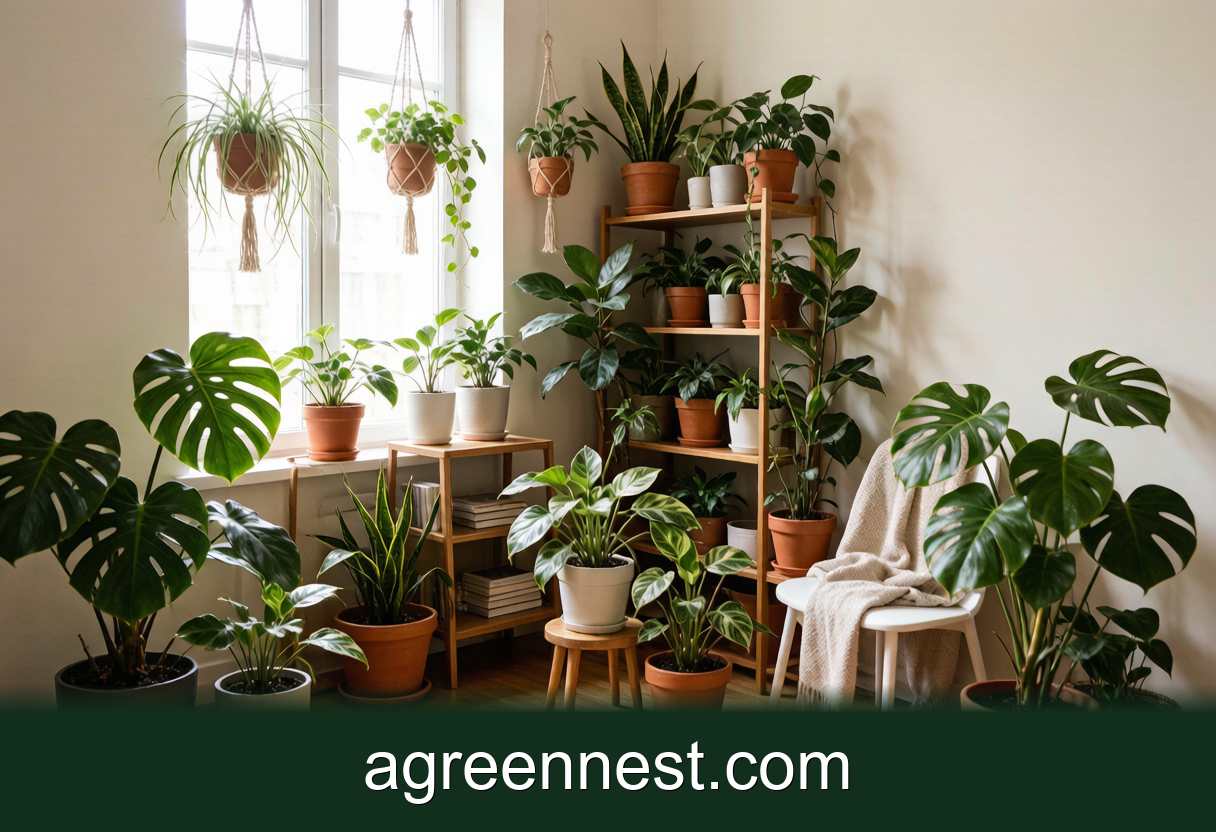
There is no fixed limit. A room holds as many plants as its light and your weekly time allow. Most people hit the wall somewhere between 25 and 40 plants, not because of damp or oxygen, but because watering that many takes over an hour a week and the darker half slowly declines.
A reader sent me a photo of her living room last spring with one question attached: "Is 41 too many?"
Forty-one plants, 22 square metres. She had read that a crowded room goes damp, that plants steal oxygen overnight, and that anything past twenty is hoarding. None of those was the thing actually going wrong in her room, and something was going wrong: eleven of the forty-one had stretched pale and leggy, with 8 cm of bare stem between leaves.
The count was never the issue. The distribution was.
How Many Plants Are Too Many for One Room?
There is no threshold. What there is, in every room, are two hard budgets.
The first is light. A typical living room has three or four positions bright enough for a Ficus lyrata or a Crassula ovata, maybe eight that suit a Spathiphyllum wallisii, and a large remainder where only a Zamioculcas zamiifolia or an Aspidistra elatior will hold its form for years. Put forty plants in a room with twelve viable positions and twenty-eight of them are on a slow decline you will not notice for four months.
The second budget is your time. Checking and watering a mature collection runs about two minutes per plant once you include moving it, feeling the soil, watering, and draining. Thirty plants is roughly an hour a week. Forty-five plants is closer to ninety minutes, plus repotting weekends and pest checks. People rarely quit because a room looks full. They quit because Sunday disappeared.
So the honest ceiling for most homes lands between 25 and 40 plants per main room. Not a rule, a pattern I have watched play out for years.
Does a Room Full of Plants Really Clean the Air?
This is the myth that pushes people to buy their fifteenth pothos, so it deserves the real numbers.
The famous 1989 study everyone half-remembers was run by NASA in sealed chambers about the size of a wardrobe, with a single formaldehyde source and no ventilation. In that box, plants removed measurable amounts of volatile compounds. Your flat is not that box.
When researchers reanalysed a dozen of those chamber studies against real rooms in 2020, the clean air delivery rate of one potted plant came out at roughly 0.02 cubic metres per hour. A normally ventilated room exchanges somewhere between 30 and 100 cubic metres of air per hour through gaps, doors and windows. To match your leaky window frame, you would need hundreds of plants per square metre of floor.
Keep the plants. Keep them because a room with foliage in it feels better to sit in, which is a real effect and a good enough reason. Just do not buy them as filtration, and do not let that argument talk you into a plant your corner cannot light.
Will 30 Plants Make My Room Damp?
Partly yes, and this one is worth doing the arithmetic on, because it is the complaint that gets people in trouble with landlords.
Almost all the water you pour into a pot leaves again as vapour. Thirty medium plants averaging 300 ml a week is 9 litres a week, so about 1.3 litres of moisture released into the room per day. For scale, one hot shower puts out 0.5 to 1 litre, and a load of laundry drying on a rack releases 2 to 3 litres. Plants are a genuine contributor, not the main one.
The trouble starts when that vapour meets a cold surface. A single-glazed window reveal in January sits at 8 to 11 °C while the room is at 20 °C, and the condensation forms there rather than spreading out politely. Two practical fixes: keep relative humidity under 60 percent, and open two windows for five minutes twice a day, which dumps the moist air without cooling the walls.
Also, stop watering to a calendar. Half the vapour load in a crowded room comes from soil that was never dry to begin with. Push a finger 4 cm in, or use a probe if you have forty pots and no patience. If you want the extra humidity somewhere useful, cluster the thirsty species where it helps, as in a bathroom set-up.
Where the Count Actually Breaks: Light
Here is the measurement that ended the debate in that reader's flat.
Her east window sill read 3,400 lux at 10 a.m. One metre back, on the sideboard, 610 lux. At the sofa, 2.4 metres in, 95 lux. Light falls off fast, and the far half of most rooms sits below the 200 lux that even a tolerant Epipremnum aureum needs to keep its leaf spacing tight.
Eleven of her plants were in that 95 lux zone. We moved seven of them into the 600 lux band by rotating the shelf arrangement, gave two away, and put two under a small LED bar running 10 hours a day at 30 cm. Nothing else changed. By August the stretched growth had been replaced by compact leaves.
Before you decide your room is full, meter it. Our lux test walkthrough takes about ten minutes with a phone, and the light calculator turns the reading into a plant list.
The Density That Works in Practice
Numbers I use when planning a room, adjusted by eye afterwards:
- One floor plant per 4 square metres. More than that and the walkways go, which is the real reason rooms start feeling smaller.
- Three to five plants per shelf metre, in two heights, so the eye reads a group rather than a row. Grouping rules cover the odd-number question properly.
- Two thirds of every window kept clear, or the plants behind the sill lose their light supply.
- One species repeated three times beats three single specimens. Repetition looks intentional; variety looks like storage.
- Vertical before horizontal. Once floor and surfaces are at capacity, go up, which is where height layering earns its keep.
If the light budget is the limit rather than the space, a 20 W LED bar over a shelf adds two or three viable positions for the price of one large plant.
Frequently Asked Questions
Q: Is it dangerous to sleep in a bedroom with 12 plants because they take oxygen at night?
A: No. Twelve houseplants consume roughly the oxygen of a small mouse overnight, on the order of 1 to 2 litres, against the 10,000 or so litres of air in an average bedroom. A sleeping partner uses several hundred times more. This myth survives because respiration sounds alarming when you leave out the quantity.
Q: My hygrometer reads 68 percent in a 25 square metre flat with 34 plants. Are the plants doing that?
A: They are contributing maybe 8 to 12 points of it. Check for a drying rack, an unvented tumble dryer, or a bathroom door left open after showers first, because those swamp the plant load. Then group your pots away from cold exterior walls and ventilate twice a day.
Q: My landlord blames the plants for mould on the window reveal. Is he right?
A: Only partly. Mould needs a cold surface and stagnant air, not just moisture. Move pots 30 cm back from single-glazed reveals, ventilate, and the reveal usually dries out even with the same number of plants in the room.
Q: Can I keep 40 plants in a north-facing room if I add grow lights?
A: Yes, with about 4 to 6 metres of LED bar at 10 to 12 hours a day, and a species list that skips high-light succulents. Budget for the electricity and check the lights sit within 25 to 40 cm of the foliage.
The question I wish people asked instead of "how many" is "how many good positions do I have". Answer that and the count sorts itself out, usually landing lower than you feared and healthier than what you had. Meter the room first with our free light calculator, fill the bright positions properly, then buy the next plant.
Sources & further reading
GreenNest authors research and write every guide independently. The external links below are reputable references we recommend for deeper reading — they are not the sources we copied from.
- Royal Horticultural Society — Houseplant care — RHS
- Missouri Botanical Garden — Missouri Botanical Garden
- NC State Extension Plant Toolbox — NC State Extension
Recommended Tools for Plant Styling & Display Care
Free, no-signup helpers matched to this guide.
Free Ebooks to Explore
Downloadable handbooks — no email required.
Free Ebook
The AGreenNest Succulent Care Handbook
The complete, beginner-to-confident guide to growing fat, happy succulents — 10 chapters and a 20-plant directory.
Free Ebook
Haworthia & Haworthiopsis Care Handbook
A focused guide to the striped, forgiving Haworthia clan.
Share Your Plant Story
Grown something tricky, or found a trick that finally worked? Tell us in the comments, or see what other readers are sharing on our Community page. The best reader tips get folded back into our guides.
Join the Conversation
Have a tip or a question about How Many Plants Are Too Many for One Room?? Share it below — comments are saved on our server.