 AGreenNest
Plant Styling & Display
Picture Ledge Plant Styling: Big Impact, 9 cm Deep
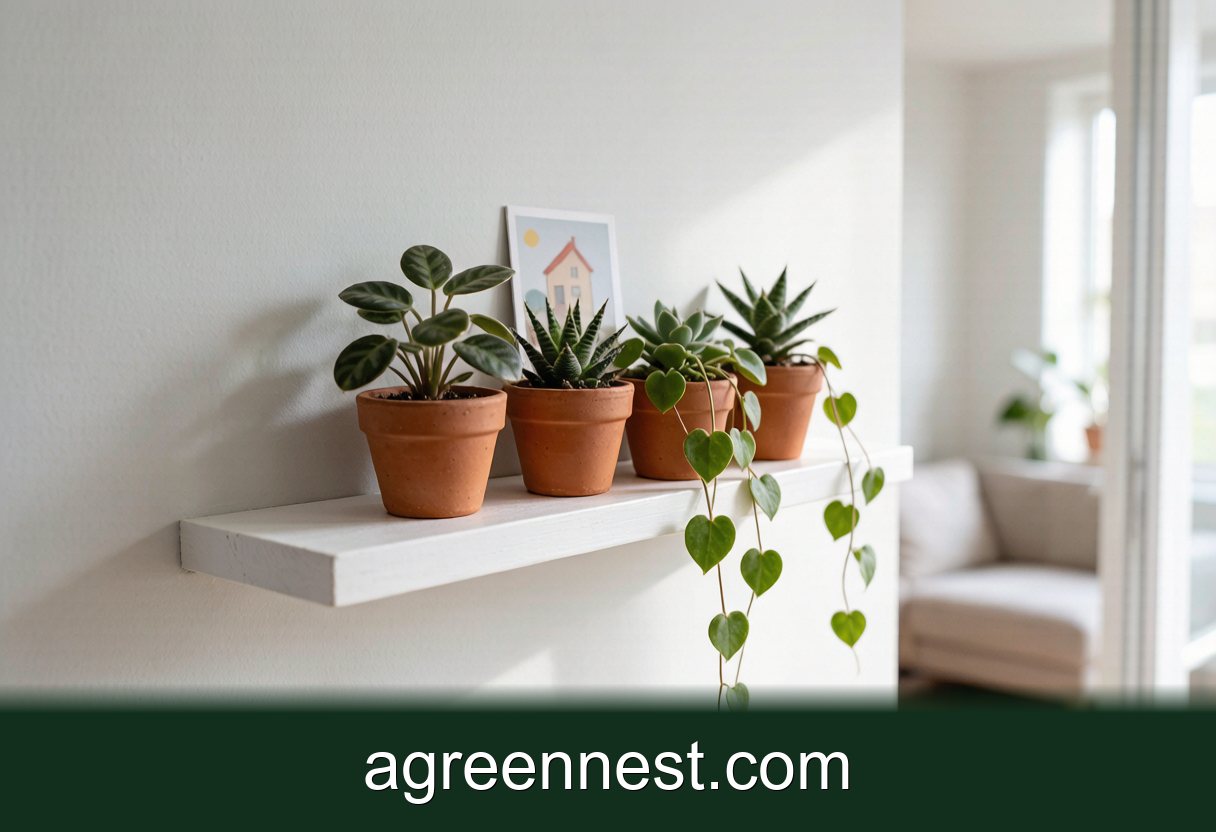
A picture ledge holds plants beautifully if you match the shelf's limits: pots 8 cm wide or less, total weight under about 5 kg per metre, and a front lip of at least 1.5 cm. Pick compact growers like *Peperomia* and young *Ceropegia woodii*, and water at the sink, never in place.
The narrowest shelf in my house grows more plants than the widest one. It is a picture ledge, 115 cm long and 9 cm deep, screwed to the wall beside my desk, and it currently holds seven small pots, a postcard, and zero water stains. That last part took some learning.
Picture ledges were designed for frames leaning against a wall, which makes them an odd but wonderful plant stage. The lip that stops frames sliding also stops pots creeping toward the edge, and the shallow depth forces you into small pots, keeping the display light, cheap, and quick to restyle. The catch: no room for saucers, no depth for big root balls, no forgiveness if you water in place over a sofa.
What Actually Fits on a 9 to 12 cm Ledge?
Most picture ledges run 9 to 12 cm deep with a lip of 1 to 2 cm. Measure yours before buying a single pot, because the useful depth is the shelf minus the lip thickness, and a "10 cm" pot is usually 10 cm at the rim plus a rolled edge.
My working rules after three ledges and one broken Echeveria:
- Pot diameter 8 cm or less. A 6 cm terracotta pot sits with room to spare; an 11 cm pot overhangs and begs to be knocked.
- Height under 25 cm including the plant, if the ledge hangs at eye level. Taller plants read as clutter and shade their neighbours.
- Total load matters. A metre of ledge on two proper wall plugs handles roughly 5 kg comfortably; seven 6 cm clay pots with damp soil weigh about 2.5 kg, so you have margin, but a single 15 cm ceramic pot of wet soil can weigh 2 kg on its own. Small and many beats big and few.
Species-wise, think compact and slow. Peperomia obtusifolia and Peperomia caperata stay tidy for years in a 7 cm pot. Haworthiopsis attenuata barely notices being root-bound. Young Ceropegia woodii gives you a 20 to 30 cm trail without the weight of a mature hanging basket. NC State's Plant Toolbox lists mature sizes for all of these; check that column before you buy.
Where Should the Ledge Hang for Plant Light?
Here is the part most styling photos skip: a ledge is wall furniture, and walls are dim. A ledge on the wall directly opposite a window can still receive 1,000 to 2,500 lux across the day. The same ledge on a wall perpendicular to the window might read 300 lux at one end and 800 at the other, a gradient you can measure in ten minutes with the phone method from our home lux test.
Use that gradient instead of fighting it. On my perpendicular ledge, the bright end nearest the window holds the Haworthiopsis and a tiny Crassula ovata; the dim end gets a plain green pothos cutting and a Peperomia that tolerates 400 lux without stretching. RHS houseplant guidance makes the same point in fewer words: match the plant to the position, not the position to your wishes.
Two placements to avoid: above a radiator, where rising heat bakes small pots dry in two days, and above a bed or sofa, where one watering mistake lands on fabric. If you must style there, stick to mounted Tillandsia.
The Take-Down Watering Routine
Small pots on a narrow shelf dry fast. A 6 cm terracotta pot in a 22 °C room can go from soaked to bone dry in 4 to 6 days, roughly twice the pace of the same plant in an 11 cm pot on a windowsill.
Once a week, I lift every pot onto a tray and carry it to the sink. Anything light for its size gets dunked to half its height for ten minutes, drained for twenty, then goes back up. Nothing gets watered on the ledge, ever. Missouri Botanical Garden's houseplant pages flag standing water and poor drainage as the fastest routes to rot, and on a ledge there is nowhere for excess water to hide except your wall.
The tray trip is also your inspection pass. Leaves get a quick flip for webbing or sticky residue, and any pot that stayed heavy from last week skips this round. If you like instruments more than finger tests, a slim probe from a moisture meter fits even 6 cm pots.
How Do You Stop Pots Falling Off?
A question I get every month, usually after a cat is mentioned.
The lip does most of the work, but three additions make the display genuinely stable. First, museum putty: a pea-sized blob under each pot resists sideways knocks and peels off cleanly, which also makes this trick safe for rentals, along with the other tricks in rental-friendly plant styling. Second, weight low: choose squat pots over tall ones, since a 7 cm cube tips far less readily than a 12 cm cylinder of the same volume. Third, spacing: leave 3 to 4 cm between pots so retrieving one does not domino the rest.
If the ledge shares a wall with a door that slams, skip trailing pots near the ends. Vibration walks lightweight plastic pots a millimetre at a time toward the edge. Clay stays put.
Styling the Line: Rhythm Beats Symmetry
A ledge is a single line at one height, so the usual tricks of height layering need shrinking. Work with rhythm instead. Alternate leaf textures along the row: ripple, gloss, spike, trail. Repeat one pot material at least three times so the line reads as a collection, an approach that borrows from floating shelf styling but tighter.
Then break the rhythm once. A postcard, a small print leaning on the wall, a candle in the gap. Picture ledges hold pictures gracefully, and one non-plant object stops the display looking like retail shelving. Let a single trailer spill over the lip near one end, the way trailing plants soften shelf edges, and keep it trimmed above head height if people walk beneath.
Restyle seasonally. My ledge has been a succulent line in summer and a cutting gallery in winter, and the swap takes fifteen minutes.
Frequently Asked Questions
Q: My picture ledge is above a sofa. Can I still put plants on it?
A: Only plants that never get watered in place, and honestly I would limit it to air plants. Mount two or three Tillandsia on small cork pieces, soak them at the sink weekly, and let them dry fully before rehanging. Potted plants above upholstery eventually cost you a cushion.
Q: How much weight can an IKEA-style picture ledge actually hold with plants?
A: Common 115 cm ledges are rated around 7 to 15 kg when fixed into studs or proper masonry plugs, but ratings assume static frames, not a hand pressing down while lifting pots. I cap a metre at about 5 kg of pots and damp soil.
Q: Why do the plants at one end of my ledge stretch while the others look fine?
A: Your ledge sits across a light gradient, and the stretching end is the dim end. Swap positions so shade-tolerant species like Peperomia hold the dark side, or accept a slow rotation where every plant takes a turn near the window end each month.
Q: Do I need drainage holes in pots this small, or can I use cute hole-less ones?
A: Holes, always, at this size. A 6 cm pot holds so little soil that one over-pour in a sealed pot means saturated roots for a week. Use the hole-less pot as a cachepot over a plastic liner if you love the look, and tip it out after watering.
A picture ledge asks for restraint: small pots, light loads, water at the sink, one object that is not a plant. In exchange it turns 9 cm of blank wall into the most flexible display in the house. Before you drill, spend ten minutes checking what the wall actually receives with our free light calculator so the line you plant matches the light you have.
Sources & further reading
GreenNest authors research and write every guide independently. The external links below are reputable references we recommend for deeper reading — they are not the sources we copied from.
- Royal Horticultural Society — Houseplant care — RHS
- Missouri Botanical Garden — Missouri Botanical Garden
- NC State Extension Plant Toolbox — NC State Extension
Recommended Tools for Plant Styling & Display Care
Free, no-signup helpers matched to this guide.
Free Ebooks to Explore
Downloadable handbooks — no email required.
Free Ebook
The AGreenNest Succulent Care Handbook
The complete, beginner-to-confident guide to growing fat, happy succulents — 10 chapters and a 20-plant directory.
Free Ebook
Haworthia & Haworthiopsis Care Handbook
A focused guide to the striped, forgiving Haworthia clan.
Share Your Plant Story
Grown something tricky, or found a trick that finally worked? Tell us in the comments, or see what other readers are sharing on our Community page. The best reader tips get folded back into our guides.
Join the Conversation
Have a tip or a question about Picture Ledge Plant Styling: Big Impact, 9 cm Deep? Share it below — comments are saved on our server.