 AGreenNest
Plant Styling & Display
Laundry Room Plant Styling: The Most Overlooked Room in the House
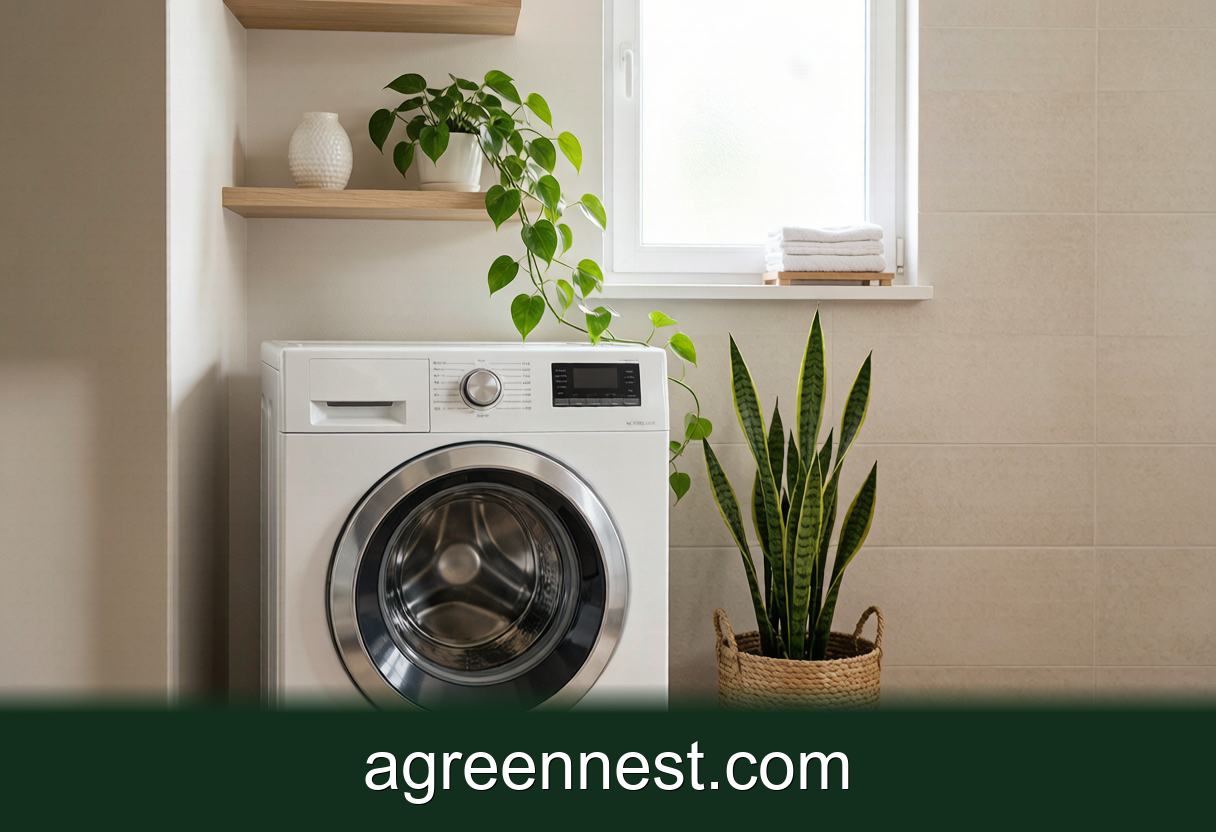
A laundry room offers 60 to 75 percent humidity in short bursts plus warm air from the dryer, which suits ferns, pothos and calathea. Keep pots 40 cm from the dryer vent, choose a shelf above the machines rather than on them, and check light before anything else.
I killed a Calathea orbifolia in a utility room by putting it in the objectively best spot for humidity. It sat on top of the tumble dryer, 30 cm from the vent, and it crisped from the edges inward over five weeks while I congratulated myself on the free moisture.
The laundry room is genuinely one of the better rooms for houseplants. It is also the one with the most hostile microclimate inside a single square metre, and styling it well is mostly about knowing where the bad half metre is.
Read the Room Before You Buy Anything
Utility rooms are not simply "humid". They are volatile, and the swing is the problem.
Over one wash-and-dry cycle in my own room I logged humidity going from 44 percent at rest to 78 percent fifteen minutes into the dry cycle, then back under 50 within an hour of the machine stopping. Temperature at bench height moved from 21 to 27 °C. Air 30 cm from the vent hit 44 °C in short bursts.
Three consequences follow, and they drive every decision below.
The humidity is a spike, not a baseline. Two hours of 75 percent on laundry day does not equal a humid room. Plants respond to the average, and for most households that average lands near 55 percent — pleasant, unremarkable, and nothing like a bathroom. If you want to know your actual number rather than the number you hope for, run it through the humidity calculator.
The dryer vent is a hairdryer. Hot dry air moving across leaves strips moisture faster than roots replace it. That is what killed the Calathea — not heat exactly, but desiccation while surrounded by damp air. It is why the plant on top of the dryer always looks worse than the plant on the shelf above it.
Light is usually the real ceiling. Utility rooms get one small high window, or none. I metered mine at 260 lux at noon on the wall opposite the window and 90 lux behind the door. That is below what most plants tolerate long term, and no amount of humidity compensates. Meter it with the light calculator before you commit to anything with variegation.
The Three Zones
Once you map the room this way, placement stops being guesswork.
Zone A — the shelf above the machines. The best real estate in the room. Warm air rises, so humidity here runs 5 to 10 points above bench level, but you are out of the vent's direct path. Mount a shelf 40 cm above the machine tops. Any lower and you cannot lift the washer lid; any higher and you are on a stool to water.
Zone B — the wall opposite the window. Coolest, most stable, and usually the brightest vertical surface. This is where anything demanding goes.
Zone C — within 40 cm of the vent or the machine top. Empty. Put a basket of pegs there. This zone also vibrates: a spin cycle at 1,400 rpm walks a terracotta pot toward the edge over a few months, and I have swept up two.
What Actually Copes
Reliable, low light plus humidity swings
- Epipremnum aureum — the obvious answer and the right one. Tolerates 150 lux, shrugs off the swing, trails off a high shelf where nobody knocks it.
- Nephrolepis exaltata — Boston fern. Loves the spikes, forgives the troughs better than most ferns, but wants to be out of the vent stream.
- Aspidistra elatior — the cast iron plant, genuinely unbothered by everything except direct sun and soggy roots.
- Chlorophytum comosum — spider plant, and it propagates itself into every other room you own.
- Asplenium nidus — bird's nest fern, glossy enough to read as deliberate styling rather than greenery-by-default.
Only with real light
Calathea, Maranta, Philodendron 'Birkin', anything strongly variegated. These want 600 lux plus. In a windowless utility room they decline slowly and you blame the humidity.
Skip entirely
Succulents, cacti, Sansevieria in a room that spikes to 78 percent twice a week. The wet-dry-wet cycle at the root is exactly what rots them.
Styling It So It Reads as Design
The trap is that utility rooms are already visually noisy — white boxes, plastic bottles, a drying rack. Scattered small pots add clutter rather than softness.
Group in threes on one plane. Three pots at staggered heights on a single shelf beat six pots spread across three surfaces. This is the same logic behind plant shelf styling, and it works harder here because the background is so busy.
Commit to one pot material. I use matte white ceramic throughout mine, so the plants read as a single deliberate gesture against the machines. Mixed terracotta, plastic and glazed pots in a room this small looks like storage overflow.
Use the vertical. Floor space is taken by baskets and the machines themselves. A wall-mounted rail with three hanging pots at 1.6 m puts greenery at eye level and out of the way of the door swing. Hooks screwed into a joist, not plasterboard alone — a watered 15 cm pot is 2 kg swinging.
Hide the ugly with the trailing. A pothos trained along the top of a wall cabinet does more for a utility room than any other single move, because it draws a soft horizontal line across the hard rectangles below it.
Let the door swing be your constraint. Measure the arc before mounting anything. I lost a fern frond to this and the plant looked lopsided for a year.
Watering and Safety Details
Watering here is genuinely easier — there is a sink, a drain, and a floor that is meant to get wet. Take pots to the sink, water thoroughly, let them drain fifteen minutes, put them back. No saucers, no drips down a cabinet.
Two cautions specific to the room:
Detergent and softener are not plant-safe. A splash of concentrated softener into a pot is a salt dose the roots cannot cope with. Keep pots off the dosing bench entirely. If something does spill, flush the pot with three times its volume of clean water at the sink.
Check pets, because utility rooms are often where the litter tray and food bowls live. That makes them one of the higher-contact rooms in the house despite being the least visited by people. Run any new plant through the pet safety checker first — spider plant and Boston fern are fine, but plenty of the tough low-light options are not.
If this room is also the only spare surface you have, the density rules in small space plant styling apply directly. And if you are choosing between this room and the bathroom for your humidity-lovers, the bathroom is the steadier bet — bathroom plant styling covers that side, and the species shortlist in bathroom humidity plants overlaps heavily with what works here.
Frequently Asked Questions
Q: Is the humidity from a tumble dryer actually good for plants?
A: Only indirectly. A vented dryer raises room humidity for an hour or two per cycle, which helps ferns on a nearby shelf. The air leaving the vent itself is hot and dry and will desiccate any leaf within about 40 cm of it. Benefit from the room, not the vent.
Q: Can I put plants directly on top of the washing machine?
A: I would not. A 1,400 rpm spin cycle walks pots toward the edge over weeks, and the surface is where detergent gets spilled. Mount a shelf 40 cm above the machines instead — better humidity, no vibration, and you keep the lids usable.
Q: My utility room has no window at all. What can I keep?
A: With a single LED bar on a 10-hour timer, pothos, cast iron plant and Aspidistra do fine. With genuinely zero light, nothing survives long term. Rotating two plants in and out from a brighter room every three weeks works, but it is maintenance, not styling.
Q: Will detergent fumes or dryer sheets harm houseplants?
A: Ambient fumes at normal domestic levels are not a measurable problem. Direct contact is — liquid softener or concentrated detergent in the soil delivers a salt load that scorches roots. Keep pots away from the dosing area and flush thoroughly if something spills.
Treat the utility room as three zones rather than one humid box, and most of the difficulty disappears. Shelf above the machines, nothing within 40 cm of the vent, and honest light measurement before you buy the plant rather than after it declines. My replacement for that scorched Calathea is a Boston fern on a shelf 40 cm up and a metre to the left of the vent. Three years, no crisping, and it is the only thing in there anyone comments on.
Sources & further reading
GreenNest authors research and write every guide independently. The external links below are reputable references we recommend for deeper reading — they are not the sources we copied from.
- Royal Horticultural Society — House Plants — Royal Horticultural Society
- Clemson Cooperative Extension — Home & Garden Information Center — Clemson Cooperative Extension
- University of Minnesota Extension — Houseplants — University of Minnesota Extension
Recommended Tools for Plant Styling & Display Care
Free, no-signup helpers matched to this guide.
Free Ebooks to Explore
Downloadable handbooks — no email required.
Free Ebook
The AGreenNest Succulent Care Handbook
The complete, beginner-to-confident guide to growing fat, happy succulents — 10 chapters and a 20-plant directory.
Free Ebook
Haworthia & Haworthiopsis Care Handbook
A focused guide to the striped, forgiving Haworthia clan.
Share Your Plant Story
Grown something tricky, or found a trick that finally worked? Tell us in the comments, or see what other readers are sharing on our Community page. The best reader tips get folded back into our guides.
Join the Conversation
Have a tip or a question about Laundry Room Plant Styling: The Most Overlooked Room in the House? Share it below — comments are saved on our server.