 AGreenNest
Plant Styling & Display
Layering Plant Heights: Style a Room in Three Levels
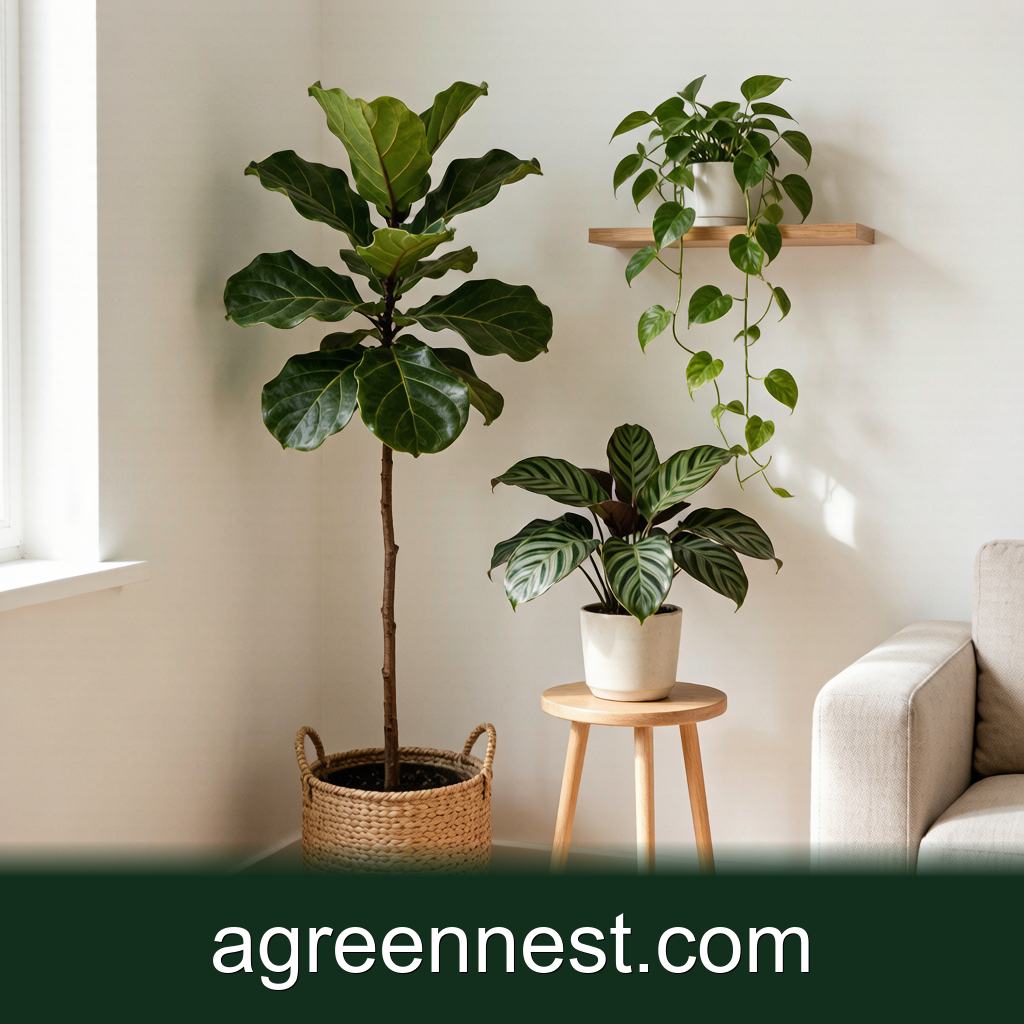
Style plants in three height bands: floor level at 90-180 cm with a tall anchor like Ficus lyrata, mid level at 40-80 cm on stands or stools, and eye level at 150-170 cm on shelves or hangers. One plant per band makes any corner read as designed.
Every pot in my first apartment sat at exactly the same height. Eleven plants, one long windowsill, a row of 10 cm nursery pots standing shoulder to shoulder like commuters waiting for a train. My mother visited, looked at the sill for a moment, and said the room felt like a garden centre clearance shelf. She was right, and the fix cost me nothing. I moved one plant to the floor and hung another from the curtain rail. Same plants, three heights, and suddenly the corner looked like someone had planned it.
That is the whole trick, and this guide gives you the numbers to do it in an afternoon.
Why Does the Same Plant Collection Look Better at Three Heights?
Your eye scans a room in horizontal bands. When every plant sits in the same band, usually tabletop height around 75 cm, the eye registers one green stripe and moves on. Spread the same plants across three bands and the eye has to travel up and down, which reads as depth and intention.
Interior designers call this the triangle rule: the eye should be able to draw a triangle between the tallest point, the middle mass, and the lowest spill. You do not need eleven plants for that. Three will do it, as long as they occupy three different levels.
There is a practical bonus too. Separating plants vertically improves airflow, and crowded foliage that stays damp is where fungus starts. Keep pots at least 10 cm apart within each level so leaves dry properly after misting.
The Three Levels, With Real Numbers
Level one: the floor, 90 to 180 cm of plant. This is your anchor. A Ficus lyrata or Dracaena marginata in a 25 to 30 cm pot gives you a vertical line the whole arrangement hangs on. If your budget is tight, a Sansevieria trifasciata at 70 to 90 cm in a tall planter fakes the same effect for a third of the price. One anchor per corner. Two tall plants side by side compete instead of anchoring, which I cover in statement floor plant styling.
Level two: the middle band, 40 to 80 cm off the floor. This is where stools, side tables, and plant stands live. A Calathea orbifolia or Aglaonema commutatum with broad horizontal leaves fills this band well because the leaf shape contrasts with the vertical anchor behind it. A three-legged stand at 50 cm turns any 15 cm pot into a mid-level plant.
Level three: eye line and above, 150 to 170 cm. Shelves, hangers, and cabinet tops. This band belongs to trailing plants. An Epipremnum aureum or Philodendron hederaceum spilling 30 to 60 cm off a shelf pulls the eye up and then back down, closing the triangle. Full hanging setups get their own treatment in hanging and trailing plant styling.
What If You Only Own Small Plants?
This was my situation for two years. Nobody starts with a 1.5 m fig tree. You borrow height instead.
A plant stand is the obvious tool, but stacks work as well: a wooden crate turned on end adds 35 cm, a pile of large books adds 15 to 20 cm, a step stool adds 45. I once used an upturned terracotta pot as a pedestal for a smaller one, which had the nice side effect of matching materials. Three small pots on the stack and one on the floor beside it gives you two levels from plants all under 25 cm tall.
The pot itself can add height too. A 20 cm plant in a tall 30 cm cylinder planter occupies 50 cm of visual space. Just keep the plant in its plastic nursery pot inside the tall one, resting on an upturned saucer, so you are not filling half a metre of planter with soil. Choosing that outer pot well matters as much as the plant, and terracotta versus plastic pots walks through the material trade-offs.
Where Do the Light Levels Fit Into This?
Here is the part styling guides skip: each height band gets different light, and the plant has to survive where the triangle wants it.
Light near a window drops fast with distance and angle. A hanging plant at 160 cm beside a south window may get twice the light of a floor pot 2 m into the room. So trailing sun lovers go up high near glass, while shade-tolerant anchors like Dracaena take the dimmer floor spots. A Hoya carnosa of mine produced zero new leaves in five months on a dark floor stand, then pushed out four vines the spring after I hung it 40 cm from the window.
Match the band to the plant's needs, not the other way round. If your dream corner is dark, build the triangle from the shade-tolerant list first, the same way you would plan a corner plant display. And remember that raised and hanging pots dry out faster, since warm air collects near the ceiling. My hanging pothos needs water every 5 to 6 days in summer while the identical floor plant goes 9 or 10.
If the perfect spot for your triangle has no natural light at all, a small clamp grow light aimed at the mid band for 10 to 12 hours a day keeps the arrangement alive without moving a single pot.
Common Layering Mistakes I Still See
The classic one is the staircase: tall plant, medium plant, small plant, arranged left to right in a neat descending line. It reads as a size chart, not a display. Break the line by pulling the middle plant 20 to 30 cm forward so the three pots form a shallow triangle when viewed from above as well.
The second mistake is filling all three bands in every corner. One layered corner is a focal point. Four layered corners is a jungle with a sofa in it. Pick the corner you see from your most-used seat and let the other walls rest. More traps in plant styling mistakes.
The third is ignoring pot weight up high. A wet 20 cm ceramic pot weighs 4 to 5 kg. Shelf brackets rated for books handle it; adhesive picture ledges do not.
Frequently Asked Questions
My ceiling is only 2.3 m. Is a 1.8 m floor plant too tall?
Close to it. Leave at least 40 cm between the top of the plant and the ceiling or the room feels compressed. In low rooms, cap the anchor at 1.5 m and let a hanging trailer carry the top band instead.
Can I put a heavy pot on a plant stand without it tipping?
Check the stand's base width. A stand is stable when its feet spread at least half the height of the plant-plus-pot above it. A 50 cm stand under a 60 cm plant needs feet roughly 55 cm apart, or a wall behind it for safety.
Which trailing plant grows fastest for the top level?
Epipremnum aureum wins for speed, adding 30 to 50 cm of vine per growing season in decent light. Philodendron hederaceum is close behind and tolerates dimmer shelves.
Do plants on high shelves need different watering?
Yes, more often. Warm air rises, so a shelf pot at 170 cm can dry 30 to 40 percent faster than the same pot at floor level. Watch for overwatering signs on floor plants, which stay wet longest.
How many plants do I need to start layering?
Three. One anchor over 90 cm (or a small plant on a tall stand), one mid-band plant at 40 to 80 cm, one trailer up high. Add more only after those three look settled.
Layering is rearranging, not shopping. Take ten minutes today: put your tallest plant on the floor in the corner you see most, lift one pot onto a stool, and get one trailer above eye line. Step back and check the triangle. If you are not sure your corner has the light to support all three bands, run it through our free light calculator before you commit the plants.
Sources & further reading
GreenNest authors research and write every guide independently. The external links below are reputable references we recommend for deeper reading — they are not the sources we copied from.
- Royal Horticultural Society — Houseplant care — RHS
- Missouri Botanical Garden — Missouri Botanical Garden
- NC State Extension Plant Toolbox — NC State Extension
Recommended Tools for Plant Styling & Display Care
Free, no-signup helpers matched to this guide.
Free Ebooks to Explore
Downloadable handbooks — no email required.
Free Ebook
The AGreenNest Succulent Care Handbook
The complete, beginner-to-confident guide to growing fat, happy succulents — 10 chapters and a 20-plant directory.
Free Ebook
Haworthia & Haworthiopsis Care Handbook
A focused guide to the striped, forgiving Haworthia clan.
Share Your Plant Story
Grown something tricky, or found a trick that finally worked? Tell us in the comments, or see what other readers are sharing on our Community page. The best reader tips get folded back into our guides.
Join the Conversation
Have a tip or a question about Layering Plant Heights: Style a Room in Three Levels? Share it below — comments are saved on our server.