 AGreenNest
Plant Styling & Display
Do Plants Make a Room Look Smaller?
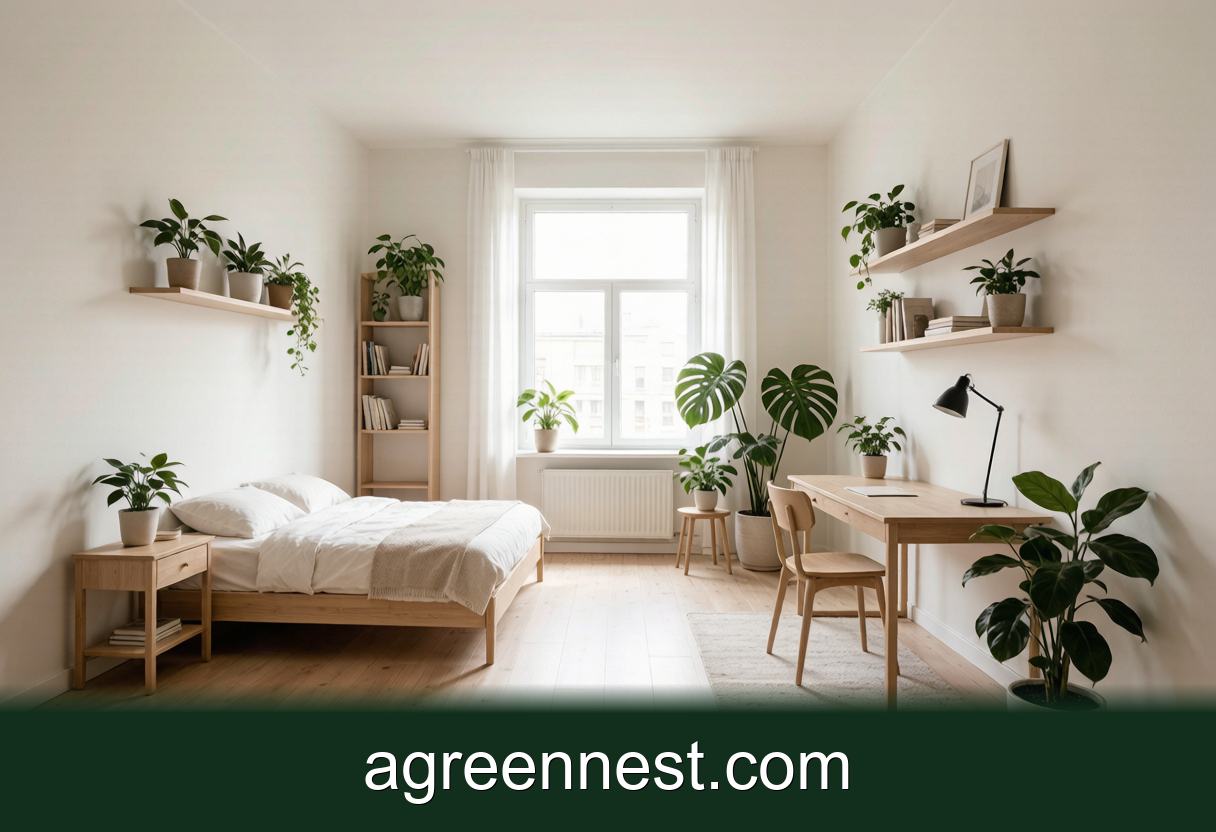
Plants do not shrink a room, blocked sight lines do. A room reads smaller when pots cover floor, when foliage sits at eye level in a walkway, or when a plant hides a window. Keep two thirds of the floor visible, lift plants above 150 cm or below 60 cm, and a small room can hold a dozen.
A reader in a 14 square metre studio sent me two photos and one sentence: "I love my plants but the room feels like a cupboard now."
She had nineteen plants. My first instinct was that nineteen was too many. Then I counted where they were. Eleven were on the floor, four of those in the 90 cm strip between her bed and the wardrobe, and a Ficus lyrata about 1.4 m tall stood directly in front of her only window.
We moved seven plants and removed nothing. The room got bigger. Same nineteen plants, same square metres.
Do Houseplants Actually Make a Room Look Smaller?
Not by volume. A 20 cm pot occupies about 0.03 square metres of floor. Twelve of them take roughly a third of a square metre, which is nothing in a room of fourteen.
What changes is how far your eye can travel before something stops it. Perceived room size depends far more on uninterrupted sight lines and visible floor than on the actual cubic space left over. Interior designers have used the same principle for a century with low furniture and pale rugs, and foliage obeys it exactly.
So the honest answer: plants shrink a room when they sit in the path your eye wants to take, and they enlarge one when they extend it. Three specific offenders do nearly all the damage.
Floor pots in circulation space. Anything in a walkway forces you to move around it, and the body reads that detour as a smaller room even when the eye does not.
Foliage at eye level, 140 to 165 cm. That band is where you register a room's depth. A trailing Epipremnum aureum hanging into it from a shelf acts like a curtain.
A plant in front of a window. This is the big one. It costs you the light, the view and the sense that the room continues outward.
Which Plants Stretch a Room, and Which Compress It?
Footprint versus height is the whole calculation, and the two are not related in the way people assume.
Tall and narrow stretches the room. Sansevieria trifasciata reaches 80 to 100 cm on a footprint of 20 to 25 cm. Dracaena marginata gets to 1.8 m with a bare stem and a tuft at the top, so your eye passes straight through the lower two thirds. Both draw the ceiling up and cost almost no floor.
Wide and low compresses it. A mature Ficus lyrata spreads 70 to 90 cm at chest height. Monstera deliciosa can throw a 60 cm leaf sideways into a walkway.
Small and scattered is the worst case. Nine 12 cm pots spread across three surfaces read as clutter, not as greenery. Group them and the same nine become one object. The mechanics of that are in plant grouping rules, and grouping is the single fastest fix for a room that feels busy.
There is a size floor worth knowing. In a room under about 16 square metres, one plant of 1.2 m or more usually makes the space feel larger, because it establishes scale and tells your eye the ceiling is high. Twelve small pots do the opposite. This runs against instinct, and it is the advice I give most often. More on choosing that anchor in statement floor plants.
The Two Thirds Floor Rule
Stand in the doorway and photograph the room. If more than about a third of the visible floor has something standing on it, the room will read cramped no matter how healthy the plants are.
That gives you a working budget. In a 3 m by 4 m room, keep floor plants to two or three, put them in corners where nobody walks, and lift everything else. Corners are the cheapest real estate you own, and corner plant styling covers how to fill one without turning it into a thicket. The room-by-room method is in small space plant styling.
Circulation matters too. Leave 75 cm of clear width for a walkway, 90 cm for a main route through a room. In a hallway the margin is even tighter, which is why narrow hallway styling leans almost entirely on wall-mounted pots.
Three lifts that free floor without losing plants:
- Above 150 cm. Hanging pots, high shelves, the top of a wardrobe. Trailing species belong here, where they hang above the eye-level band rather than through it.
- Below 60 cm. Coffee tables, low sideboards, plant stands under 40 cm. Your eye skims over this zone.
- On the wall. A 12 cm pot on a bracket takes zero floor and adds depth to a flat wall.
Unglazed clay helps in a small room for a reason that has nothing to do with drainage. Terracotta is a mid-tone neutral, so a group of eight pots in the same warm clay reads as one mass instead of eight competing objects. Mixed colours multiply the visual object count, which is exactly what a small room cannot afford.
What About Light? A Dark Room Always Feels Small
This is the part that gets skipped, and it undoes everything else.
A room reads larger when light reaches the back wall. Put a dense plant on the windowsill and you cut the light entering the room, which darkens the far corners, which pulls the walls inward. I have seen a single 1 m Ficus elastica on a south sill drop the far-corner reading in a small living room from about 280 lux to under 90.
Keep the middle two thirds of every window clear. Use the sill edges, or hang plants at the top of the frame where they interrupt the least useful part of the light. If you have never metered a room, our light calculator will tell you what you are actually working with before you rearrange anything.
Frequently Asked Questions
Q: I rent a 20 square metre studio. What is the realistic maximum number of plants before it feels crowded?
A: I have seen 25 work and I have seen 8 feel oppressive. The count is not the variable. Keep floor pots to three, keep the middle of the window clear, and put the rest above 150 cm or below 60 cm. If you can photograph the room from the door and still see two thirds of the floor, you have room for more.
Q: Does a large-leaved plant like a Monstera always make a small room look smaller?
A: Only where it can spread into a walkway or across a sight line. A Monstera deliciosa against a blank wall, with its leaves reaching into empty space rather than across the room, works well in a small space because the big leaf shapes give scale. Give it 70 cm of clear width and stake it upright.
Q: My plants are all on shelves already and the room still feels cluttered. What now?
A: Check the pots rather than the plants. Eight pot colours read as eight objects. Cut to two materials and the shelf resolves into one. Also check the 140 to 165 cm band for anything trailing down into it.
Q: Will a dark green plant make a pale room feel heavier?
A: A little, and that is often useful. One dark plant such as Ficus elastica against a pale wall gives the eye something to measure the room against. Three or four dark plants in a small pale room do start closing it in, so keep the deeper foliage to roughly a quarter of the group.
The rule I keep coming back to is that a room feels as big as the distance your eye can travel across it. Plants are only ever a problem when they stand in that path. Move them up, move them down, clear the middle of the window, and a small room holds far more greenery than anybody expects. Start by measuring what your corners actually get with our free light calculator, then place the tall plant first and build around it.
Sources & further reading
GreenNest authors research and write every guide independently. The external links below are reputable references we recommend for deeper reading — they are not the sources we copied from.
- Royal Horticultural Society — Houseplant care — RHS
- Missouri Botanical Garden — Missouri Botanical Garden
- NC State Extension Plant Toolbox — NC State Extension
Recommended Tools for Plant Styling & Display Care
Free, no-signup helpers matched to this guide.
🪴 Free Tool
Bottom Watering Guide
Get the exact water depth and soak time to bottom-water any pot without risking root rot.
Free Ebooks to Explore
Downloadable handbooks — no email required.
Free Ebook
The AGreenNest Succulent Care Handbook
The complete, beginner-to-confident guide to growing fat, happy succulents — 10 chapters and a 20-plant directory.
Free Ebook
Haworthia & Haworthiopsis Care Handbook
A focused guide to the striped, forgiving Haworthia clan.
Share Your Plant Story
Grown something tricky, or found a trick that finally worked? Tell us in the comments, or see what other readers are sharing on our Community page. The best reader tips get folded back into our guides.
Join the Conversation
Have a tip or a question about Do Plants Make a Room Look Smaller?? Share it below — comments are saved on our server.