 AGreenNest
DIY Plant Projects
Why DIY Self-Watering Planters Fail: 6 Fixes
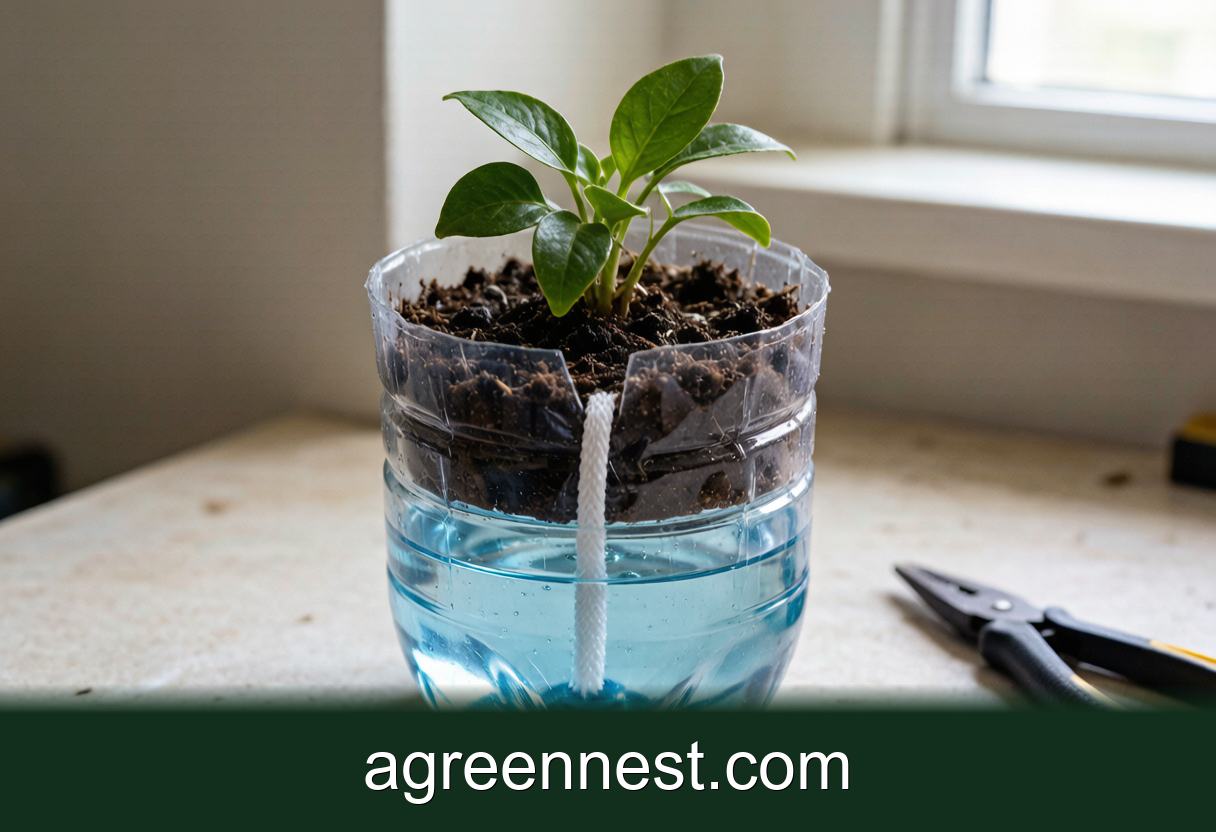
Most DIY self-watering planters rot roots for three reasons: no air gap above the water, a wick too short to reach the root zone, and no overflow hole. Keep 3 to 5 cm of dry space above the reservoir, run a 20 mm cotton wick 10 cm into the mix, and drill an overflow.
I built my first sub-irrigated planter out of a 20 litre storage tote in about forty minutes. Six weeks later I tipped it out over the bath and the root ball slid away black and slick, smelling of pond water. The plant was a Spathiphyllum wallisii that had lived happily in a plain nursery pot for two years before I improved its life.
The concept was not at fault. Sub-irrigated planters work, and for thirsty foliage they beat top watering. Six specific build details failed, and they are the same six I see in nearly every homemade version people send me photos of.
Why Does a DIY Self-Watering Planter Rot Roots?
Because most home builds park the bottom third of the root ball in standing water and never let it dry.
A working sub-irrigated planter has three zones stacked up. Reservoir at the bottom, holding free water. Potting mix at the top, which must never touch that water. Between them, an air gap crossed by one narrow column of soil or fabric that pulls moisture upward by capillary action.
Commercial pots do this with a moulded false floor. DIY builds usually skip it, soil goes straight into the water, and the lower 5 cm stays at full saturation. Roots in that band run out of oxygen inside two weeks and rot bacteria travel up from there.
Build to these numbers: reservoir 4 to 8 cm deep, air gap 3 to 5 cm, and 15 cm minimum of mix above the gap. Any shallower and the permanently damp band reaches the crown. My step-by-step tote build is in how to build a self-watering planter, and the false floor is the part worth the extra ten minutes.
The Wick Is the Wrong Size or the Wrong Material
Capillary rise is not infinite. In a peat or coir based mix it tops out around 10 to 14 cm of vertical lift, and delivery rate depends on the wick's cross section and its fibre.
Too short. A wick that stops at the soil surface does nothing. It has to run 8 to 10 cm up inside the root ball, splayed out, not poked in as a single spike.
Wrong fibre. Polyester rope and nylon cord wick badly. Cotton clothesline, strips of old cotton T-shirt and 100 percent wool felt all move water. Test before you build it in: hang a 25 cm length with 5 cm in a glass of water and check it after an hour. Cotton climbs 6 to 10 cm. Nylon climbs about a centimetre and stops.
Too thin for the pot. One 6 mm shoelace serves a 12 cm pot. A 25 cm planter holding a Monstera deliciosa wants two or three 20 mm cotton strips, or a full soil column 5 to 7 cm across dropping through the false floor into the water. Undersize it and the top 10 cm of mix stays bone dry while the reservoir sits full.
Why Is My Reservoir Still Full After Three Weeks?
Because water is not moving, and the mix is a more likely culprit than the wick.
Chunky mixes drain beautifully and wick terribly. Bark, pumice and coarse perlite create pores too wide for surface tension to bridge, so a 60 percent bark aroid mix will sit above a full reservoir for a month. Sub-irrigation wants a finer, uniform medium: roughly 50 percent coir or peat, 30 percent fine perlite, 20 percent compost, with nothing bigger than 8 mm in the wicking column.
Cold rooms slow the whole system too. A planter that drank 2 litres a fortnight in July may take 6 weeks to empty at 16 °C in January. Before blaming the build, push a probe deep rather than trusting the top 2 cm, following how to use a moisture meter.
Skipping the Overflow Hole
Drill a 6 to 8 mm hole through the outer wall at the exact height of the top of the reservoir, just below the false floor. Now the reservoir cannot be overfilled. Pour until water runs out of the hole, stop, and the air gap is guaranteed every time without measuring anything.
Without it you are eyeballing the level through an opaque tote wall, and the first person who waters your plant for you will top it up to the soil line. Outdoors the stakes are higher, since 40 mm of rain into an open planter with no escape route floods the root zone in an afternoon.
Which Plants Should Never Live in One?
Anything that evolved to dry out hard between drinks.
Skip Sansevieria trifasciata, Zamioculcas zamiifolia, Echeveria elegans, Haworthia fasciata and most Hoya. Constant humidity at the root base reads as a rot signal to these species, and a sub-irrigated planter supplies constant humidity very well. For those, a slow point-release device fits better, which is the case for a terracotta olla waterer.
Plants that thrive in one: Spathiphyllum wallisii, Chlorophytum comosum, Fittonia albivenis, Epipremnum aureum, Nephrolepis exaltata and most herbs except rosemary and thyme. If a plant wilts on you every hot week, it is a candidate.
Salt Buildup, the Slow Failure
The build can be perfect and still fail at month eight.
In sub-irrigation, water leaves only through the plant and the soil surface. Dissolved fertiliser salts do not leave at all, so they concentrate in the top 3 cm as a white crust. Leaf tips brown, growth stalls, and the planter gets blamed.
Put it on a schedule. Every 6 to 8 weeks, top water heavily with 1.5 to 2 times the soil volume in plain water and let it run out of the overflow hole. Feed at half the label strength, since a reservoir holds nutrients far longer than a draining pot does.
For how this build compares with mats, globes and wicks over a two week absence, the tested version is in vacation watering systems compared, and the flat-surface option lives in the DIY capillary watering mat.
Frequently Asked Questions
Q: My DIY planter grew mosquito larvae in the reservoir. How do I stop that without chemicals?
A: Seal the fill tube with a cork or fine mesh so the only openings are the tube and the overflow hole. If larvae are already there, flush the reservoir out through the overflow and refill. A mosquito needs roughly 8 days of open standing water to complete a cycle, and an enclosed reservoir breaks it.
Q: Can I convert an existing potted plant without repotting it?
A: Only if the nursery pot fits inside your container with 3 cm of air beneath it. Sit the pot on two upturned saucers, run two cotton wicks from the drainage holes down into the water, and keep the level below the pot base. It works, though wicks clog and want replacing every 12 to 18 months.
Q: How deep should the reservoir be for a 30 cm wide planter?
A: About 6 to 8 cm, which gives roughly 3 to 4 litres. That is a two to three week supply for a mature Spathiphyllum wallisii in a warm room, and it empties fast enough that the water does not go stagnant between refills.
Q: Why does the soil surface stay dry while the plant looks fine?
A: That is the system working. Sub-irrigation feeds from below, so the top 2 to 3 cm stays dry and the moisture gradient sits deeper. A dry surface here is not a signal to water from the top, which is the opposite of how you read a normal pot.
Get three things right and the rest is decoration: a real air gap, a fat cotton wick reaching 10 cm into the root ball, and an overflow hole drilled at reservoir height. Then choose a plant that wants wet feet. Work out how long your reservoir will genuinely last before you leave town with our vacation watering planner, and flush the salts every couple of months so the build that saved you time in July is still alive in March.
Sources & further reading
GreenNest authors research and write every guide independently. The external links below are reputable references we recommend for deeper reading — they are not the sources we copied from.
- Michigan State University Extension — Michigan State University
- NC State Extension Plant Toolbox — NC State Extension
- University of Minnesota Extension — U Minnesota Extension
Recommended Tools for DIY Plant Projects Care
Free, no-signup helpers matched to this guide.
Free Ebooks to Explore
Downloadable handbooks — no email required.
Free Ebook
The AGreenNest Succulent Care Handbook
The complete, beginner-to-confident guide to growing fat, happy succulents — 10 chapters and a 20-plant directory.
Free Ebook
Haworthia & Haworthiopsis Care Handbook
A focused guide to the striped, forgiving Haworthia clan.
Share Your Plant Story
Grown something tricky, or found a trick that finally worked? Tell us in the comments, or see what other readers are sharing on our Community page. The best reader tips get folded back into our guides.
Join the Conversation
Have a tip or a question about Why DIY Self-Watering Planters Fail: 6 Fixes? Share it below — comments are saved on our server.