 AGreenNest
Plant Styling & Display
Styling Plants With Lamps: Light After Dark
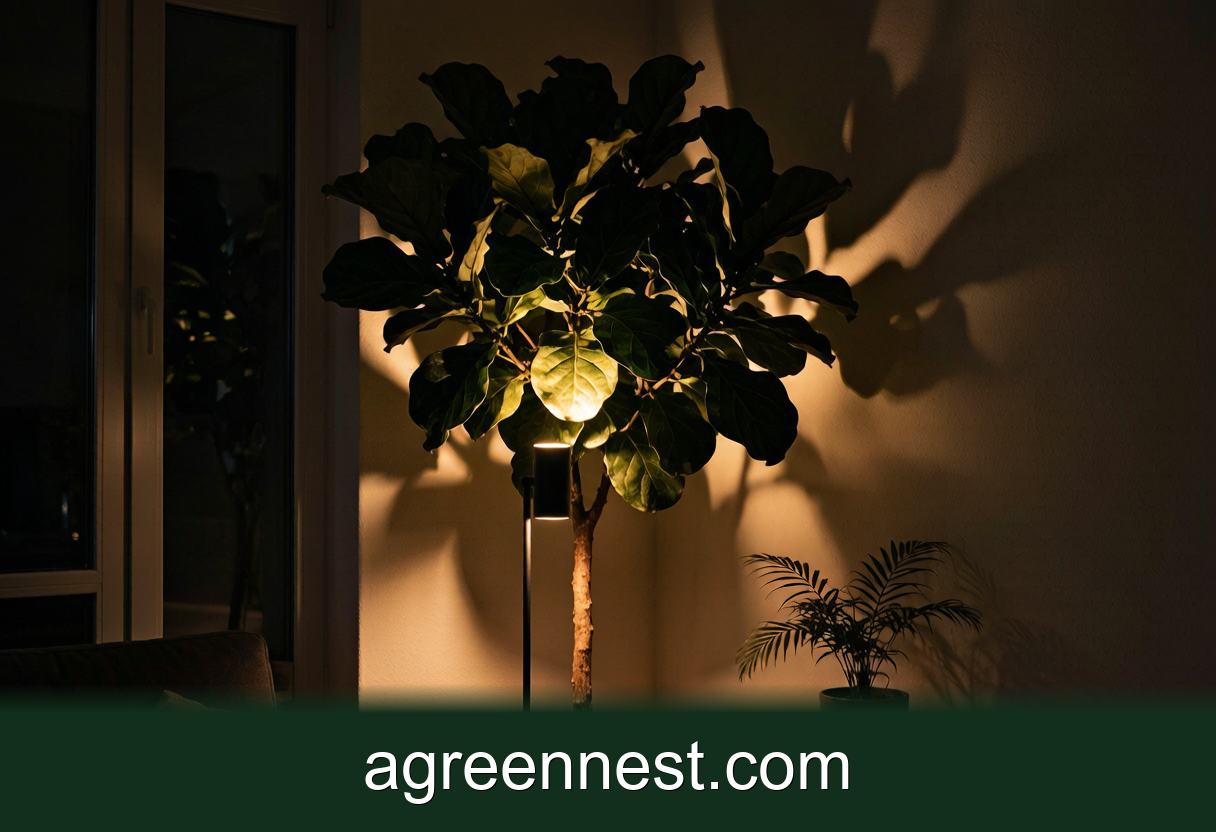
Plant corners look flat at night because ceiling light hits foliage from directly above and flattens it. Put a lamp low, 30 to 40 cm from the pot and off to one side, use a 2700 K bulb with CRI 90 or higher, and let the leaves throw shadows on the wall behind them.
At eleven in the morning my living room corner is the best thing in the flat. By seven in the evening it has gone. Not dark exactly, just absent, a grey shape behind the sofa that nobody looks at.
I spent a long time thinking I needed a different plant there. What I needed was a $19 lamp on the floor, pointing up.
Why Does My Plant Corner Disappear After Dark?
Daylight arrives sideways. It comes through a window at somewhere between 10 and 60 degrees above the horizon, rakes across leaf surfaces, and gives every leaf a lit top edge and a shadowed underside. That contrast is what your eye reads as shape.
Ceiling lights arrive from straight above. A downlight at 2.4 m throws the same flat wash onto every horizontal surface, and foliage that was sculptural at noon becomes a dark blob with a bright top. Worse, the shadow falls straight down onto the floor where nothing sees it.
The fix is positional before it is technical. Get the light source below leaf height, or out to one side, and the corner comes back. My Ficus lyrata went from invisible to being the first thing guests comment on, and the only change was a floor uplight 35 cm from its pot.
Do Lamps Actually Do Anything for the Plants?
Almost nothing, and it helps to know the size of the gap.
A typical 8 W LED bulb, the one sold as a 60 W equivalent, puts out around 800 lumens. Set it 1.5 m from a plant in a shade and you are delivering roughly 80 to 150 lux at the leaves. Foliage houseplants want 800 lux and up for 10 to 12 hours to hold steady growth. So four evening hours of lamp light contributes something like one or two percent of a useful daily light total.
I am not being purist about this. It is the reason a plant styled beautifully under lamps still needs a real daylight position during the day, and why nobody should move a Calathea into a windowless snug because the lamp looks nice. Check what the spot gives you in daylight first with the lux test for how dark your home really is.
If you want a lamp that both looks like furniture and grows plants, that exists now, and I get to it below.
Three Lamp Positions That Work
Uplight, 30 to 40 cm from the pot. A small can uplighter on the floor, aimed up through the canopy. This is the one that transforms tall plants: Ficus lyrata, Dracaena fragrans, mature Monstera deliciosa. Light passes through the leaves, so thin foliage glows amber and the shadow of the canopy lands on the ceiling. Keep the fitting 15 cm clear of any leaf, since even a cool LED runs at 45 to 55 °C on its housing.
Side light at 30 to 45 degrees. A table lamp or plug-in wall light set slightly above and to one side of a group. This is the closest thing to window light, and it is what you want for texture. Velvet and quilted leaves need raking light to show their nap, which is the whole argument in textured leaf plants.
Backlight. A lamp behind the plant, aimed at the wall rather than the plant. Translucent foliage like Asplenium nidus or a young Alocasia reads as a silhouette with a lit rim. Do this in a corner and the plant appears to float off the wall. It is the cheapest drama available.
One rule holds for all three: only one lamp per plant group. Two lights from opposite sides cancel the shadows and you are back to the flat ceiling look with extra electricity. A mirror opposite the lamp will bounce a soft second source for free, which is one of the tricks in styling plants with mirrors.
Which Bulb Makes Green Leaves Look Alive?
Colour rendering matters more than brightness here, and it is the spec most people never check.
CRI 90 or higher. Cheap LEDs at CRI 80 render foliage as a muddy grey-green because they are short on the deep red part of the spectrum that leaves reflect. Move to CRI 90 or 95 and the same Philodendron micans goes bronze again. The number is printed on the box, usually in small type near the wattage.
2700 K for warmth, 3000 K for accuracy. A 2700 K bulb flatters wood and terracotta and makes an evening room feel settled. At 3000 K, variegation stays crisper and white pots stay white. Above 4000 K a living room starts to feel like a dentist's waiting room after 20:00, whatever it does for the plants.
400 to 800 lumens per fitting. Bright enough to model the plant, dim enough that the bulb itself is not the thing you look at.
Frosted, not clear. A clear filament bulb 40 cm from glossy leaves scatters hard little highlights everywhere. Frosted glass gives a softer gradient across the leaf.
Narrow beam for uplights. A 24 to 36 degree spot concentrates light into the canopy. A bare bulb sprays the skirting board and washes the corner out.
Grow Lights That Do Not Look Like Grow Lights
The blue-pink panels are efficient and they make a living room look like a laboratory. There is a middle path.
White full-spectrum LED bulbs in a standard E27 fitting now come at 3000 to 4000 K with CRI 90, and a 15 to 20 W version 40 cm above a plant delivers something in the range of 150 to 250 µmol per square metre per second. Put one in an ordinary anglepoise or a plain black cone pendant over a plant table and it reads as a lamp, not equipment.
Run it on a timer for 10 to 12 hours starting in the morning, not in the evening, since the plant benefits from a consistent daily block and you get to use the room normally at night. The scheduling detail is in our grow light timer guide, and the efficiency comparison behind these bulbs sits in LED versus fluorescent grow lights.
Frequently Asked Questions
Q: Will leaving a lamp on all evening disturb my plants' day-night rhythm?
A: At 80 to 150 lux, no. Flowering plants that need long dark nights to bud, like Schlumbergera in autumn, are the exception, and even those respond to bright light rather than a dim table lamp. Keep a real grow light off after about 20:00 though.
Q: My uplight makes the *Monstera* leaves look yellow and washed out. What is wrong?
A: Two likely causes. The bulb is under CRI 85, or it is too close and blowing out the near leaves while the rest go dark. Move the fitting from 30 cm out to 50 cm and swap to a CRI 90 bulb at 2700 K before changing anything else.
Q: Can a lamp replace a window for a plant in a hallway with no daylight?
A: A decorative lamp cannot. A 15 to 20 W full-spectrum bulb on a 12 hour timer can keep a Zamioculcas zamiifolia or a Sansevieria alive indefinitely in a dark hall, but it needs to run during the day, not for two hours at night.
Q: How do I get the shadow of the leaves on the wall rather than the ceiling?
A: Move the lamp from directly under the canopy out to about 60 cm in front of it, at floor level, aiming back and up at maybe 60 degrees. The shallower the angle, the lower and wider the shadow lands.
Start with one lamp, one plant, and the floor. Point it up through the canopy from 35 cm away, use a frosted 2700 K bulb at CRI 90, and turn the ceiling light off to see what you actually made. If that corner earns its keep after dark, work out whether it is earning its keep in daylight too with our free light calculator, because a plant that photographs well at 21:00 still does its living at noon.
Sources & further reading
GreenNest authors research and write every guide independently. The external links below are reputable references we recommend for deeper reading — they are not the sources we copied from.
- Royal Horticultural Society — Houseplant care — RHS
- Missouri Botanical Garden — Missouri Botanical Garden
- NC State Extension Plant Toolbox — NC State Extension
Recommended Tools for Plant Styling & Display Care
Free, no-signup helpers matched to this guide.
Free Ebooks to Explore
Downloadable handbooks — no email required.
Free Ebook
The AGreenNest Succulent Care Handbook
The complete, beginner-to-confident guide to growing fat, happy succulents — 10 chapters and a 20-plant directory.
Free Ebook
Haworthia & Haworthiopsis Care Handbook
A focused guide to the striped, forgiving Haworthia clan.
Share Your Plant Story
Grown something tricky, or found a trick that finally worked? Tell us in the comments, or see what other readers are sharing on our Community page. The best reader tips get folded back into our guides.
Join the Conversation
Have a tip or a question about Styling Plants With Lamps: Light After Dark? Share it below — comments are saved on our server.