 AGreenNest
Plant Pests & Diseases
Does Diatomaceous Earth Work on Houseplant Pests?
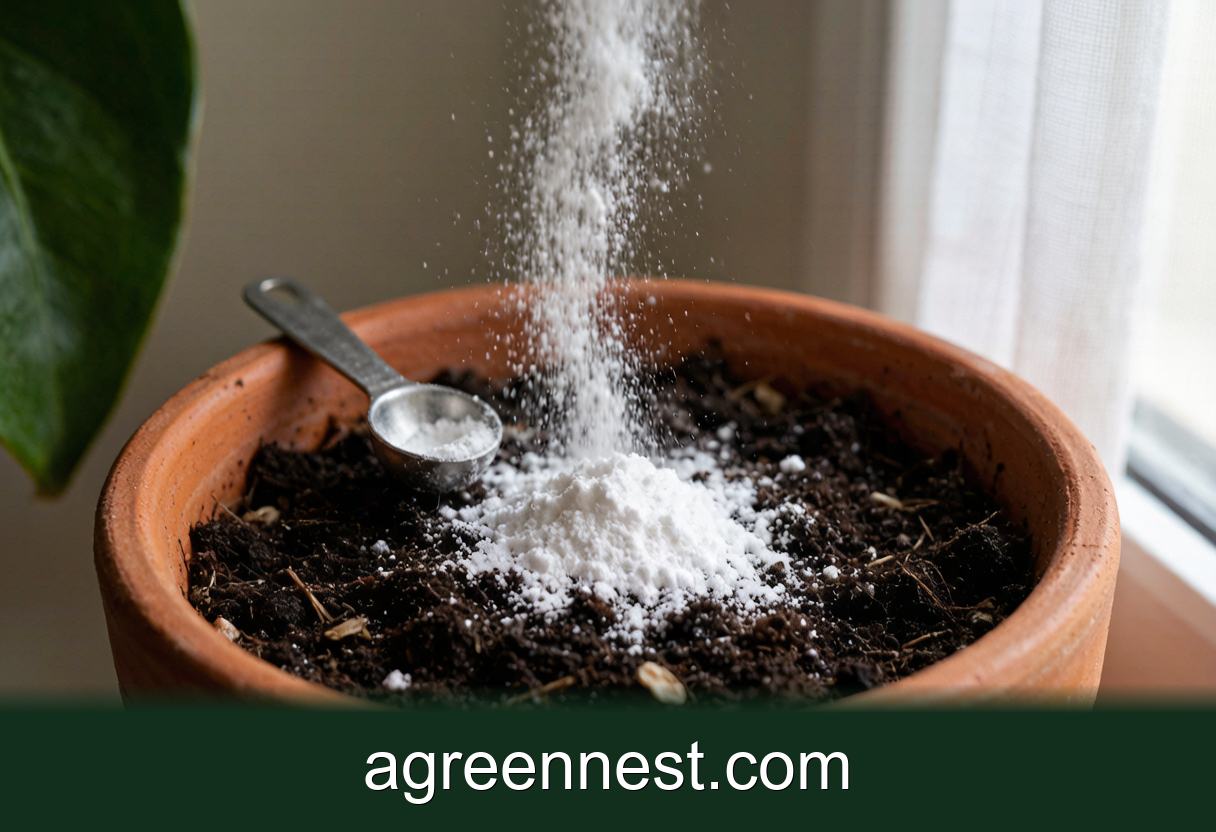
Diatomaceous earth kills crawling insects by abrading their waxy coating, but it only works while bone dry, so it fails on damp potting soil within days. It can cut fungus gnat and springtail numbers if you bottom water and keep a dry 3 mm surface layer. It does nothing to spider mites, mealybugs, or scale.
The advice turns up under every fungus gnat post: dust the soil with diatomaceous earth and the gnats are finished. Plausible enough that I bought a 2 kg bag of food grade DE last winter and treated three infested pots. Two weeks later one pot was clean and the other two were as bad as the day I started. The difference had nothing to do with the powder and everything to do with how I watered them.
What Diatomaceous Earth Does to an Insect
DE is the fossilised silica shells of diatoms, ground to a fine powder. Under magnification the particles are jagged and porous. No poison is involved. When a soft-bodied insect crawls over the powder, those sharp edges score its cuticle while the porous silica absorbs the waxy epicuticular lipid layer that keeps the insect from losing water. It desiccates and dies, usually within 24 to 72 hours of sustained contact.
Two things follow from that mechanism, and they explain the rest of this article. Insects cannot evolve resistance to being physically abraded, a real advantage over chemical sprays. And the effect depends completely on the powder staying dry and loose. Wet silica does not abrade and it does not wick oil.
Why Does It Stop Working in a Plant Pot?
Because a plant pot is damp, and DE needs the opposite.
Efficacy falls off sharply above roughly 60 to 70 percent relative humidity and drops to near zero on wet soil. Tip a watering can over a dusted pot and the powder mats into a pale crust. The loose particles bind together and an insect strolls across it like pavement. In my test the top-watered pot crusted after a single watering, about 40 hours in.
There is a second problem specific to fungus gnats. The larvae you need to kill live 1 to 3 cm inside the damp mix, feeding on fungi and fine roots. A surface dusting never reaches them. DE can only intercept insects that cross the surface, which for gnats means adults emerging from the mix and females landing to lay eggs. That is a barrier, not a cure, and it is a very different claim from the one the viral posts make.
What Happened in My Three-Pot Test
Three infested pots of Epipremnum aureum, matched as closely as I could manage, one yellow sticky card each, adult counts every few days for three weeks. Every pot got a 4 mm layer of food grade DE at the start.
| Pot and watering method | Day 0 | Day 7 | Day 21 |
|---|---|---|---|
| DE + top watering as usual | 24 | 21 | 26 |
| DE + bottom watering, surface kept dry | 22 | 9 | 3 |
| DE + bottom watering + BTI in the water | 26 | 5 | 0 |
The top-watered pot achieved nothing, and its count drifted upward. Bottom watering changed the outcome completely, because the DE stayed powdery and the top 3 cm of mix dried out. Honest reading of my own data: a good share of that improvement is the drying, not the silica. Larvae starve in dry mix regardless of what you sprinkle on it. The powder adds a kill layer for emerging adults on top of a drying strategy that was already working.
Pot three is the one I would recommend to anyone. BTI reaches the larvae that DE cannot, and I went through that combination in BTI and mosquito bits for fungus gnats.
Which Pests Does It Actually Kill?
Verdicts, from my testing and from the mechanism itself:
Fungus gnat adults and springtails: yes, conditionally. Both crawl across the soil surface. Keep that surface dry and DE kills them on contact. Springtails are especially easy targets, and the springtail guide explains why their presence usually flags soil that stays too wet.
Spider mites: no. They live on leaf undersides inside their own webbing and never cross the soil. Dusting foliage clogs stomata, looks chalky, and misses the colonies entirely. Use the approach in spider mites on houseplants.
Mealybugs and scale: no. Mealybugs carry a thick wax coat of their own and shelter in leaf axils and root zones. Armoured scale sits under a shell and does not move at all. Neither offers an abradable surface at soil level.
Thrips: partly. Adults fly and feed on foliage, so a surface layer misses them, though many thrips species drop into the top 1 to 2 cm of mix to pupate, and a dry dusted surface can interrupt that stage. As a standalone control it still fails.
Food Grade or Pool Grade, and the Dust Problem
This distinction matters for your lungs, not just your plants.
Food grade DE is amorphous silica, typically under 1 percent crystalline. Pool filter grade has been calcined at high temperature, which converts much of it to crystalline silica. Crystalline silica dust is a recognised respiratory hazard, and calcined DE also performs worse as an insecticide. Buy food grade and check the label says so.
Even with food grade, wear an N95 mask and apply outdoors or over a sink. The fine fraction hangs in the air for minutes. Keep it away from your eyes and away from cats, who will walk through it and then groom. The US EPA registers DE products for insect control, and the label directions exist for a reason. Read those rather than the comment section.
How to Apply It So It Has a Chance
The routine that produced my one good result:
- Let the top 3 cm of mix dry before you start. Applying to wet soil wastes the powder.
- Sift an even 3 to 5 mm layer across the whole surface, right up to the pot wall, using a flour sieve or a small shaker.
- Water from below only. Stand the pot in 2 to 3 cm of water for 20 minutes, then drain it fully.
- Reapply after any top watering, after repotting, or roughly every 3 weeks as the layer settles and thins.
- Run yellow sticky cards alongside for the full 3 weeks, because the adults already in flight are outside the barrier's reach.
Skip it on plants that need a consistently moist surface, and skip it if your rooms sit above 70 percent humidity. Under those conditions you are decorating soil. Before committing to any of it, confirm what you are dealing with, because more than half the "gnat" photos I get sent turn out to be something else living in the soil.
Frequently Asked Questions
Q: How thick should the diatomaceous earth layer be on a houseplant pot?
A: 3 to 5 mm, even, across the entire surface including the edge against the pot wall. Thinner layers leave gaps that insects walk straight through, and thicker ones waste powder while slowing evaporation from the mix.
Q: My DE went hard and crusty after watering. Is it still working?
A: No. Once it mats it stops abrading anything. Scrape off the crust, let the surface dry, reapply, then switch to bottom watering so the new layer stays loose.
Q: Will diatomaceous earth kill fungus gnat larvae down in the soil?
A: Not the ones already inside the mix. Larvae sit 1 to 3 cm down and never touch a surface layer. Use BTI or let the top 5 cm dry between waterings, and treat the DE purely as a barrier against emerging and egg-laying adults.
Q: How long does one application last before I reapply?
A: On a bottom-watered pot at normal room humidity, roughly 3 weeks before it compacts and thins. Any top watering resets that to zero.
Diatomaceous earth earns a conditional pass. It is a genuine, non-toxic barrier against crawling insects, and it accomplishes nothing at all if your soil surface is damp or if the pest never touches the soil. Pair it with bottom watering and BTI for gnats, and reach for something else entirely for mites, mealybugs, and scale. More kitchen-cupboard remedies get the same treatment in home pest remedies tested, and you can narrow down the culprit first with our pest identifier tool.
Sources & further reading
GreenNest authors research and write every guide independently. The external links below are reputable references we recommend for deeper reading — they are not the sources we copied from.
- US EPA — Safer Pest Control — US EPA
- NC State Extension Plant Toolbox — NC State Extension
Recommended Tools for Plant Pests & Diseases Care
Free, no-signup helpers matched to this guide.
🔍 Free Tool
Pest & Problem Identifier
Pick the symptoms you see and get the likely culprit plus a fix.
Free Ebooks to Explore
Downloadable handbooks — no email required.
Free Ebook
The AGreenNest Succulent Care Handbook
The complete, beginner-to-confident guide to growing fat, happy succulents — 10 chapters and a 20-plant directory.
Free Ebook
Haworthia & Haworthiopsis Care Handbook
A focused guide to the striped, forgiving Haworthia clan.
Share Your Plant Story
Grown something tricky, or found a trick that finally worked? Tell us in the comments, or see what other readers are sharing on our Community page. The best reader tips get folded back into our guides.
Join the Conversation
Have a tip or a question about Does Diatomaceous Earth Work on Houseplant Pests?? Share it below — comments are saved on our server.