 AGreenNest
Plant Pests & Diseases
Do Ultrasonic Pest Repellers Work on Houseplant Pests?
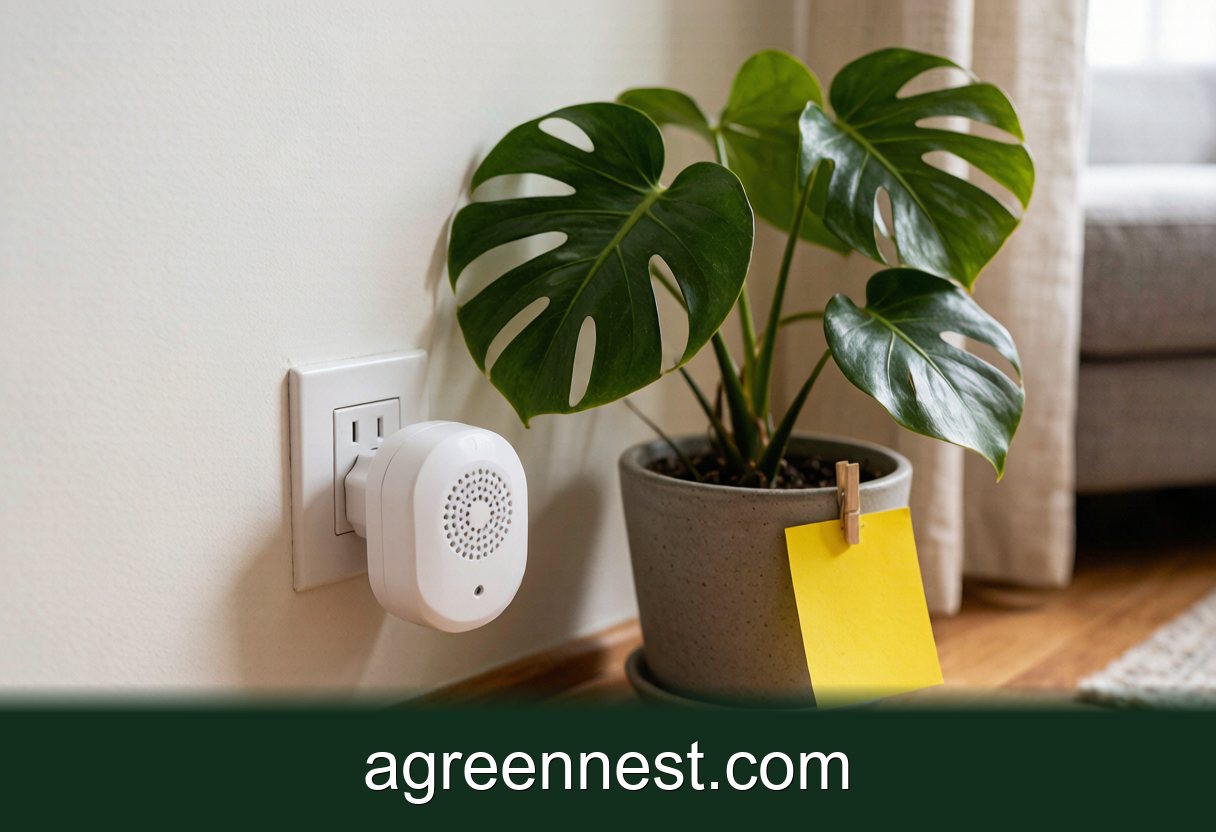
No. Ultrasonic plug-ins do not reduce fungus gnats, spider mites, or any common houseplant pest. Most of these arthropods cannot hear ultrasound at all, and in my three-week two-room count the device side actually logged slightly more gnats. Spend the money on sticky cards and a soil-drying routine instead.
My aunt keeps a little white box plugged in behind her Monstera deliciosa and credits it with a pest-free living room. The box hums at frequencies neither of us can hear, cost her $23 for a four-pack, and has 31,000 reviews. She asked why I still bother with sticky traps and soap sprays when "the plug-in handles it."
That question deserved a real answer, not a shrug. So I bought the same four-pack and set up a count.
What These Devices Actually Claim
The packaging on my four-pack promises to "repel insects, rodents, and spiders" by emitting ultrasound between 22 and 65 kHz, sweeping through the range so pests "cannot adapt." Note the careful wording: repel, not kill. The theory is that the sound stresses pests until they leave.
Two problems appear before you even plug one in. First, ultrasound at these power levels is directional and weak; it does not pass through a sofa, a pot, or 3cm of moist potting soil where fungus gnat larvae (Bradysia species) spend their entire feeding stage. Second, and this is the part the packaging never mentions, an animal can only be annoyed by a sound it can detect. Rodents hear ultrasound. Moths and some beetles have tympanal organs tuned to bat frequencies. But spider mites (Tetranychus urticae) have no hearing organs of any kind, and the small flies and thrips that plague houseplants perceive their world mainly through smell, humidity, and the yellow-green reflectance of stressed leaves, which is exactly why yellow sticky cards out-collect any gadget.
Did the Plug-In Reduce My Fungus Gnats?
I had an established gnat population across eight pots, split between two rooms with similar light and the same watering schedule. Device room: two plug-ins running around the clock, one at outlet height, one on an extension lead at shelf height 40cm from the pots. Control room: nothing. One fresh yellow card per pot each Monday, counted with a loupe before replacement.
Three weeks, 24 card-counts. The device room logged 209 adult gnats; the control room logged 194. The week-by-week numbers ran 63, 71, 75 with the devices and 66, 60, 68 without. That is not a repellent effect. That is two rooms with the same infestation and normal noise in the counts.
I also watched behaviour directly. Adults rested on the wall 10cm from a running unit, walked across the casing, and one spent an afternoon on the LED indicator. Whatever the box was broadcasting, the gnats were not receiving it.
What Does the Research Say About Ultrasonic Repellers?
My apartment is one data point, so I went looking for bigger ones, and this is where the story gets damning. Controlled trials going back to the 1980s have tested ultrasonic devices against cockroaches, mosquitoes, ants, and spiders, and the consistent finding is no meaningful repellent effect. The U.S. Federal Trade Commission wrote warning letters to more than 60 manufacturers in 2001 demanding scientific evidence for their claims; the industry produced nothing that changed the regulatory picture, and the devices quietly shifted to marketing language about "creating an uncomfortable environment."
For plant pests specifically, the evidence gap is even wider, because almost nobody has bothered to run the trial. There is no published study showing ultrasound reduces fungus gnats, thrips, aphids, scale, or mites on indoor plants. The US EPA's guidance on safer pest control centres on sanitation, exclusion, and targeted least-toxic treatments; ultrasonic devices do not feature in it. When a $23 gadget claims to solve a problem that university extension programs still tackle with cultural controls and soil management, the burden of proof sits with the gadget.
Why Do So Many Reviews Swear It Worked?
This is the genuinely interesting question, because thousands of reviewers are not lying. They plugged the device in and their gnats faded within two or three weeks. I can explain that without any ultrasound.
An indoor fungus gnat boom is usually tied to one overwatered pot. Adults live about a week; the whole egg-to-adult cycle runs roughly 3 to 4 weeks at room temperature. People typically buy a repeller at peak annoyance, which is also when they start letting the soil dry, moving pots, and paying attention. The larvae starve in drying soil, the last adult generation dies on schedule, and the plug-in gets the credit for a decline that was already coming. Reviewers who report gnats "coming back after a month" are watching the next wet-soil generation hatch straight through the ultrasound.
If you want to know what is actually breeding in your pots before you spend anything, the walk-through in identifying plant pests early separates gnats from the harmless springtails and soil mites that panic-buy a lot of gadgets.
What to Spend That $23 On Instead
The boring toolkit beats the box on every count I have run. Let the top 3 to 5cm of soil dry between waterings, which starves gnat larvae where they live; the full routine is in our fungus gnat elimination guide. Add yellow cards at soil level as your census. For stubborn infestations, a soil drench with a Bacillus thuringiensis israelensis product kills larvae directly, and contact sprays handle the leaf-dwellers.
For mites, thrips, and aphids, insecticidal soap or neem applied to leaf undersides every 5 to 7 days does what no sound wave can: it touches the pest. And every new plant spends two weeks in quarantine before it joins the shelf, which costs nothing at all.
My aunt's living room, for the record, has bone-dry terracotta pots and a south window. Her plug-in is guarding plants that gnats would struggle to breed in anyway.
Frequently Asked Questions
Q: My gnats disappeared two weeks after I plugged the repeller in. Coincidence?
A: Almost certainly. Two weeks is about one adult generation. If anything else changed, drier soil, cooler weather, a moved pot, the population was already collapsing. Plug it out and watch: if the soil stays dry, they will not return.
Q: Can ultrasound at least stop spider mites, since they hate disturbance?
A: No. Tetranychus urticae has no auditory organs, so there is nothing for the device to disturb. Mites respond to dry air and crowded leaves. A hard weekly rinse and miticide rotation work; sound does not.
Q: Do the devices harm the plants themselves or my pets?
A: Plants have no hearing, so no. Dogs and cats can hear parts of the ultrasonic range, and some animals visibly dislike the units, which is worth more attention than the pest claims get.
Q: Is there any pest where an ultrasonic device is worth trying?
A: Rodents can hear the frequencies, but trials show they habituate within days and return. For arthropod plant pests there is no supporting evidence at all. Sanitation and traps outperform in every published comparison.
A device that cannot reach the pest, at a frequency the pest cannot hear, backed by no trials, is not a pest control plan. It is a nightlight with marketing. Count your pests on cards for two weeks before and after any product you try, this one included, and the data will make your buying decisions for you. If you are not sure what you are counting, run your find through our pest identifier tool first.
Sources & further reading
GreenNest authors research and write every guide independently. The external links below are reputable references we recommend for deeper reading — they are not the sources we copied from.
- US EPA — Safer Pest Control — US EPA
- NC State Extension — Plant Toolbox — NC State Extension
Recommended Tools for Plant Pests & Diseases Care
Free, no-signup helpers matched to this guide.
🔍 Free Tool
Pest & Problem Identifier
Pick the symptoms you see and get the likely culprit plus a fix.
Free Ebooks to Explore
Downloadable handbooks — no email required.
Free Ebook
The AGreenNest Succulent Care Handbook
The complete, beginner-to-confident guide to growing fat, happy succulents — 10 chapters and a 20-plant directory.
Free Ebook
Haworthia & Haworthiopsis Care Handbook
A focused guide to the striped, forgiving Haworthia clan.
Share Your Plant Story
Grown something tricky, or found a trick that finally worked? Tell us in the comments, or see what other readers are sharing on our Community page. The best reader tips get folded back into our guides.
Join the Conversation
Have a tip or a question about Do Ultrasonic Pest Repellers Work on Houseplant Pests?? Share it below — comments are saved on our server.