 AGreenNest
Plant Pests & Diseases
I Incubated 4 Bags of Potting Soil. 3 Had Pests
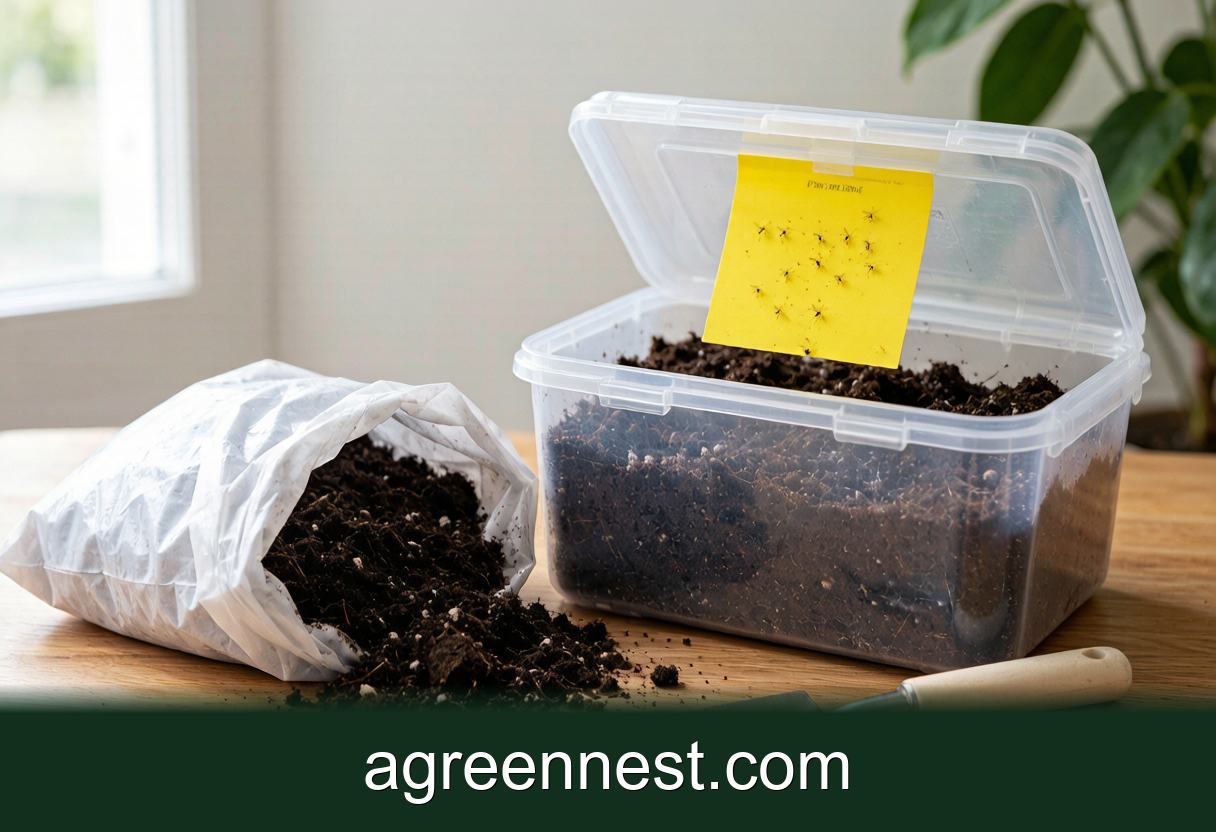
Store-bought potting soil can carry live fungus gnat eggs and larvae, especially bags stored wet outdoors. In my 4-week bin test, 3 of 4 brands produced adult gnats. Baking moist soil at 82-93 °C for 30 minutes, or solarising bags in a hot car, kills the stowaways before they reach your plants.
The infestation that started this test was not my fault. I want that on record.
In March I repotted a healthy Pilea peperomioides into fresh mix from a brand-new sealed bag. No new plants had entered the flat in two months, every pot had passed my usual sticky-trap check, and the windows were shut against a cold spring. Eleven days later, fungus gnats. Dozens. The only new variable was the bag.
So I bought four bags of potting mix from three shops, set up clear storage bins on a shelf, and spent four weeks finding out whether soil really arrives pre-infested. Short answer: usually, yes.
Can Sealed Potting Soil Really Contain Live Pests?
It can, and the mechanics are less mysterious than they sound.
Fungus gnats (Bradysia species) lay 100 to 200 eggs per female into moist organic matter. Commercial mixes are rich in exactly that: composted bark, peat, coir. Bags are filled at outdoor facilities, stacked on outdoor pallets at garden centres, and most have small perforations so they do not balloon in transit. A female gnat needs about two seconds at a perforation hole to make the bag her nursery. Once inside, eggs hatch in 3 days, larvae feed for 10 to 14, pupate for 4, and emerge as the adults you see drifting off the shelf.
The bag does not even need a visiting gnat. If the compost windrows at the facility carried eggs before bagging, the sealed bag ships as an incubator. Damp, dark, full of food, and between 15 and 25 °C in a warehouse. I struggle to design a better rearing chamber.
The Test: 4 Bags, 4 Bins, 4 Weeks
Method, so you can repeat it. Each bag got its own clear 10-litre bin with a yellow sticky card taped to the lid's underside and a fine mesh vent. I tipped in 3 litres of mix, moistened it to roughly wrung-sponge level, closed the lids, and kept the bins at 21 to 23 °C. Any adult gnat that emerged would end up on the card. Once a week I photographed the cards and counted.
Results by day 28:
- Bag A (budget multipurpose, stored outdoors at the shop, visibly rain-soaked): 43 gnats on the card, first adults by day 9. Also a thriving springtail colony, which, to be fair, is harmless and even useful.
- Bag B (mid-range houseplant mix, indoor shelf): 11 gnats, first adults day 13.
- Bag C (same brand as B, different shop, outdoor pallet): 29 gnats, day 11.
- Bag D (premium mix with perlite, sealed thicker bag, indoor shelf): zero gnats in four weeks. One lonely springtail.
Three of four bags shipped with live gnats. The two outdoor-stored bags were the worst by a wide margin, and storage seemed to matter as much as brand, given B and C were the same product.
How Do You Sterilise Potting Soil Before Using It?
Heat is the only method I trust after this test, and the numbers are specific.
Oven method. Spread moist (not wet) mix 8 to 10 cm deep in a roasting tray, cover with foil, and bake until the centre of the soil holds 82 to 93 °C for 30 minutes. A probe thermometer through the foil takes the guessing out. Below 82 °C, gnat eggs and larvae can survive; much above 93 °C you start burning organic matter and the flat smells like a peat fire for a day. Cool it fully before potting.
Solarising. Double-bag the mix in black plastic sacks and leave them in a parked car or on a sun-baked balcony for two full afternoons above 30 °C outdoor temperature. Interior car temperatures reach 50 to 60 °C in summer sun, and larvae die within hours above 45 °C. This was my lazy method for Bag A's remainder, and a follow-up bin test on the treated soil caught zero gnats in three weeks.
Freezing gets suggested constantly, so I tried it: 72 hours at -18 °C knocked adult emergence down but did not eliminate it, and eggs of many soil insects tolerate freezing far better than heat. I have filed freezing with the home remedies that failed my last test.
What About the Soil Already in Your Pots?
If you repotted recently and gnats appeared within two weeks, assume the bag seeded the pot. You do not need to unpot everything.
Let the top 3 to 4 cm dry hard between waterings, since larvae die in dry substrate, and switch to bottom watering for a month. Sticky cards catch the adults before they re-lay. For an active outbreak, a biological drench with Bacillus thuringiensis israelensis (BTI) clears larvae in about two weeks; the full protocol, dosing included, is in our fungus gnat elimination guide. Where larvae are chewing fine roots on seedlings, an insecticidal soap drench is the gentler rescue before you escalate.
And the habit that costs nothing: treat a new soil bag like a new plant. I run every incoming bag through the same two-week quarantine routine I use for new plants now, either heat-treated on arrival or stored sealed in a lidded bin with a sticky card as a sentinel.
Which Bag Should You Buy Next Time?
My sample is four bags, not forty, so read this as a pattern, not a league table. Still, the pattern was blunt.
Pay for the thicker sealed bag if the alternative spent its life on an outdoor pallet. Squeeze before buying: a bag that feels wet through the plastic has been rained on, and wet storage was the single strongest predictor of gnats in my test. Check for perforations bigger than a pinhead. And skip any bag with moss or mushrooms sprouting at the seams, which I saw on three bags at one shop and should not need to say out loud.
Sterile seed-starting mixes and inorganic media dodge the problem entirely. Gnat larvae feed on fungi in decomposing organic matter, so a mineral substrate like LECA offers them nothing to eat.
Frequently Asked Questions
Q: The gnats appeared a week after repotting with fresh soil. Is it the bag or my watering?
A: Timing points to the bag. Eggs already in the mix produce adults in 2 to 3 weeks at room temperature. Overwatering did not create the gnats, but it will feed the next generation, so tighten the drying cycle either way.
Q: Can I microwave small amounts of soil instead of using the oven?
A: Yes, for potting-sized batches: 900 g of moist mix, uncovered, on full power for about 90 seconds until it steams, then rest it covered for 15 minutes. Remove any perlite bags' metallic labels first and expect an earthy smell.
Q: Do the gnat larvae in a bag actually harm plants, or are they just annoying?
A: In mature plants the damage is mostly cosmetic. On seedlings and cuttings, larvae chew root hairs and tunnel stems, and a heavy load can kill a tray. Propagators should be the most paranoid about bag hygiene.
Q: Is a bag safe if it has been sitting unopened in my shed for a year?
A: Safer, oddly. With no new eggs entering, a gnat population inside a sealed bag crashes once food fungi are exhausted. Dry storage for months does more good than harm, but heat-treat it anyway if it ever sat damp.
Q: Should I return an infested bag to the shop?
A: Take photos of the emerging adults and try. Most garden centres will swap it without a fight. What matters more is telling them the pallet stored outdoors is the likely source, because that is fixable.
Three of my four bags came with tenants, and the wettest bag carried four times the gnats of the driest. Heat-treat anything destined for seedlings, quarantine the rest, and judge bags by their storage, not their marketing. If the flies are already circling your pots, start with our step-by-step fungus gnat elimination guide.
Sources & further reading
GreenNest authors research and write every guide independently. The external links below are reputable references we recommend for deeper reading — they are not the sources we copied from.
- US EPA — Safer Pest Control — US EPA
- NC State Extension — Plant Toolbox — NC State Extension
Recommended Tools for Plant Pests & Diseases Care
Free, no-signup helpers matched to this guide.
🔍 Free Tool
Pest & Problem Identifier
Pick the symptoms you see and get the likely culprit plus a fix.
Free Ebooks to Explore
Downloadable handbooks — no email required.
Free Ebook
The AGreenNest Succulent Care Handbook
The complete, beginner-to-confident guide to growing fat, happy succulents — 10 chapters and a 20-plant directory.
Free Ebook
Haworthia & Haworthiopsis Care Handbook
A focused guide to the striped, forgiving Haworthia clan.
Share Your Plant Story
Grown something tricky, or found a trick that finally worked? Tell us in the comments, or see what other readers are sharing on our Community page. The best reader tips get folded back into our guides.
Join the Conversation
Have a tip or a question about I Incubated 4 Bags of Potting Soil. 3 Had Pests? Share it below — comments are saved on our server.