 AGreenNest
Plant Pests & Diseases
Does Misting Prevent Spider Mites? I Tested It
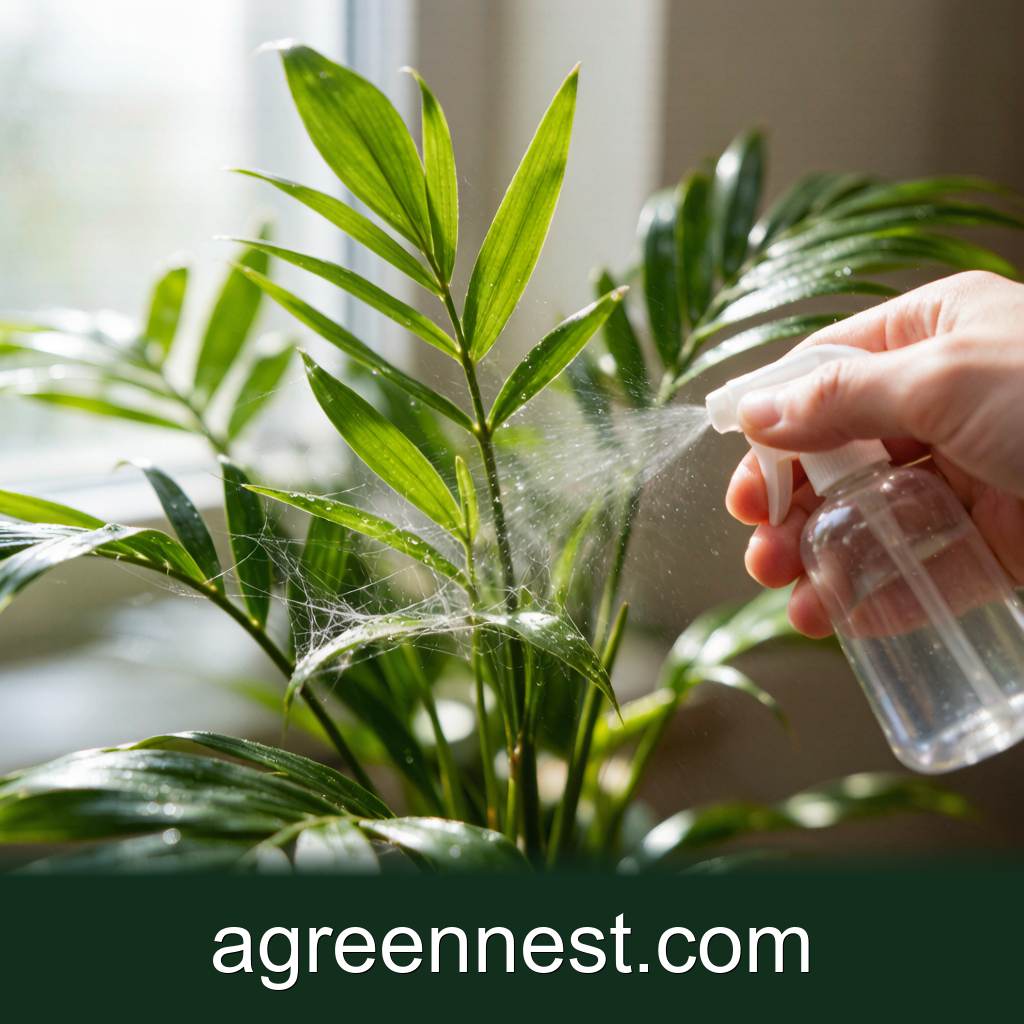
Mostly no. Spider mites do breed fastest in hot, dry air, but a spray-bottle misting raises leaf humidity for roughly 15 minutes, far too briefly to slow *Tetranychus urticae*. In my side-by-side palm test, the misted plant had nearly as many mites after 14 days. Sustained humidity, water blasts, and insecticidal soap work; misting theatre does not.
Type "spider mites" into any search bar and the same advice surfaces within three results: mist your plants daily, because spider mites hate humidity. It appears in care apps, on plant shop chalkboards, and in roughly every third comment under a webbing photo.
Half of that sentence is true. Spider mites genuinely do thrive in dry air. The leap from there to "so a spray bottle will protect you" is where the logic falls off a cliff, and I wanted numbers instead of vibes. So I put two equally infested parlor palms on opposite ends of a room and misted exactly one of them, twice a day, for two weeks.
Spoiler: the spray bottle lost.
Where Did the Misting Advice Come From?
Like most durable plant myths, this one grew from a real observation. Tetranychus urticae, the two-spotted spider mite behind most houseplant outbreaks, is a heat-and-drought specialist. At 30°C and low humidity it can sprint from egg to breeding adult in about 8 days; cool that room to 21°C and the cycle stretches to roughly two weeks. Populations also build faster when relative humidity sits below about 50 percent, which is exactly what heated winter air and hot summer windowsills deliver. That summer link is why infestations explode in July on the same plants that looked clean in May.
Greenhouse growers noticed decades ago that mite pressure dropped in consistently humid houses, and the advice got compressed over time from "sustained high humidity suppresses reproduction" down to "mist your plants". The compression is the problem. A greenhouse fog system holds 70 percent humidity around the clock. Your spray bottle does not.
How Long Does a Misting Actually Raise Humidity?
I taped a $14 hygrometer probe among the fronds of a Chamaedorea elegans and misted until the leaves dripped. Humidity at the leaf surface jumped from 44 percent to the high 80s, then slid back to the room's baseline in 12 to 18 minutes across five trials. On a warm, bright windowsill it was closer to 10.
Call it 15 minutes of mite-hostile air per misting. Mist twice a day and you have covered 30 minutes out of 1,440. The other 23.5 hours belong to the mites, who are perfectly comfortable finishing their 8-day sprint in your dry living room. The mister vs humidifier comparison reached the same conclusion for humidity-loving plants: misting feels productive, but the air forgets it almost immediately.
There is one honest exception. A hard mist physically knocks mites and webbing around, and eggs dislodge with enough water pressure. That mechanical effect is real. It is also better delivered by a shower, which brings me to the test.
What Happened When I Misted One Infested Palm for Two Weeks?
Two parlor palms, both carrying an established infestation from the same neglected corner, both confirmed under a 10x loupe with live adults and stippled fronds. Palm A got misted morning and evening. Palm B got nothing at all. Same window, same watering, 14 days.
My counting method was crude but consistent: tap three fronds over white paper and count the moving specks. Day zero, both palms shed 20-plus mites per tap session.
| Day | Palm A (misted 2x daily) | Palm B (untouched) |
|---|---|---|
| 0 | 22 mites | 24 mites |
| 7 | 15 mites | 26 mites |
| 14 | 17 mites | 31 mites |
The misted palm looked slightly better, mostly because the webbing kept getting flattened and some mites drowned or washed to the soil. But 17 mites per tap on day 14 is not control; it is a slightly inconvenienced outbreak. New stippling kept appearing on fresh growth throughout. Verdict: misting slowed the party, it did not end it.
For contrast, when a Monstera of mine caught mites last year, a real intervention, shower blast plus soap sprays on a schedule, took tap counts to zero in three weeks. That full protocol is in the monstera rescue log.
What Actually Knocks Spider Mites Back?
Four things, in the order I deploy them:
1. Water, with force. Take the plant to the shower or hose and blast the undersides of every leaf. This removes adults, nymphs, and a good share of eggs mechanically. Repeat every 3 to 4 days. This is what the misting myth is groping toward; the difference is pressure and coverage.
2. Insecticidal soap, on a calendar. Soap kills on contact and leaves no residue, so coverage and repetition decide everything. Spray until runoff, hitting leaf undersides, every 5 to 7 days for three rounds minimum to catch the eggs that hatch between sprays. Skipping the second round is the classic failure; it made my list of pest treatment mistakes for a reason.
3. Sustained humidity, not performative humidity. A humidifier holding the room above 50 to 60 percent, or a pebble tray under a grouped cluster of plants, changes the climate mites experience all day. That is the greenhouse effect the myth misremembers.
4. Quarantine and cull. Mites walk between touching leaves. Separate the patient, and if a plant is more web than foliage, binning it protects the other thirty.
The EPA's guidance on safer pest control makes the same point in duller language: match the method to the pest's biology, start with the least toxic option, and repeat treatments to break the life cycle. Full identification and treatment detail lives in the spider mite guide.
Frequently Asked Questions
Q: I misted daily and my plant still got covered in webbing. Did I do it wrong?
A: No, you ran the same experiment I did and got the same result. Webbing means an established population, and droplets cannot reach the colony working the leaf undersides. Move straight to shower blasts plus a soap schedule.
Q: Does misting at least stop mites from arriving in the first place?
A: Not meaningfully. Mites arrive on new plants, cuttings, clothing, and through open windows. Prevention that works is quarantine and a weekly loupe check of leaf undersides, not ambient moisture.
Q: My hygrometer says 55 percent. Am I safe from spider mites?
A: Safer, not safe. Reproduction slows as humidity climbs, but it does not stop, and a hot bright windowsill can run 15 points drier than the middle of the room where your gauge sits.
Q: Can I just buy predatory mites like Phytoseiulus persimilis for a houseplant?
A: You can, and Phytoseiulus persimilis is devastating against two-spotted mites in greenhouses. For one or two houseplants the economics are poor: a sachet order costs $25 to $40, and the predators starve and die once prey runs out. Soap and water win on a windowsill.
Q: Is neem oil better than insecticidal soap for mites?
A: They are close, and both need repeat sprays. Soap acts purely on contact; neem adds a mild growth-disrupting effect but smells stronger and can spot sensitive foliage in direct sun. I alternate them on stubborn outbreaks.
Misting is not useless; it is just a 15-minute answer to a 24-hour problem, and against an active infestation it performs like my Palm A, slightly damp and still crawling. Save the spray bottle for cleaning leaves. If you spot stippling, confirm the culprit with our pest identifier, then go straight to water pressure and a soap schedule, because the mites are not waiting for the air to dry out.
Sources & further reading
GreenNest authors research and write every guide independently. The external links below are reputable references we recommend for deeper reading — they are not the sources we copied from.
- US EPA — Safer Pest Control — US EPA
- NC State Extension Plant Toolbox — NC State Extension
Recommended Tools for Plant Pests & Diseases Care
Free, no-signup helpers matched to this guide.
🔍 Free Tool
Pest & Problem Identifier
Pick the symptoms you see and get the likely culprit plus a fix.
Free Ebooks to Explore
Downloadable handbooks — no email required.
Free Ebook
The AGreenNest Succulent Care Handbook
The complete, beginner-to-confident guide to growing fat, happy succulents — 10 chapters and a 20-plant directory.
Free Ebook
Haworthia & Haworthiopsis Care Handbook
A focused guide to the striped, forgiving Haworthia clan.
Share Your Plant Story
Grown something tricky, or found a trick that finally worked? Tell us in the comments, or see what other readers are sharing on our Community page. The best reader tips get folded back into our guides.
Join the Conversation
Have a tip or a question about Does Misting Prevent Spider Mites? I Tested It? Share it below — comments are saved on our server.