 AGreenNest
Succulent Care
Echeveria elegans Care: The Mexican Snowball
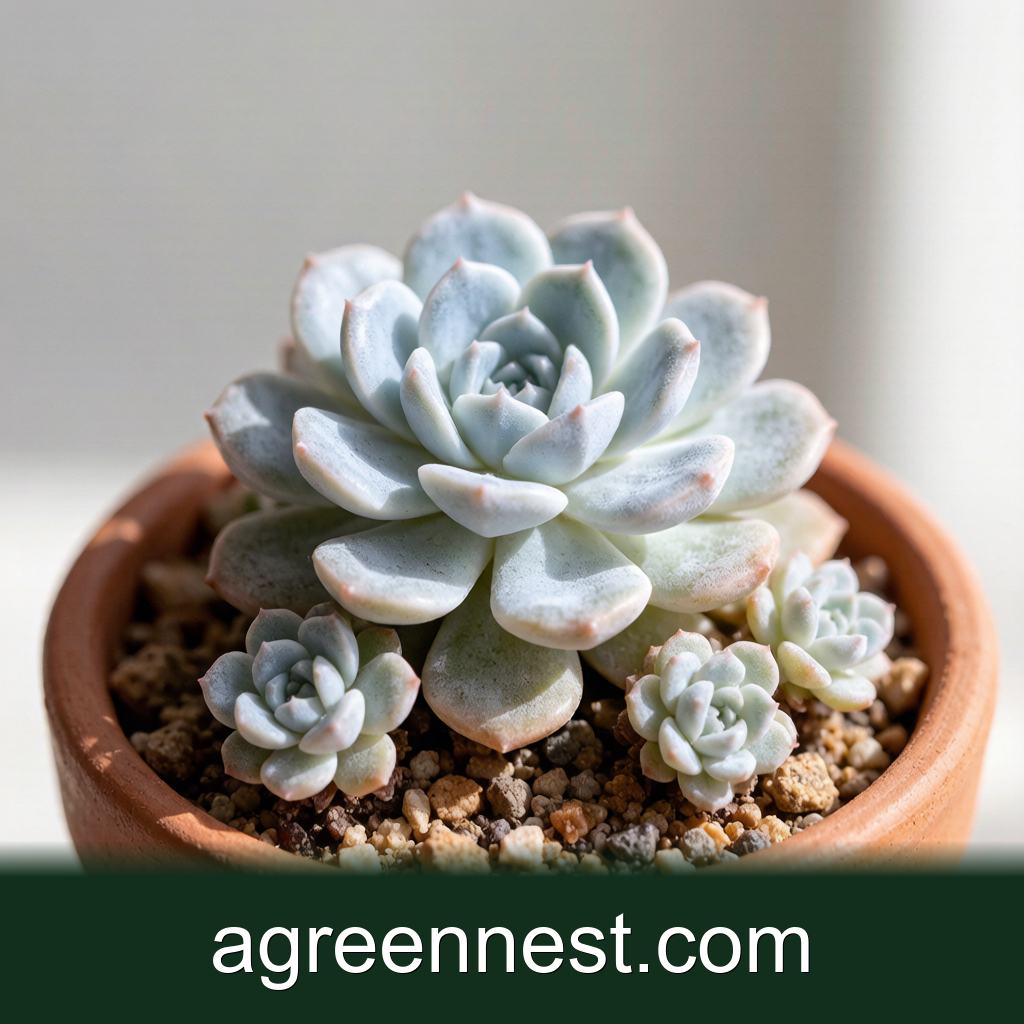
The Mexican snowball (Echeveria elegans) is a powdery blue rosette succulent that stays compact under bright indirect light and sparse water. Wait until the top 3 to 4cm of soil dries, then soak every 10 to 14 days in summer. Gritty soil and a shallow terracotta pot keep the base dry.
The first Echeveria elegans I owned arrived as a single 8cm rosette so pale I was sure it was plastic. Three years on, it had thrown out so many offsets the pot looked like a handful of sugared almonds. This is the Mexican snowball, a succulent that, once settled, behaves like a tidy party that keeps inviting more guests.
Where the Mexican snowball comes from
Echeveria elegans grows on the rocky, sun-baked slopes of north-central Mexico, where it copes with thin soil, bright light, and long dry spells. The plant stores water in its leaves, shrugs off a missed watering, and sulks the moment its feet stay wet. Our complete succulent guide covers the family habits, but this is a forgiving rosette once you respect two rules: lots of light and a hard dry-down between drinks.
A mature rosette runs 8 to 15cm across and holds 50 to 100 or more spoon-shaped leaves, each dusted in white wax. Left alone it sends out short runners topped with baby rosettes, and one plant becomes a dense clump 20 to 30cm wide in two or three seasons.
Why do the leaves look dusted with snow?
That powder is farina, a natural wax the plant spreads over its leaves as a sunscreen. It gives Echeveria elegans its ghostly blue-white finish, and it is fragile. Rub a leaf with your thumb and the mark stays, a shiny fingerprint that never grows back.
Treat the farina as the plant's coat, not a cleaning job. Water from below or pour at the soil line so the leaves stay dry, and never polish them. The coating reflects harsh light and slows moisture loss, so intact farina copes far better with bright sun than a rubbed one. The light and temperature guide explains how that coating interacts with heat on a hot windowsill.
How much light keeps the rosette round
Mexican snowball wants more sun than a typical shelf plant. Aim for 4 to 6 hours of bright indirect light, or a few hours of gentle morning sun. An east window is ideal, and a west window behind a sheer curtain works too. In good light the rosettes stay tight.
Too little light is the fastest way to lose the shape. The plant reaches for the brightest spot it can find, the leaf spacing widens, and the rosette stretches into a leggy star. If your best window is weak, run a grow light for 10 to 12 hours a day about 20 to 30cm above the canopy. In a heatwave keep it off the hot glass, because the farina scorches where leaves touch the pane.
Why is my Echeveria elegans stretching?
Stretching, or etiolation, almost always means not enough light. Move the plant to a brighter spot and accept that stretched growth will not tighten back up. Trim the worst leggy growth if you like, let the cut callous for a day, and the fresh growth will be compact. A badly stretched plant is also a good candidate for the propagation method below.
The other cause of a changed shape is overwatering, which softens the base and lets the rosette splay. That is different from light stretch, and the tell is in the leaves near the soil, covered further down.
How often should I water it?
Water when the top 3 to 4cm of soil is fully dry, about every 10 to 14 days in spring and summer and every 3 to 4 weeks in winter. When you do water, soak the pot until liquid runs from the drainage hole, then let it dry hard.
The classic mistake is a fixed weekly splash, which keeps the shallow roots wet and rots the base. A moisture meter takes the guesswork out of winter, when the dry-down is slow. The common mistakes guide lists the other traps owners fall into.
Soil, pot, and keeping the base dry
Use a gritty mix: 2 parts cactus or succulent soil to 1 part pumice or coarse perlite. The blend should shed water in seconds, not hold a damp clump. Build your own with our succulent soil recipe if the bagged mix feels heavy. A terracotta pot pulls moisture from the root zone and suits this plant better than a glazed ceramic.
Pot depth matters less than drainage. Mexican snowball likes to be slightly snug, so a shallow pot 8 to 12cm wide with a drainage hole is plenty. A wide, shallow pot also shows off the clump of offsets. Move up only one pot size when the clump fills the current one, usually every 2 to 3 years.
How do I make more of it?
Offsets are the easy route. In spring, slide the plant from its pot and gently separate the small rosettes that have formed their own roots, then set them in gritty mix. They root in 2 to 3 weeks and become their own little snowballs. Leaf propagation also works, though slower: twist a healthy leaf cleanly from the stem, rest it on dry mix, and a tiny rosette forms at its base. The first month care guide covers the early routine for new plants.
Why are the lower leaves going soft and mushy?
Soft, translucent lower leaves that fall apart at a touch usually mean rot from too much water, not thirst. Check the base of the rosette: a healthy one is firm, while a rotting one is soft and may smell musty. If you catch it early, the rotting succulent rescue walks through the dry, cut, and repot steps that bring it back.
The opposite problem is thirst, where leaves wrinkle and flatten but stay firm. A thorough soak plumps them back within a day or two. The difference is in the feel: thirsty leaves are dry and papery, rotted leaves are wet and soft. The wrinkled leaves guide helps you tell them apart.
Frequently Asked Questions
Q: Is Echeveria elegans safe around cats and dogs?
A: Yes, it is non-toxic to pets, a rare worry-free succulent for homes with curious animals. The round leaves still look like a snack to a cat, so keep the pot where a swat will not send offsets across the floor.
Q: Why did my Mexican snowball grow a tall stalk with pink flowers?
A: That is a flower stalk, a good sign. Mature plants send up an arching stem 20 to 30cm tall topped with bell-shaped pink, peach, or red blooms in spring or early summer. Let it flower, then snip the stalk once it fades so the plant refocuses on the rosette.
Q: Can I grow Echeveria elegans outdoors in summer?
A: Yes, in morning sun and afternoon shade once nights stay above about 10C. Harden it off over a week and bring it back in before the first cold night, because it has no frost tolerance and a single freeze browns the leaves.
Q: The white coating rubbed off some leaves. Will it come back?
A: No, farina does not regenerate on a leaf that has lost it, though new leaves grow in fully coated. Avoid handling the rosette and water at the soil line so the rest stays intact.
Q: Should I fertilise my Mexican snowball, and when?
A: Feed once a month in spring and summer with a cactus fertiliser at half strength, and stop in winter. Too much nitrogen pushes soft, leggy growth that loses the round look, so less food makes a better plant.
Echeveria elegans rewards a light hand more than a busy one: bright light, a hard dry-down between waters, and grit under its roots will keep the snowball round for years. Watch the farina, water by feel rather than by calendar, and resist the urge to handle the rosette. For the wider picture, our complete succulent guide is the page I would read next.
Recommended Tools for Succulent Care
Free, no-signup helpers matched to this guide.
Free Ebooks to Explore
Downloadable handbooks — no email required.
Free Ebook
The AGreenNest Succulent Care Handbook
The complete, beginner-to-confident guide to growing fat, happy succulents — 10 chapters and a 20-plant directory.
Free Ebook
Haworthia & Haworthiopsis Care Handbook
A focused guide to the striped, forgiving Haworthia clan.
Sources & further reading
GreenNest authors research and write every guide independently. The external links below are reputable references we recommend for deeper reading — they are not the sources we copied from.
- Royal Horticultural Society — Houseplant care — RHS
- Missouri Botanical Garden — Missouri Botanical Garden
- NC State Extension — Plant Toolbox — NC State Extension
Share Your Plant Story
Grown something tricky, or found a trick that finally worked? Tell us in the comments, or see what other readers are sharing on our Community page. The best reader tips get folded back into our guides.
Join the Conversation
Have a tip or a question about Echeveria elegans Care: The Mexican Snowball? Share it below — comments are saved on our server.