 AGreenNest
Hydroponic Growing
Summer Hydroponic Reservoir Care: Beat the Heat
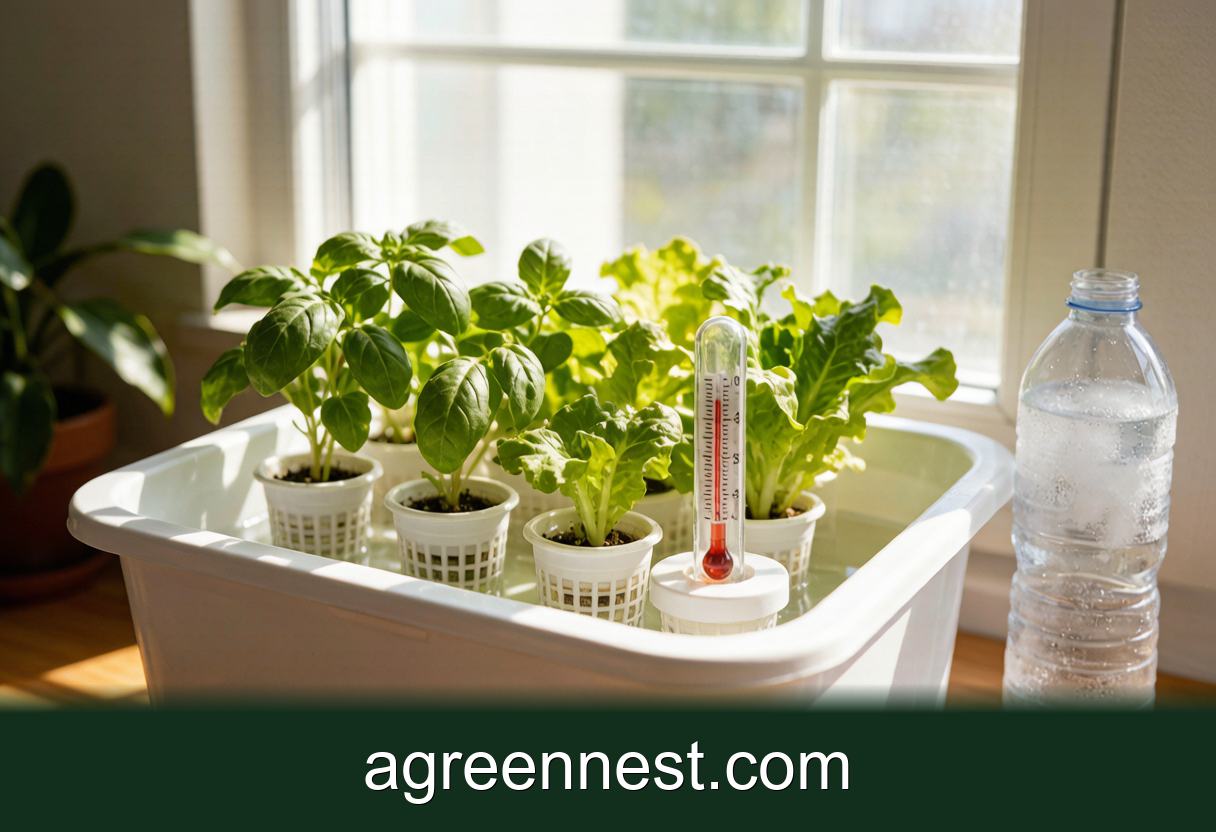
Keep a hydroponic reservoir between 18 and 22°C in summer. Above 24°C dissolved oxygen falls and Pythium root rot takes hold within days. Cheapest fixes first: shade the tank, insulate with 2 cm foam, swap in frozen 500 ml bottles twice daily, and top off evaporation with plain water to stop EC creep.
Last July I measured 29.5°C in a friend's deep water culture tub at 4 in the afternoon. The basil up top looked fine. The roots underneath had gone from white cords to brown slime in under a week, and the whole crop was compost by August. Nothing about his nutrient mix was wrong. The water was cooking.
Summer is the season that punishes hydroponic growers hardest, and almost every failure traces back to one number: reservoir temperature. Here is what that number should be, why it matters more than EC or pH once the heat arrives, and the fixes ranked from free to worth-it.
What Temperature Should a Hydroponic Reservoir Be?
Target 18 to 22°C (65 to 72°F). That band is the compromise between two competing curves.
Cold water holds oxygen. At 20°C, fully aerated water carries roughly 9 mg/L of dissolved oxygen. At 30°C it holds barely 7.5 mg/L, and the roots are respiring faster at the same time, so effective oxygen availability drops much harder than the raw figure suggests. Roots in warm, oxygen-poor water suffocate slowly, and suffocating roots are exactly what Pythium species need to move in.
Warm water also speeds every bad reaction. Nutrient salts drift faster, beneficial biology slows, and algae treat the tank like a heated greenhouse. The crossover point I watch for is 24°C. Below it, most summer setups are fine. Above it, I expect trouble within a few days unless something is actively cooling the water. This is separate from the general hydroponic water temperature curve, which stays relevant year round, but summer is where it actually bites.
Why Heat Destroys Roots Faster Than You Think
Pythium and its relatives are everywhere. They are in the air, the tap, the stray bit of dead root. They only become a disease when roots are weak enough to take the hit, and warm water weakens roots on three fronts at once.
First, low oxygen. Roots need oxygen to take up nutrients and to defend themselves. Drown that supply and the same organism that was harmless becomes the one killing your crop.
Second, heat stress. A root sitting at 28°C is running a metabolic fever. It leaks sugars and cell contents into the water, which feeds exactly the pathogens circling it.
Third, the lag. The canopy looks healthy for a week because the leaves are still spending stored reserves. By the time the tops wilt, the root mass is already brown and the plant rarely recovers. That is why I measure the tank, not the leaves, in summer.
How Do You Keep a Reservoir Cool in Summer?
Cheapest fixes first. I have never needed all of these on one system, but the list scales with how brutal your summers are.
Shade the tank. A reservoir in direct sun hits 30°C by noon. Move it into a cabinet, behind a curtain, or into the coolest corner of the room. This alone fixes half of home setups.
Insulate. Wrap the reservoir in 2 cm closed-cell foam, the kind used for pipe lagging. A black tub in a warm room soaks up heat through the walls even out of direct sun. Foam breaks that path for the price of a few metres of tape.
Add thermal mass. Bury the reservoir partially, or set it inside a larger outer tub with an air gap, and the temperature swings shrink.
Drop in frozen bottles. Two 500 ml bottles of frozen water, swapped morning and evening, pulls a 20 L reservoir down 2 to 3°C and holds it there through the afternoon peak. Rotate three bottles so one is always frozen.
Only after all that, consider a real chiller. A 1/10 hp aquarium chiller holds 20°C through anything but costs 150 dollars plus and draws real power. I reach for one only on a recirculating deep water culture system running valuable crops, never on a single basil jar.
How Often Should You Top Off and Change Water in Summer?
Evaporation runs hard in heat, and as water leaves, the nutrient salts stay behind. The EC climbs even though the plants are drinking normally. Left alone, a tank drifts from 1.8 to 3.0 EC in two weeks and the plants get salt-shocked.
Top off daily with plain water, no nutrients. A reservoir that drops 1 cm a day in August needs roughly 0.5 to 1 L back per day depending on size. Adding nutrients on top of top-off is the classic beginner error and it is why so many summer plants crisp at the leaf tips.
Change the full reservoir on a shorter clock in summer. I run 7 days in July and August versus 10 to 14 days in spring. A complete change resets the salt balance, dumps the early algae, and gives you a clean EC and pH baseline. If you are new to the method, the common hydroponic mistakes guide covers the top-off error in more detail.
What About Algae and Stagnant Summer Water?
Algae love the same warmth your plants hate. A green film on the tub wall is a warning, not a cosmetic issue, because it competes for the same oxygen your roots need at night.
Block light completely. Algae cannot grow without it. Opaque reservoir, opaque lid, no clear tubing. If you can see the water, algae can too. Our note on preventing algae in hydroponics walks the full light-proofing setup.
Keep the air stone running 24/7 in summer. Aeration does double duty: it drives oxygen in and it gently mixes the tank so no warm layer settles on top. A 2 W stone is enough for a 20 L tub.
Smell is your last line of defence. Healthy nutrient solution smells faintly earthy or like nothing. A sour, sewage, or rotten note means anaerobic rot has started and the water needs an immediate full change, not a top-off.
Frequently Asked Questions
Q: My reservoir hits 26°C by midafternoon but the plants look okay. Should I panic?
A: Not yet, but act. Above 24°C you are on borrowed time, usually a few days before roots show it. Shade and frozen bottles will buy you the margin. If it stays over 26°C for more than 48 hours, expect root rot within the week.
Q: Can I just add ice cubes straight to the nutrient solution?
A: Skip it. Melted ice dilutes nutrients and dumps your EC, and most cubes carry chlorine or tap minerals you did not budget for. Use sealed frozen bottles so the water stays contained and the temperature drops without changing the mix.
Q: Does a bigger reservoir stay cooler on its own?
A: Yes, a 40 L tank swings far less than a 5 L one because the volume resists a quick warm-up. But a big black tub in the sun still cooks. Size buys time, it does not replace shading and insulation.
Q: How cold is too cold for a summer reservoir?
A: Below 16°C roots slow uptake and nutrient absorption drops, especially for warm-loving crops like basil and tomatoes. Hold 18 to 22°C and you stay in the productive band without chilling the feed.
Q: Is a weekly full water change a waste of nutrients?
A: In summer it is insurance, not waste. The salt creep and early algae you flush out would cost you the crop otherwise. Use the spent mix on soil containers outside rather than pouring it down the drain.
Summer hydroponics lives or dies at the thermometer. Keep the tank 18 to 22°C, shade it, insulate it, top off with plain water, and change the full reservoir every seven days, and the warm months become your highest-yield season instead of your biggest loss. Start by dropping a cheap floating thermometer in the tub and reading it at 4 pm for three days. If you are choosing a system to begin with, our guide to the best hydroponic kits points at setups that are easy to keep cool.
Sources & further reading
GreenNest authors research and write every guide independently. The external links below are reputable references we recommend for deeper reading — they are not the sources we copied from.
- Michigan State University Extension — Michigan State University
- University of Minnesota Extension — U Minnesota Extension
- NC State Extension — Plant Toolbox — NC State Extension
Recommended Tools for Hydroponic Growing Care
Free, no-signup helpers matched to this guide.
Free Ebooks to Explore
Downloadable handbooks — no email required.
Free Ebook
The AGreenNest Succulent Care Handbook
The complete, beginner-to-confident guide to growing fat, happy succulents — 10 chapters and a 20-plant directory.
Free Ebook
Haworthia & Haworthiopsis Care Handbook
A focused guide to the striped, forgiving Haworthia clan.
Share Your Plant Story
Grown something tricky, or found a trick that finally worked? Tell us in the comments, or see what other readers are sharing on our Community page. The best reader tips get folded back into our guides.
Join the Conversation
Have a tip or a question about Summer Hydroponic Reservoir Care: Beat the Heat? Share it below — comments are saved on our server.