 AGreenNest
Hydroponic Growing
Winter Hydroponics Indoors: What to Change
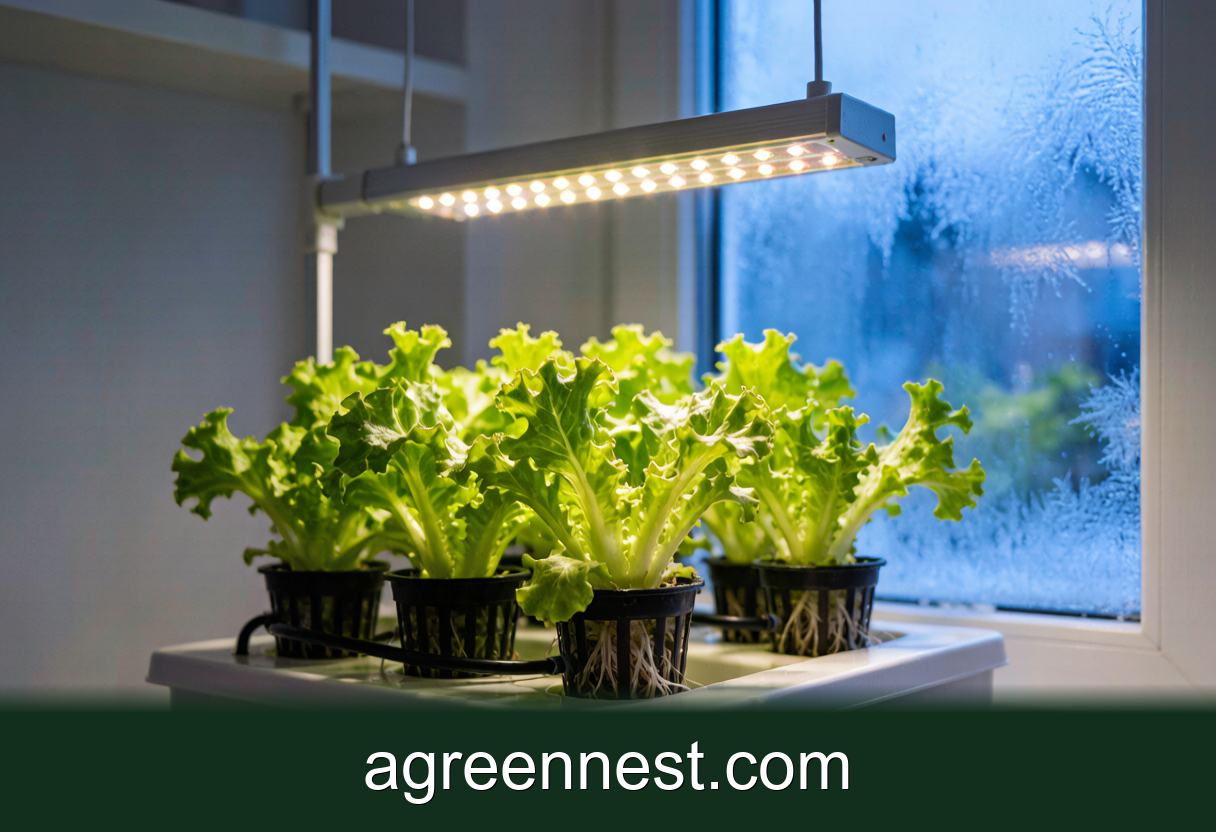
Winter hydroponics slows because reservoirs drop below 18°C, days fall under 10 hours, and cold roots eat less. Fix it: warm the water to 18 to 22°C, run grow lights 12 to 14 hours, cut nutrient strength 15 to 20 percent, and grow cool-season leafy crops like lettuce instead of fruiting plants.
My basement lettuce did great until the first hard frost, then it just sat there for three weeks, same size, sulking. The nutrients were fine. The pH was fine. The room had dropped to 14°C and the reservoir with it, and cold roots stop working. Winter does not kill an indoor system, but it quietly slows everything down unless you make a few deliberate changes.
Here is what actually shifts when the season turns, and the specific numbers I change to keep a home setup producing through the dark months.
Why Does My Hydroponic System Slow Down in Winter?
Three things gang up on you at once, and they all pull in the same direction.
First, the water gets cold. Reservoir temperature drives root activity, and once the tank drifts below 18°C, nutrient and water uptake slow sharply. Down at 12 to 14°C, phosphorus and iron get locked out and growth nearly stalls even with a good solution in the tank.
Second, the days get short. Natural light through a window drops below 10 hours in midwinter at most latitudes, and the sun sits low and weak. Leafy crops want 12 to 14 hours of usable light to keep building leaf.
Third, cold roots eat less. A plant growing at 15°C metabolises slower than the same plant at 22°C, so it draws down the reservoir more slowly. If you keep dosing nutrients on your summer schedule, salts build up and the EC creeps high.
None of these is fatal. Each has a fix, and they stack.
What Water Temperature Should I Hold in Winter?
Same target as always: 18 to 22°C. The difference is that in summer you fight to cool the tank, and in winter you fight to warm it.
An unheated garage or basement tank will happily sit at 12 to 15°C, which is too cold for anything but the toughest greens. The clean fix is a submersible aquarium heater sized to your volume, roughly 25 watts per 20 litres, set to 20°C. It is cheap, it runs on a thermostat, and it holds the water steady while the room swings. I explain why this single number matters so much in hydroponic water temperature.
If you would rather not add a heater, move the reservoir. Getting the tank off a cold concrete floor and onto a shelf, then wrapping it in an insulating jacket, often buys you 3 to 5°C for free. Measure the water, not the air, at the coldest point of the night. That early-morning low is what your roots actually live in.
How Much Light Do Plants Need Over Winter?
More than the window gives you, so plan to supplement. For leafy greens, run a full-spectrum LED for 12 to 14 hours a day on a timer. Fruiting crops like peppers and tomatoes (Solanum lycopersicum) want 14 to 16 hours and a lot more intensity, which is why most people park the fruiters until spring.
Distance and intensity matter as much as hours. A panel too far away just makes the plants stretch and go pale. Keep a mid-power LED roughly 25 to 40 cm above the canopy for leafy crops, and dial it by watching the plants: tight, compact growth means the light is right, while long stems and small leaves mean move it closer or add hours. Our best grow lights guide covers picking a fixture, and the light calculator helps you sanity-check coverage before you buy.
One winter bonus: with lights on a timer, your indoor system is more consistent than a summer windowsill, because you control every hour of light instead of hoping for sun.
Do I Change the Nutrients When It Gets Cold?
Yes, and this is the step most people miss. Cold, slow plants drink and feed less, so your summer EC will be too strong.
Drop the nutrient concentration 15 to 20 percent below your warm-season target. If you run lettuce (Lactuca sativa) at 1.2 EC in summer, take it to about 1.0 in deep winter. Watch the reservoir: if the water level barely drops over several days and the EC climbs on its own, the plants are not feeding, and piling on more nutrient only burns the roots. Top up with plain pH-adjusted water more often than with full-strength solution.
Keep checking pH, because it drifts faster in a low-uptake tank. Hold leafy greens around 5.8 to 6.2 as usual; the pH management guide has the drift troubleshooting. And if you want the fundamentals on mixing, the nutrients guide breaks down strength by crop.
Which Crops Actually Thrive Indoors in Winter?
Play to the season. Cool-season leafy crops love the shorter, cooler conditions and shrug off a chilly room.
- Lettuce (Lactuca sativa): the winter workhorse. Happy at 16 to 20°C, fast, forgiving. Start with hydroponic lettuce.
- Spinach (Spinacia oleracea): actually prefers cool water and short days, so winter is its moment.
- Kale, chard, and Asian greens like bok choy: tough, productive, and unbothered by a cool basement.
- Herbs such as mint and parsley: slower than summer but steady under lights.
Skip the summer fruiters unless you have serious lighting and a heated space. Tomatoes and peppers need warmth, long light, and pollination help indoors, and in a cold room they sulk and stretch. A reliable starter rig makes the leafy-green route almost hands-off, and the best hydroponic kits roundup flags ones with decent built-in lighting.
Frequently Asked Questions
Q: My reservoir sits at 15°C and growth stopped. Is a heater really necessary?
A: For steady winter growth, yes. Below 18°C uptake slows and below 15°C phosphorus and iron lock out, so the plant starves in a full tank. A 25 watt per 20 litre aquarium heater set to 20°C fixes it for the price of a takeaway. Insulation alone rarely holds a cold room.
Q: Can I just leave the grow light on 24 hours to make up for short days?
A: No. Most crops need a dark period to respire and reset, and continuous light stresses them and wastes power. Run 12 to 14 hours for leafy greens and give them 10 to 12 hours off. A timer keeps it honest.
Q: Why is my EC rising when I have not added nutrients?
A: Cold plants drink water faster than they take up salts, so the water evaporates and transpires off while nutrients concentrate behind. That climbing EC is a signal to top up with plain pH-adjusted water and lower your mix strength for the season.
Q: My winter lettuce tastes more bitter than summer. What changed?
A: Usually heat stress or light stress, not cold. Check that the water has not spiked warm under the lights and that intensity is not scorching the tops. Steady 18 to 20°C water and moderate light keep leafy greens sweet.
Winter does not end indoor growing, it just changes the dials. Warm the water to 18 to 22°C, put your light on a 12 to 14 hour timer, ease the nutrient strength back, and grow the crops that actually like cool, short days. Do that and a basement system can out-produce a summer windowsill. Get the reservoir right first with the hydroponic water temperature guide, and the rest falls into place.
Sources & further reading
GreenNest authors research and write every guide independently. The external links below are reputable references we recommend for deeper reading — they are not the sources we copied from.
- Michigan State University Extension — Michigan State University
- University of Minnesota Extension — U Minnesota Extension
- NC State Extension Plant Toolbox — NC State Extension
Recommended Tools for Hydroponic Growing Care
Free, no-signup helpers matched to this guide.
Free Ebooks to Explore
Downloadable handbooks — no email required.
Free Ebook
The AGreenNest Succulent Care Handbook
The complete, beginner-to-confident guide to growing fat, happy succulents — 10 chapters and a 20-plant directory.
Free Ebook
Haworthia & Haworthiopsis Care Handbook
A focused guide to the striped, forgiving Haworthia clan.
Share Your Plant Story
Grown something tricky, or found a trick that finally worked? Tell us in the comments, or see what other readers are sharing on our Community page. The best reader tips get folded back into our guides.
Join the Conversation
Have a tip or a question about Winter Hydroponics Indoors: What to Change? Share it below — comments are saved on our server.