 AGreenNest
Low-Light Indoor Plants
August Indoor Plant Care: The Turning Point
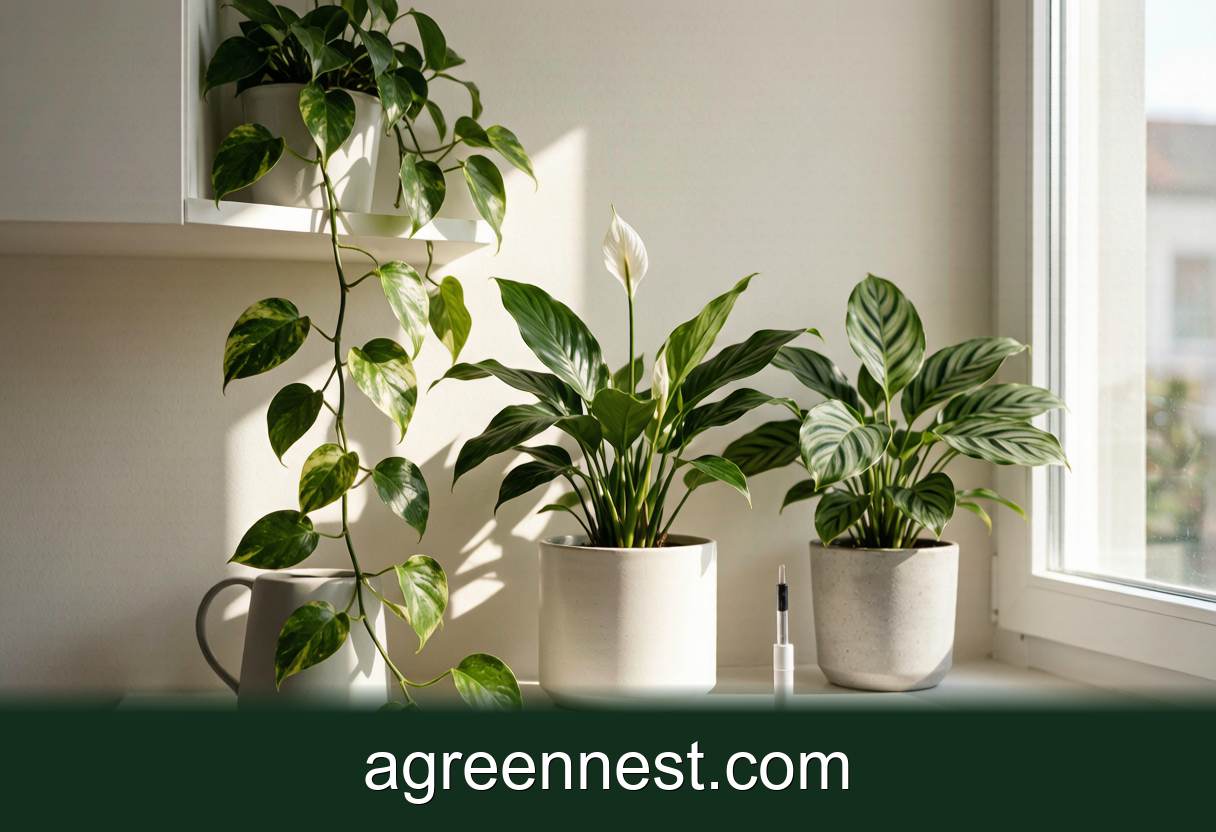
August is the turning point for indoor plants. Daylight at 40 degrees north drops about 75 minutes across the month, so growth slows and pots stay wet longer. Stretch watering intervals, taper feeding to half strength every three weeks, finish any repotting now, and watch for the summer's last pest surge.
The first week of August always fools me. The rooms are still hot, the Epipremnum aureum over my kitchen door is still throwing out a leaf every ten days, and it feels like high summer with months to run.
Then I look at my window notes from last year and remember what is actually happening. On 1 August my flat gets a little over fourteen hours of daylight. By 31 August that is down to roughly twelve hours and fifty minutes. Seventy-five minutes gone, quietly, while the temperature says nothing has changed.
That gap between how a room feels and what the light is doing causes more August plant problems than heat ever does.
The Light Starts Leaving Before the Warmth Does
The sun is also sitting lower. At 40 degrees north, midday sun altitude falls from about 70 degrees at the start of the month to nearer 60 by the end. That changes how deep light reaches into a room.
Here is what it looked like on my own meter last August, measured at 1 pm on clear days about three weeks apart. My north-facing shelf went from 780 lux to 520. The east window sill dropped from 4,400 lux in the morning to about 3,100. My south wall, two metres back from the glass, barely moved, because that spot was already living on reflected light.
Two useful things follow from this. Plants in genuinely dim corners feel the change first and hardest. Plants near glass have a buffer, so they carry on growing for several more weeks. If you have never measured your own rooms, late August is a good moment to do it, and the lux test for dark homes walks through doing it with a phone.
I move two plants every August without fail. My Calathea orbifolia comes forward from 60 cm behind the east window to about 25 cm, and my Spathiphyllum wallisii shifts from the hall to the living room sill. Neither is in trouble yet. That is the point of moving them now.
Why Is My Plant Suddenly Drinking Less in August?
Because photosynthesis is slowing before the thermometer admits it, and a plant that is growing less pulls less water out of the pot.
This catches careful people out. You built a reliable summer rhythm, perhaps every five days for a pothos in a 15 cm pot, and you keep to it because it worked in July. Meanwhile the soil is taking seven or eight days to dry to the same depth. Three weeks of that and the roots at the bottom of the pot have been sitting damp the whole time.
The fix is not a new schedule. It is going back to checking rather than counting. I push a finger in to the second knuckle, roughly 5 cm, and water only if it comes out dry. For anything in a heavy ceramic pot or a low-light spot, a probe is more honest than a finger, since the top can feel dry while the base is still wet.
Late-summer overwatering looks unlike the classic version. You get soft yellowing on the oldest leaves, a faint sour smell at the soil surface, and growth that just stops. The overwatering signs in low light covers the pattern in more detail, and it is worth knowing before September, when the same mistake becomes much slower to recover from.
When Should I Stop Fertilising for the Year?
Taper through August, then stop for most plants somewhere between mid-September and early October depending on your light.
Through June and July I feed at half the label strength every two weeks. From about 10 August I stretch that to every three weeks at the same half strength. The last feed of the year goes on in the third week of September, and anything living under 800 lux gets its last one two weeks earlier than that.
Fertiliser given to a plant that has stopped growing is not taken up, so salts build up in the substrate. You see it as a white crust on the pot rim and crisp brown leaf tips by November. If you want the underlying logic, fertilising houseplants basics sets out the ratios.
One exception. Plants under a grow light on a fixed 12 hour timer are not reading the season at all, so they carry on growing and can keep being fed into autumn.
The Jobs Worth Doing This Month
August is the last comfortable window for anything that asks a plant to recover.
- Repotting. A root-bound plant repotted now has six to eight weeks of decent light to establish before growth slows. The same job in October means a wet pot and no growth to dry it out. Repotting houseplants, when and how has the timing details.
- Pruning and shaping. Cut back leggy growth while the plant can still respond. My Aspidistra elatior gets its tired outer leaves removed at the base in mid-August every year.
- A proper leaf clean. Dust cuts light transmission noticeably, and you are heading into a season where every lumen counts. A damp cloth, both sides, takes ten minutes for a shelf.
- The last pest sweep. Warm rooms plus new soft growth is peak spider mite territory, and infestations that start in August coast right through autumn. Check leaf undersides while you clean them.
- Plan the winter positions. Not move them yet, plan them. I keep a note on my phone of which plant goes where in November, and it saves a scramble in the first cold week.
If you sent plants out to a balcony in June, start thinking about the return trip now rather than at the first cold night. Bringing them back over a couple of weeks, with an inspection and ideally a quarantine, avoids importing a pest problem into a closed house. Overwintering houseplants goes through that handover properly.
Frequently Asked Questions
Q: My pothos put out four leaves in July and none in the last fortnight. Is something wrong?
A: Almost certainly not. Growth in August often pauses for a week or two as day length shortens, especially away from a window. Check that the soil is drying within a sensible span and that you have not moved the pot, then leave it be.
Q: Should I repot in August or wait until spring?
A: Repot now if the plant is genuinely root-bound, meaning roots circling the pot base or water running straight through. If it is merely "due", waiting until March is kinder, because there is far more recovery light available then.
Q: Is it too late to propagate cuttings this month?
A: Early August, no. Cuttings taken in the first two weeks still root in two to three weeks in a warm room. After about 20 August the rooting time stretches and the failure rate climbs, so I would wait for spring rather than lose the cutting.
Q: My south window plants look bleached this month. Sunburn or something else?
A: Look at where the pale patches sit. Sunburn shows on the leaf faces angled towards the glass and has crisp, dry centres. Even, overall paling across the whole plant is more often a nutrient or watering issue.
Q: When do I switch the grow lights back on?
A: When your measured light drops below what the plant needs, not on a calendar date. For most low-light tropicals I start supplementing in late September, running the light 10 to 12 hours a day to hold the summer day length steady.
August rewards small adjustments rather than big interventions. Water by checking instead of counting, stretch the feeding interval, get any repotting done in the next three weeks, and take one careful look under the leaves while the room is still warm. Those four habits carry a collection into autumn in far better shape than a scramble in October ever will. If you are unsure whether a spot will still be bright enough in November, our free light calculator gives you a number to plan around.
Sources & further reading
GreenNest authors research and write every guide independently. The external links below are reputable references we recommend for deeper reading — they are not the sources we copied from.
- Royal Horticultural Society — Houseplant care — RHS
- Missouri Botanical Garden — Missouri Botanical Garden
- NC State Extension Plant Toolbox — NC State Extension
Recommended Tools for Low-Light Indoor Plants Care
Free, no-signup helpers matched to this guide.
Free Ebooks to Explore
Downloadable handbooks — no email required.
Share Your Plant Story
Grown something tricky, or found a trick that finally worked? Tell us in the comments, or see what other readers are sharing on our Community page. The best reader tips get folded back into our guides.
Join the Conversation
Have a tip or a question about August Indoor Plant Care: The Turning Point? Share it below — comments are saved on our server.