 AGreenNest
Low-Light Indoor Plants
Bird's Nest Fern Care: The Fern for Dim Rooms
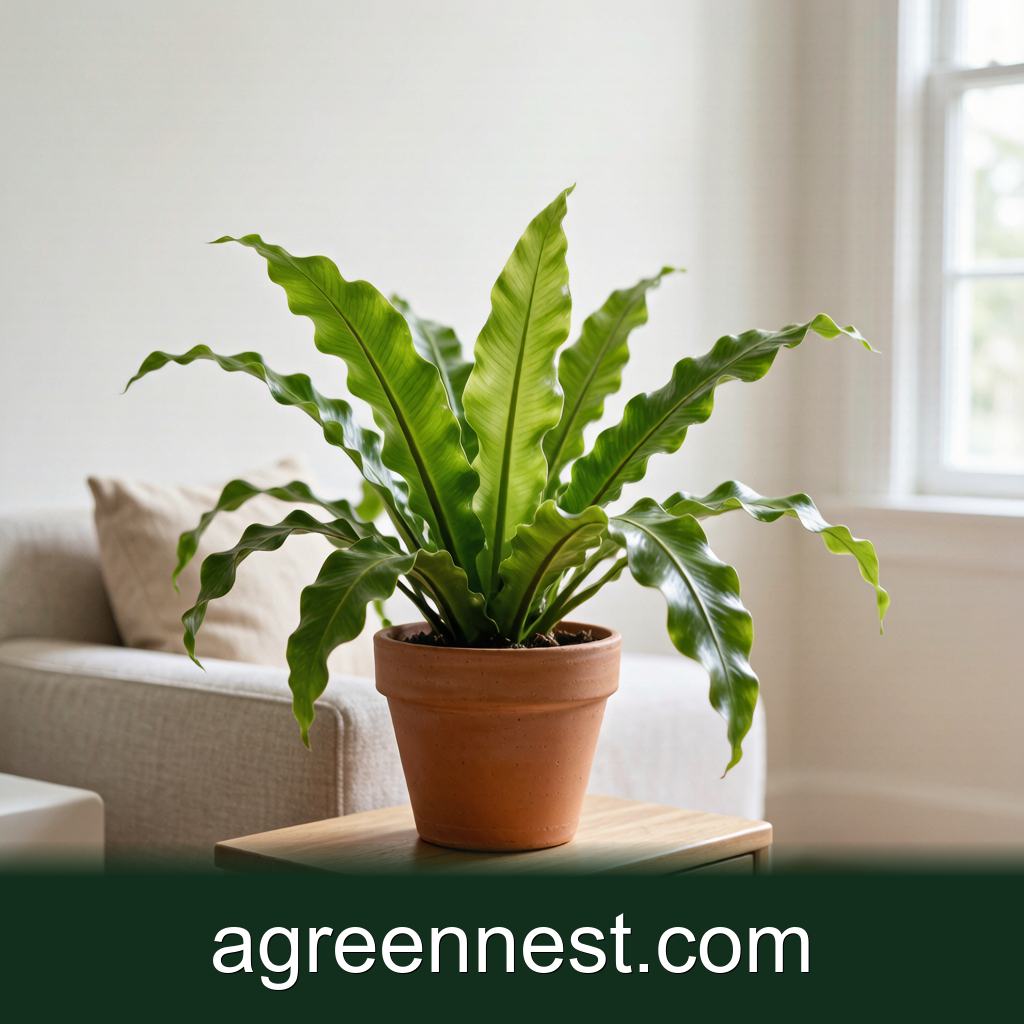
Bird's nest fern (*Asplenium nidus*) is the most low-light-tolerant fern for homes, holding glossy fronds at 500 to 800 lux. Water the soil around the rosette, never into the central crown, and keep humidity near 50 percent. Brown crispy edges mean dry air or fertiliser burn, not underwatering.
I killed my first bird's nest fern with kindness in about six weeks. Every Sunday I poured water straight into that lovely green vase at the centre, the way you'd fill a fountain. By week five the newest fronds came out blackened at the base, and by week six the whole rosette lifted out of the pot in my hand, rotted clean through. The fern was fine with my dark hallway. It was the watering can aimed at its heart that did it in.
That failure taught me what matters most about Asplenium nidus: it tolerates dim rooms remarkably well, and it has one non-negotiable rule about water. Get those right and this is the longest-lived fern you can keep indoors.
Why This Fern Survives Where Boston Ferns Give Up
Most ferns we grow indoors are forest-floor plants with thin, feathery fronds that shed moisture fast and crisp up the moment humidity drops. A bird's nest fern is built differently. In the wild it grows as an epiphyte, wedged into tree branches across Southeast Asia and the Pacific, and its fronds are entire, glossy, and thick, more like a banana leaf than a lace doily. Less surface area per leaf means less water lost to your radiator-dried living room air.
The fronds emerge from a central rosette that looks like a nest, unfurling from tight spirals the colour of new apples. Indoors they reach 40 to 60 cm long. Compare that to the constant needle-drop of a Boston fern in a dim corner and you can see why I steer fern-curious beginners here first.
Two cultivars worth knowing: 'Crispy Wave' has ruffled, seersucker-textured fronds and stays compact; 'Victoria' has narrow, wavy-edged fronds. Care is identical.
How Much Light Does a Bird's Nest Fern Actually Need?
Less than almost anything else with fronds. Mine has held steady, glossy growth at 600 lux, measured at leaf height, about 2.5 metres from a north-facing window. The practical floor is around 500 lux; below that, new fronds emerge but come out shorter and the plant slowly shrinks over a year or two. The comfortable range is 800 to 1500 lux, and the ceiling matters just as much: direct midday sun scorches pale bleached patches into those broad fronds within a single afternoon.
Take a reading before you commit to a spot. A phone app gets you close enough, and our lux measuring walkthrough shows how to do it in two minutes. East windows filtered by a sheer curtain are ideal. Bathrooms with a decent window are even better, because this fern also wants the humidity, and it earns a spot on our bathroom plant shortlist for exactly that reason.
Fronds grow toward the light, so give the pot a quarter turn every couple of weeks or the rosette leans like a satellite dish.
Watering: Around the Crown, Never Into It
Here is the rule my first fern died teaching me. Water the compost in a ring around the rosette, keeping the central cup dry. Water sitting in that crown has nowhere to drain, and the tightly packed frond bases rot fast, taking the growing point with them. In a rainforest canopy, rain drains through instantly; in a pot at 19 °C, it just sits.
I water when the top 2 to 3 cm of mix is dry, roughly every 5 to 7 days in summer and every 10 to 12 days in winter. The root ball should stay lightly moist, never soggy and never bone dry. A moisture meter takes the guesswork out if your pot is deep.
If the lower fronds yellow while the mix stays damp for two weeks at a stretch, you are looking at too much water in too little light, and the overwatering signals in dim rooms apply to this fern exactly as they do to a pothos.
Why Are the Frond Edges Turning Brown and Crispy?
This is the complaint I hear most, and the cause is almost never thirst. Three culprits, in the order I check them:
Dry air. Below about 40 percent relative humidity, edges brown first and the ruffle on 'Crispy Wave' flattens. Aim for 50 percent or higher. A room humidifier is the real fix; a pebble tray under the pot adds a few points locally and costs almost nothing. Misting feels helpful but the effect evaporates within the hour.
Fertiliser burn. This fern feeds lightly. Half-strength balanced liquid fertiliser once a month, spring through early autumn, is plenty. Full-strength doses show up two weeks later as brown margins and deformed, puckered new fronds. If you have been feeding at label strength, flush the pot with a full watering-can of plain water and skip a month.
Cold contact. Fronds pressed against a winter windowpane brown in patches where they touch. Keep the plant above 16 °C and leave a hand's width between glass and leaf.
Cosmetic tip: trim brown edges with clean scissors, following the frond's natural curve. Never remove a frond that is more than half green; the plant is still drawing from it.
Soil, Pots, and the Repot It Rarely Needs
Remember the epiphyte heritage. Roots want air as much as water, so use a chunky, open mix: I do two parts peat-free houseplant compost, one part perlite, one part fine orchid bark. A standard dense potting soil holds water against the root ball for too long in a dim room.
The root system is small relative to the leaf mass, so repotting comes around only every 2 to 3 years, and only one pot size up. A shallow pot suits it better than a deep one. Mine went from a 14 cm to a 17 cm pot after three years, and the roots had barely filled the original. Spring is the moment, just as new spirals start unfurling at the centre.
One more habit worth keeping: wipe the fronds with a damp cloth monthly. Those broad surfaces collect dust fast, and a clean frond in a 600 lux room photosynthesises noticeably better than a furry one.
Frequently Asked Questions
Q: There are brown fuzzy stripes on the underside of my fern's fronds. Are they pests?
A: Check the pattern first. Neat parallel rows of brown lines radiating from the midrib are spore cases, completely normal on mature Asplenium nidus fronds. Scale insects, by contrast, sit as scattered individual bumps you can flick off with a fingernail, often with sticky residue below them.
Q: The new fronds in the centre are tiny and come out crinkled. What went wrong?
A: Small fronds usually mean light below roughly 500 lux; crinkled or deformed ones point to fertiliser applied too strong or too often, or to physical damage while the spiral was still soft. Never touch or wipe the unfurling centre spirals; they bruise at the slightest pressure and carry the mark for the frond's whole life.
Q: Can I divide a bird's nest fern into two plants like I would a Boston fern?
A: No. It grows from a single central crown rather than spreading rhizomes, so there is nothing to divide; cutting the rosette kills it. Propagation happens by spores, which is a months-long project on damp sphagnum and honestly one I'd leave to nurseries.
Q: My cat took a bite out of a frond. Do I need to worry?
A: The plant is the main casualty. Asplenium nidus is listed as non-toxic to cats and dogs, which makes it one of the safer lush-foliage choices for pet households. The bitten frond will not regrow its tip, so trim the ragged edge for looks.
A bird's nest fern asks for a dim-but-not-dark spot, water around the rosette instead of into it, and air that isn't desert-dry. Meet those three terms and it repays you with a fountain of glossy green for a decade or more. Before you pick its shelf, run your room's numbers through our free light calculator and let the fern start in the right place on day one.
Sources & further reading
GreenNest authors research and write every guide independently. The external links below are reputable references we recommend for deeper reading — they are not the sources we copied from.
- Royal Horticultural Society — Houseplant care — RHS
- Missouri Botanical Garden — Missouri Botanical Garden
- NC State Extension Plant Toolbox — NC State Extension
Recommended Tools for Low-Light Indoor Plants Care
Free, no-signup helpers matched to this guide.
Free Ebooks to Explore
Downloadable handbooks — no email required.
Share Your Plant Story
Grown something tricky, or found a trick that finally worked? Tell us in the comments, or see what other readers are sharing on our Community page. The best reader tips get folded back into our guides.
Join the Conversation
Have a tip or a question about Bird's Nest Fern Care: The Fern for Dim Rooms? Share it below — comments are saved on our server.