 AGreenNest
Low-Light Indoor Plants
Why Won't My Hoya Bloom? 5 Fixes That Got Mine Flowering
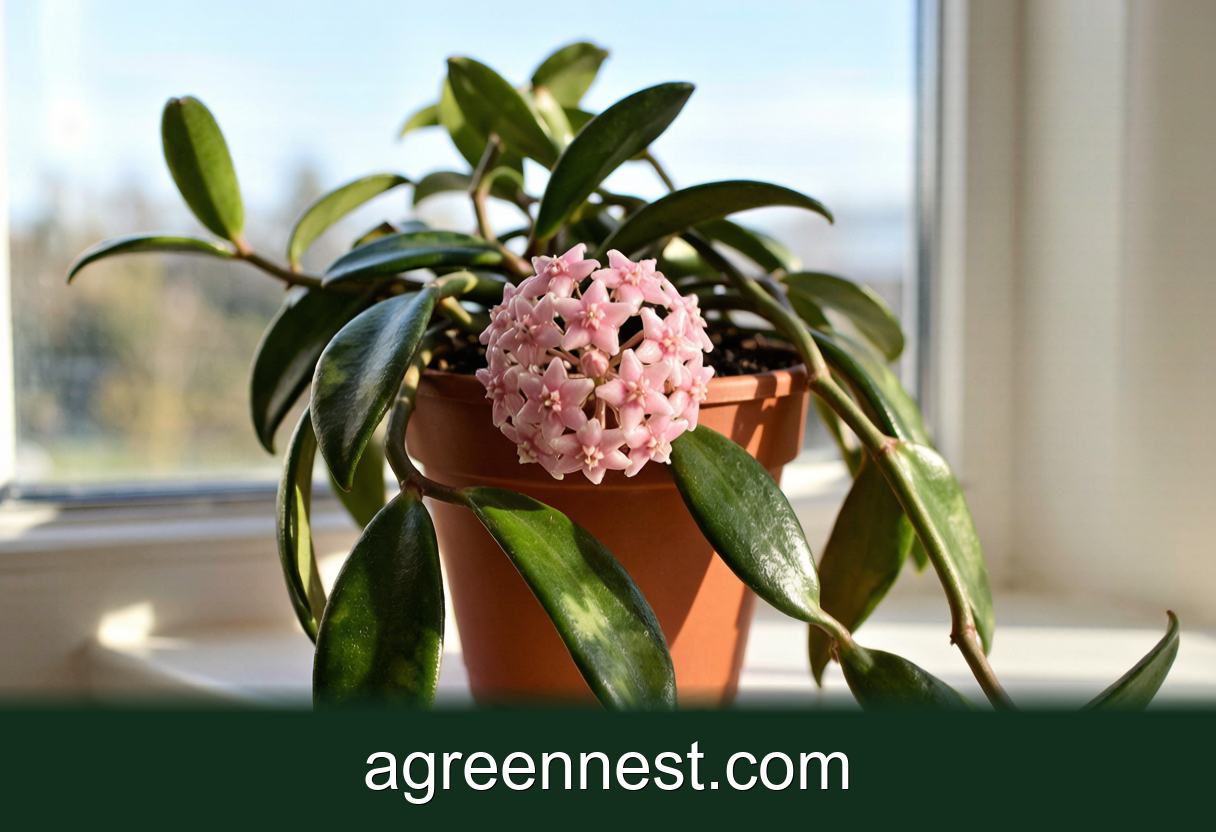
A hoya that refuses to bloom is almost always short on light. Move it to within 50cm of an east or west window, keep it slightly root-bound, never cut the leafless spurs, and let the soil dry halfway between waterings. Mature Hoya carnosa vines usually reward you within one growing season.
For six years my Hoya carnosa was the most boring plant I owned. Long vines, glossy leaves, perfect health, and not one flower. Meanwhile my neighbour two floors up had the same species dripping with pink umbels that scented her whole kitchen every June. Same building, same species, same watering can, wildly different results.
The difference, it turned out, was about four metres. Hers lived pressed against a west window. Mine sat looking pretty across the room on a bookshelf. Hoyas will survive in that spot for decades. They just will not flower there, and nobody tells you that when you buy one.
Here is everything I changed the year mine finally bloomed, in order of how much each fix mattered.
Why Won't My Hoya Flower Even Though It's Growing?
Because growing and blooming have different light budgets. A hoya photosynthesises enough to push out vines and leaves at around 800 to 1,500 lux, which is ordinary bright-room light. Setting flower buds is far more expensive, and most growers put the practical threshold somewhere above 3,000 lux for several hours a day, with morning or late-afternoon sun on the leaves.
That gap explains the classic complaint: "it grows like mad but never flowers." Mine put out over a metre of vine a year on the bookshelf. Vigorous growth in dim light is often slightly stretched growth, and if your vines have long bare gaps between leaf pairs, you are seeing the same etiolation pattern that hits sun-starved succulents.
Measure before you guess. Phone light-meter apps are rough but good enough to rank spots, and our lux self-test walks you through it in ten minutes. My bookshelf read 900 lux at noon. The windowsill I moved her to read 6,500. She set her first buds fourteen months later.
Is Your Hoya Old Enough and Root-Bound Enough?
Two quieter reasons hide behind the light problem.
Age first. Most Hoya carnosa need to reach maturity before flowering, commonly two to three years from a cutting, sometimes longer. A vine bought as a young plant may not be ready yet, no matter how perfect the care. Hoya bella tends to flower younger; the big-leaf Hoya kerrii makes you wait longest of the common three.
Then the pot. Hoyas flower best slightly root-bound, and this is one of those old grower rules that keeps proving true. A snug root ball seems to tip the plant from vegetative growth toward reproduction, and a too-large pot of damp soil pushes it the other way while flirting with rot. Mine has been in the same 15cm pot for four years now and gets fresh soil worked into the top few centimetres each spring instead of a size up. Repot only when roots circle the drainage holes, and then go up just 2 to 3cm.
Stop Cutting the Spurs (This One Hurts)
Here is the mistake I made for two full years after fixing the light, and I want to spare you the same grief. Hoyas flower from spurs, called peduncles: short, knobbly, leafless stubs that poke off the vine at odd angles. They look dead. They look exactly like something a tidy-minded person would trim off.
Do not trim them. Hoyas rebloom from the same spurs year after year, and each season the spur gets a little longer and can carry a larger umbel. Snip one and you delete not just this year's flowers but the whole compounding future of that spot. When I finally learned this, I counted the scars on my oldest vine and mourned. Prune hoyas only for length, cutting just after a leaf node, and treat every leafless nub as treasure.
The same logic applies after flowering: let the spent umbel drop on its own and leave the spur alone. If mealybugs move into those knobbly joints, and they love hiding there, treat the pest without removing the spur; my hoya mealybug rescue covers that without sacrificing bloom sites.
Water and Feed Like It's a Semi-Succulent
Hoyas store water in those thick, waxy leaves, and they set buds most reliably when life is slightly hard. I water mine when the top half of the pot is dry, roughly every 9 to 12 days in summer and every 3 weeks in winter, in a chunky mix of two parts orchid bark to one part perlite to one part regular potting soil. Constantly moist soil is the second-fastest way to guarantee no flowers, right after deep shade, because the roots suffocate and the plant spends its energy on survival instead.
Some growers push this further with a deliberate spring dry-down, withholding water for four to five weeks as days lengthen. I have done it twice with good results, though I would only try it on an established plant with plump leaves. If the leaves wrinkle like a deflating balloon, you have gone too far; give it a normal drink and it recovers in days, the same trick that works on a shrivelled string of pearls.
Feeding matters less than folklore claims, but a bloom-leaning fertiliser helps at the margin. From March to August mine gets a phosphorus-tilted liquid feed at half strength once a month, and nothing at all from October to February. More is not better; overfed hoyas grow lush and lazy. The basics in our houseplant feeding guide transfer directly.
What Finally Worked for Mine: The Full Sequence
For the record, here is the timeline that took my carnosa from six barren years to a plant that now blooms every summer. Year one: moved to 50cm from a west window, about 6,500 lux at midday, and stopped repotting. Year two, spring: switched to the chunky bark mix, started half-strength monthly feeding, and stopped touching the spurs. Year two, June: first three spurs appeared. Year two, August: first umbel opened, 22 star-shaped flowers, and the warm honey scent after dusk was worth every barren year.
One warning for the impatient: once buds form, do not move the pot. Hoyas drop developing buds when their orientation to the light changes. Turn the pot for even growth in winter if you like, but from bud set to bloom, hands off.
Frequently Asked Questions
Q: My hoya has spurs but the buds dry up and fall before opening. What's wrong?
A: Bud blast, and the usual triggers are the pot being moved after bud set, soil swinging from bone dry to soaked, or air below about 40 percent humidity. Park the plant, even out your watering, and the next flush usually holds.
Q: Can a hoya bloom under a grow light with no window at all?
A: Yes, given enough output and time. Aim for 10 to 12 hours daily under a full-spectrum LED positioned 30 to 45cm above the foliage. Our grow light distance guide has the spacing math.
Q: Does the variegated 'Krinkle Kurl' or 'Tricolor' bloom as readily as the plain green carnosa?
A: They can, but variegated types run about a season behind on the same light because white leaf sections do not photosynthesise. Give them the brightest spot you have and extra patience.
Q: My hoya bloomed once three years ago and never again. Why?
A: Something changed after that bloom: commonly a move away from the window, a generous repot into a big pot, or pruned spurs. Rewind whichever of the three happened and the flowers usually come back within a year or two.
A non-blooming hoya is not broken; it is budgeting. Give it real light, a snug pot, a slightly tough watering rhythm, and its spurs, and the plant almost always says yes eventually. Mine took eight years from purchase to first flower, and I would not trade the wait. Find out what your windowsill actually delivers with our window light estimator before you blame the plant.
Sources & further reading
GreenNest authors research and write every guide independently. The external links below are reputable references we recommend for deeper reading — they are not the sources we copied from.
- Royal Horticultural Society — Houseplant care — RHS
- Missouri Botanical Garden — Missouri Botanical Garden
- NC State Extension — Plant Toolbox — NC State Extension
Recommended Tools for Low-Light Indoor Plants Care
Free, no-signup helpers matched to this guide.
Free Ebooks to Explore
Downloadable handbooks — no email required.
Share Your Plant Story
Grown something tricky, or found a trick that finally worked? Tell us in the comments, or see what other readers are sharing on our Community page. The best reader tips get folded back into our guides.
Join the Conversation
Have a tip or a question about Why Won't My Hoya Bloom? 5 Fixes That Got Mine Flowering? Share it below — comments are saved on our server.