 AGreenNest
Plant Styling & Display
Statement Floor Plants: Style One Big Plant Right
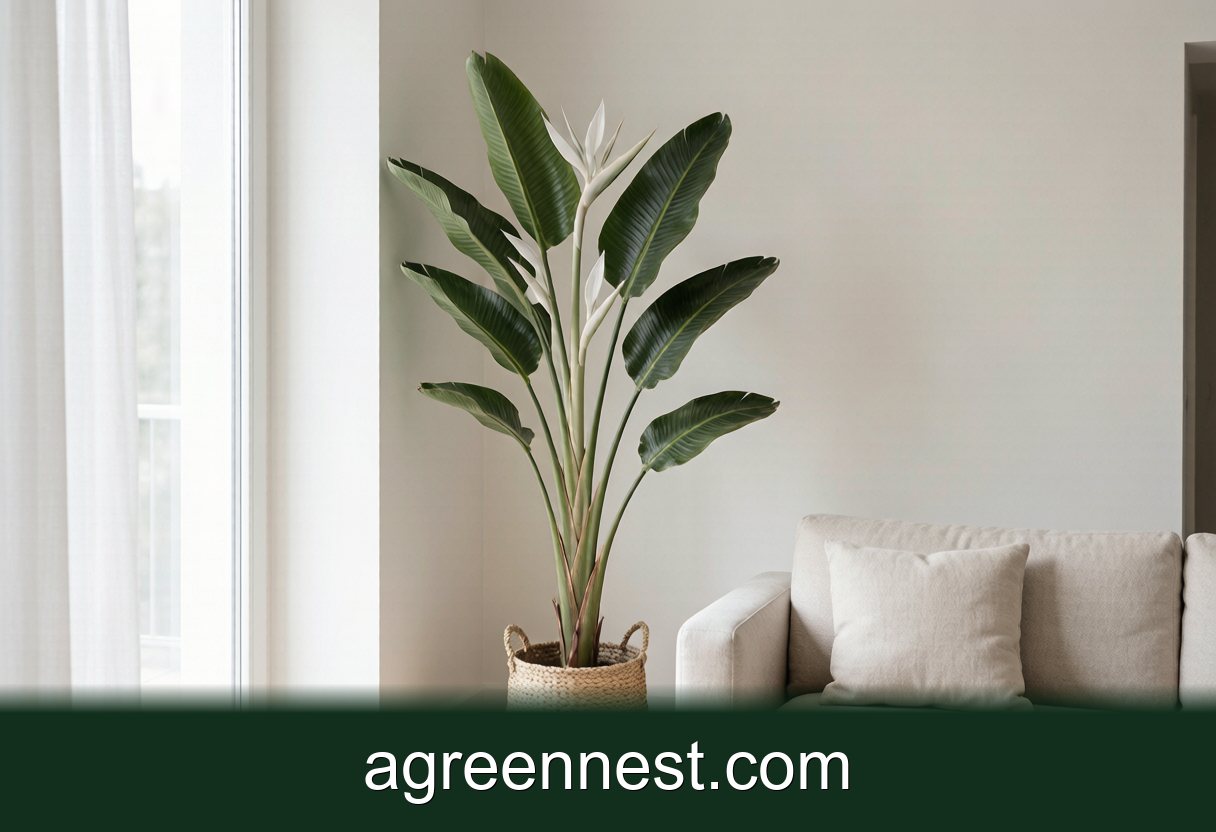
One statement floor plant, 1.5 to 2.5 m tall, does more for a room than five small pots. Pick a species that stops 60 cm short of your ceiling, keep it within 2 m of a window, and use a cachepot about two-thirds the height of the visible trunk. Anchor, then decorate around it.
The most flattering thing anyone ever said about my living room had nothing to do with the sofa. A friend looked at the 2 m Strelitzia nicolai in the corner and asked if I had hired a decorator. I had not. I had spent 60 euros on one plant and moved it three times until the room clicked.
That is the whole case for a statement floor plant. Small pots decorate a shelf; one big plant changes the architecture of a room. And because there is only one of it, the styling decisions get harder, not less important. Here is how I make them.
One Big Plant Beats Five Small Ones
A cluster of 12 cm pots reads as clutter from across a room. A single 1.8 m plant reads as a design decision. The eye wants one vertical anchor per room, something that connects floor to ceiling the way a bookcase or a floor lamp does.
There is a practical argument too. Five small plants mean five watering schedules and five chances to dry out over a long weekend. One large plant in a 30 cm pot holds moisture for 10 to 14 days in summer; my big rubber plant gets checked once a week, while my old shelf of miniatures wanted attention every other day.
Keep your existing small pots, but group them on one tray or stand, then give the opposite side of the room to a single tall anchor. The contrast makes both displays look deliberate, a trick I lean on in living room plant styling as well.
Which Species Can Actually Fill a Corner?
Not every tall plant makes a good statement plant. You want presence at eye level, between roughly 1.2 and 1.8 m, where a trailing pothos offers nothing and a young palm is all ankle.
My shortlist after years of trial and error:
- Ficus lyrata (fiddle leaf fig): the classic, with 30 cm violin leaves. Dramatic, but it sulks when moved and needs a bright window; see fiddle leaf fig care.
- Strelitzia nicolai (white bird of paradise): fast, upright, banana-like paddles. Reaches 2 m indoors in 3 to 4 years and tolerates a bit of direct sun.
- Ficus elastica (rubber plant): burgundy gloss, forgiving of average light. A 1.5 m specimen costs half what a fiddle leaf of the same size does; see rubber plant care.
- Monstera deliciosa: wide rather than tall, 1.5 m in both directions. Best where it can sprawl, worst in a narrow corridor.
- Dracaena fragrans: the low-light workhorse. Slow, sculptural canes, happy 3 m from a window where a ficus would thin out. Details in Dracaena fragrans care.
- Howea forsteriana (kentia palm): soft, arching fronds for rooms where the angular ficus silhouette feels too stiff. Pricey, but tolerant of north-facing light.
Notice what is not on the list: anything sold at 40 cm with a promise of future height. Buy the biggest healthy specimen your budget allows, because the price difference buys you 2 to 3 years of growing time.
How Tall Is Too Tall for Your Ceiling?
There is an easy formula. Measure your ceiling, subtract 60 cm, and treat that as the plant's maximum height, pot included. In a standard 2.4 m room, that means nothing taller than about 1.8 m. A plant grazing the ceiling looks cramped, and the growing tip bends and distorts once it touches.
Scale works in the other direction too. A 90 cm plant on the floor of that same room disappears below the visual midline and reads as a plant that lost its table. Between 60 cm and 1.2 m, use a stand or a stool. Floor placement starts at 1.2 m of total height; the sweet spot is 1.5 to 2 m.
Width gets ignored and should not be. A Monstera claims a 1.5 m circle of floor, and a plant you brush against every morning will show torn leaves by spring.
Pots, Baskets, and the Two-Thirds Rule
The pot is half the statement. My proportion rule: the visible container should stand about two-thirds the height of the bare trunk section, the stretch from soil to the first big leaf. Tall bare trunk, tall pot; leaves at knee height, low wide pot. Get this wrong and a lovely plant looks like a broom in a bucket.
Material sets the mood. A woven seagrass basket softens a minimal room; a ribbed terracotta cylinder warms up grey interiors; matte black ceramic turns a rubber plant into sculpture. Whatever the shell, I keep the plant in its plastic nursery pot inside a cachepot 2 to 3 cm wider, sitting on an upturned saucer so the base never stews in runoff. A breathable clay pot inside the basket also buffers overwatering mistakes.
One more floor-saver: a hidden wheeled caddy under the whole arrangement. You will rotate the plant a quarter turn monthly so it grows straight, and wheels turn that chore from a deadlift into a nudge.
Placement: Light First, Looks Second
Every failed statement plant I have autopsied died of the same thing: a gorgeous spot with terrible light. The dark corner beside the fireplace begs for a tall plant, and it starves most of them within a year.
So work in this order. First, map the light: a ficus or strelitzia wants to stand within 1 to 2 m of a decent window; a kentia or dracaena can manage 2.5 to 3 m back. If your dream corner fails that test, pick the shade-tolerant species above or budget for a ceiling-mounted grow spot running 10 to 12 hours a day. Second, check the microclimate: no heat vents on the foliage, no draughty doors, no radiator within 1 m. Third, and only third, judge the aesthetics.
Corners are the natural home because a wall on two sides frames the silhouette, and I break down the geometry in corner plant styling. Beside a sofa arm or flanking a media unit works; centred on a wall usually does not, because the plant competes with whatever hangs above it. Give the anchor negative space, then let smaller pots and hanging trailers echo it at other heights.
Frequently Asked Questions
Q: My ceiling is 2.4 m. Is a fiddle leaf fig a bad idea?
A: No, but buy one at 1.2 to 1.5 m and prune the leader once it reaches about 1.8 m. Pinching the top bud in spring redirects energy into side branches, which makes a fuller, wider tree that stays under your 60 cm ceiling gap instead of a pole that hits plaster.
Q: Do I need a grow light for a floor plant 3 m from the window?
A: For Dracaena fragrans or a kentia palm, usually not. For ficus, strelitzia, or monstera, yes: expect leaf drop and 20 cm gaps between leaves without help. A ceiling spotlight with a full-spectrum bulb running 10 hours daily fixes it.
Q: How do I stop a tall plant leaning toward the window?
A: Rotate the pot a quarter turn every 2 to 4 weeks, always the same direction. Lean that has already set into the trunk can be corrected with a stake and soft ties over one growing season, then the stake comes out.
Q: What goes under the pot to protect a wooden floor?
A: A cork or felt-backed plant caddy, ideally wheeled, plus a watertight saucer inside the cachepot. Terracotta saucers weep moisture, so never sit one directly on oak; I learned that via a 30 cm white ring that outlived two sandings.
A statement floor plant is the cheapest piece of large furniture you will ever buy, and the only one that grows. Choose the species for your light rather than your Pinterest board, size it to stop 60 cm short of the ceiling, and match the pot to its proportions. Before committing to a corner, run the numbers with our free light calculator; ten minutes of measuring beats a year of watching the wrong plant fade.
Sources & further reading
GreenNest authors research and write every guide independently. The external links below are reputable references we recommend for deeper reading — they are not the sources we copied from.
- Royal Horticultural Society — Houseplant care — RHS
- Missouri Botanical Garden — Missouri Botanical Garden
- NC State Extension Plant Toolbox — NC State Extension
Recommended Tools for Plant Styling & Display Care
Free, no-signup helpers matched to this guide.
Free Ebooks to Explore
Downloadable handbooks — no email required.
Free Ebook
The AGreenNest Succulent Care Handbook
The complete, beginner-to-confident guide to growing fat, happy succulents — 10 chapters and a 20-plant directory.
Free Ebook
Haworthia & Haworthiopsis Care Handbook
A focused guide to the striped, forgiving Haworthia clan.
Share Your Plant Story
Grown something tricky, or found a trick that finally worked? Tell us in the comments, or see what other readers are sharing on our Community page. The best reader tips get folded back into our guides.
Join the Conversation
Have a tip or a question about Statement Floor Plants: Style One Big Plant Right? Share it below — comments are saved on our server.