 AGreenNest
Plant Styling & Display
Styling Plants With Mirrors: Borrowed Light, Real Results
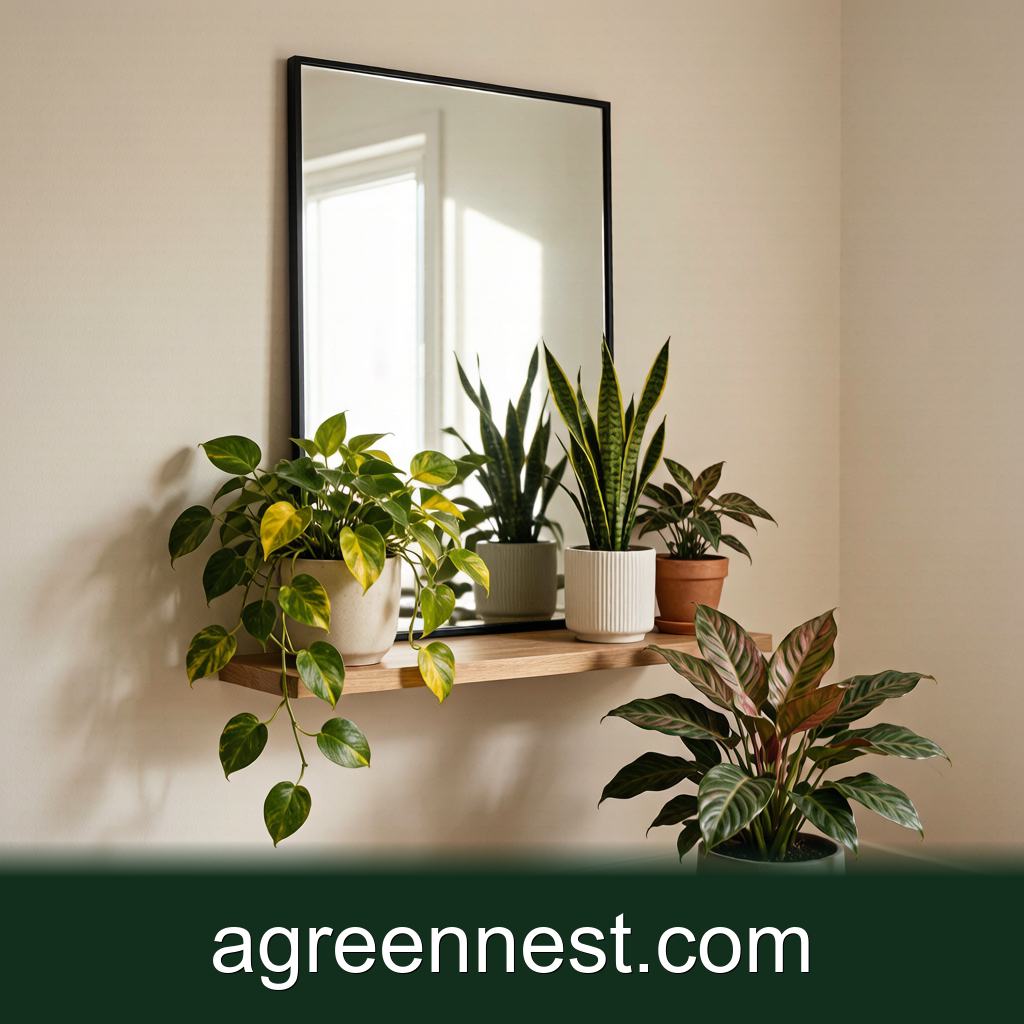
A mirror placed opposite or beside a window can raise light levels in a dark plant corner by 300 to 800 lux, enough to move a spot from 'ferns sulk here' to 'pothos grows here'. Angle the mirror toward the window, put the plant in the reflected beam, and style the pair as one deliberate vignette.
My hallway in Portland has exactly one window, and it faces the neighbour's cedar fence. For two years I treated the corner beside the coat rack as a plant graveyard. A Dracaena went pale and leggy there. A fern crisped. I nearly gave up and put a shoe cabinet in the spot.
Then I hung a 60 x 80 cm mirror on the wall beside the corner, mostly to check my coat on the way out. Within a month the Epipremnum aureum I had parked there as a last resort pushed out four new leaves, the first growth anything had managed in that spot. I did not believe the mirror had done it, so I got the lux meter out. The corner read 420 lux before I re-angled the mirror, and 1,150 lux in the reflected patch after. That is not a rounding error. That is the difference between decline and growth.
Mirrors are usually sold as a styling trick that "makes rooms feel bigger". True, and beside the point. For plant people, a mirror is borrowed light, and you can style with it deliberately.
How Much Light Does a Mirror Actually Add?
A household mirror reflects roughly 85 to 90 percent of the light that hits it, but only along one path: the angle in equals the angle out. So the gain depends entirely on geometry, not on the mirror's size alone.
Numbers from my own rooms, measured at plant height with a $12 lux meter:
| Position | Before | After | Change |
|---|---|---|---|
| Hallway corner, mirror beside window wall | 420 lux | 1,150 lux | +730 |
| Living room, mirror opposite south window, 3 m away | 900 lux | 1,600 lux | +700 |
| Bedroom, mirror on same wall as window | 350 lux | 410 lux | +60 |
Notice the third row. A mirror on the same wall as the window does almost nothing for the plants, because the reflected beam shoots back out of the glass. The mirror needs to face the window, fully or at an angle, and the plant needs to sit inside the reflected patch. Track where that patch lands at midday; it is usually obvious on the floor or wall.
If you have never measured your rooms, start there before buying anything. The room-darkness lux test walks through taking readings you can compare, and it will probably surprise you. Mine did: my "bright" kitchen corner read darker than my "dark" hallway once the mirror went up.
Which Plants Respond Best to Borrowed Light?
Reflected light is soft, diffuse, and roughly one half to one third the strength of the direct window. That suits exactly the plants sold as low-light tolerant, the ones that survive at 400 lux but only actually grow above about 800.
My reliable performers in mirror-boosted corners: Epipremnum aureum (new leaf every 2 to 3 weeks at 1,100 lux), Aglaonema commutatum 'Silver Bay', Zamioculcas zamiifolia, and Sansevieria trifasciata, which stopped throwing thin, floppy leaves once its corner crossed 900 lux. For a fuller bench of candidates, the north-window plant list overlaps almost perfectly with what thrives in reflected light.
What does not work: flowering plants, most succulents, and anything variegated that needs strong light to hold its pattern. A mirror can lift a corner from 400 to 1,200 lux, but it cannot conjure the 5,000-plus that a hoya needs to bloom. For those spots, honest answer, you want a small grow light instead.
Why Does a Mirror Behind Plants Look So Good?
The light is the science. The styling is the pleasure, and mirrors do three visual jobs at once.
They double your foliage. A Monstera leaf seen with its own reflection reads as twice the greenery from across the room. One statement plant plus one mirror can carry a corner that would otherwise need three or four pots. This is the cheapest way to fake abundance while your collection is young, and it pairs beautifully with the one-big-plant approach in statement floor plant styling.
They show you the back of the plant. Plants grown against a wall go flat and one-sided; you rotate them, but you still only ever see half. With a mirror behind, the hidden side becomes part of the display, so the plant reads full and three-dimensional.
They add depth to tight corners. A dark corner with a mirror stops being a dead end. Layer the arrangement the usual way, tall stem at the back, mid-height mound, trailing plant at the front edge, and the reflection repeats the whole composition. The height layering rules matter twice as much here because mistakes reflect too.
How Do You Style the Mirror-Plant Pairing So It Looks Intentional?
A mirror plonked behind a pot can look like a furniture-showroom accident. Small rules that fix it:
- Overlap, do not centre. Let foliage cross the mirror's edge by 10 to 20 cm on one side. Perfectly centred plant-in-mirror reads stiff; overlap reads grown-in.
- Match the frame to the pot, not to each other. Thin black frame with matte white pots, aged brass with terracotta. One echo is enough. Three matching golds turn the corner into a catalogue page.
- Floor mirrors earn their space. A leaning floor mirror behind a plant cluster bounces light at exactly plant height and gives tall species like Ficus lyrata a backdrop. Anchor it to the wall if pets or toddlers share the house.
- Mind what else reflects. Angle the glass so the reflection holds the window and the plants, not the radiator or the laundry basket. I learned this one the embarrassing way during a video call.
- Keep the glass clean. Dust and misted-on water spots cut the reflected light. I wipe mine monthly when I dust leaves.
Group sizes still follow the ordinary rules, odd numbers, varied heights, one texture contrast, so the grouping guide applies unchanged. The mirror just gives the group a second row for free.
Frequently Asked Questions
Q: Can a mirror scorch leaves the way a magnifying glass can?
A: A flat mirror cannot focus light to a burning point; it only redirects it at the same intensity, minus reflection losses. The one exception is a concave (magnifying) mirror in direct sun, which can concentrate a hot spot. Keep those away from windows entirely, plants or not.
Q: My corner reads 420 lux. Will a mirror get pothos growing there?
A: Very likely, if the mirror can see the window. My hallway went from 420 to 1,150 lux with a 60 x 80 cm mirror angled toward a north-facing window, and pothos resumed growth within a month. If the mirror cannot face the window from that corner, the gain will be small and a grow light is the better spend.
Q: Do plants lean toward the mirror or toward the window?
A: Toward whichever source is brighter at their position. In a mirror-boosted corner that is often the reflected patch, so expect some lean toward the glass. Quarter-turn the pot every week or two, same as you would on a windowsill.
Q: Is a big mirror better than two small ones?
A: For light, total reflecting area facing the window is what counts. For styling, one large mirror almost always looks calmer than a cluster of small ones behind foliage.
Q: Will the extra humidity from grouped plants damage the mirror?
A: The glass is fine. Cheap MDF-backed frames can swell under heavy misting, so leave a few centimetres between a misted plant and the frame, or pick metal or solid wood.
I spent two years assuming that corner was hopeless when a $40 mirror and a re-angle were the whole fix. Measure the spot, hang the mirror where it can see the window, put the plant in the bright patch it throws, and let the reflection do the doubling. If you want to know exactly what your corner gained, check it with our free light calculator before and after. The number will tell you whether to celebrate or to shop for a grow light.
Sources & further reading
GreenNest authors research and write every guide independently. The external links below are reputable references we recommend for deeper reading — they are not the sources we copied from.
- Royal Horticultural Society — Houseplant care — RHS
- Missouri Botanical Garden — Missouri Botanical Garden
- NC State Extension Plant Toolbox — NC State Extension
Recommended Tools for Plant Styling & Display Care
Free, no-signup helpers matched to this guide.
Free Ebooks to Explore
Downloadable handbooks — no email required.
Free Ebook
The AGreenNest Succulent Care Handbook
The complete, beginner-to-confident guide to growing fat, happy succulents — 10 chapters and a 20-plant directory.
Free Ebook
Haworthia & Haworthiopsis Care Handbook
A focused guide to the striped, forgiving Haworthia clan.
Share Your Plant Story
Grown something tricky, or found a trick that finally worked? Tell us in the comments, or see what other readers are sharing on our Community page. The best reader tips get folded back into our guides.
Join the Conversation
Have a tip or a question about Styling Plants With Mirrors: Borrowed Light, Real Results? Share it below — comments are saved on our server.