 AGreenNest
Plant Styling & Display
Styling Plants in a Narrow Hallway That Works
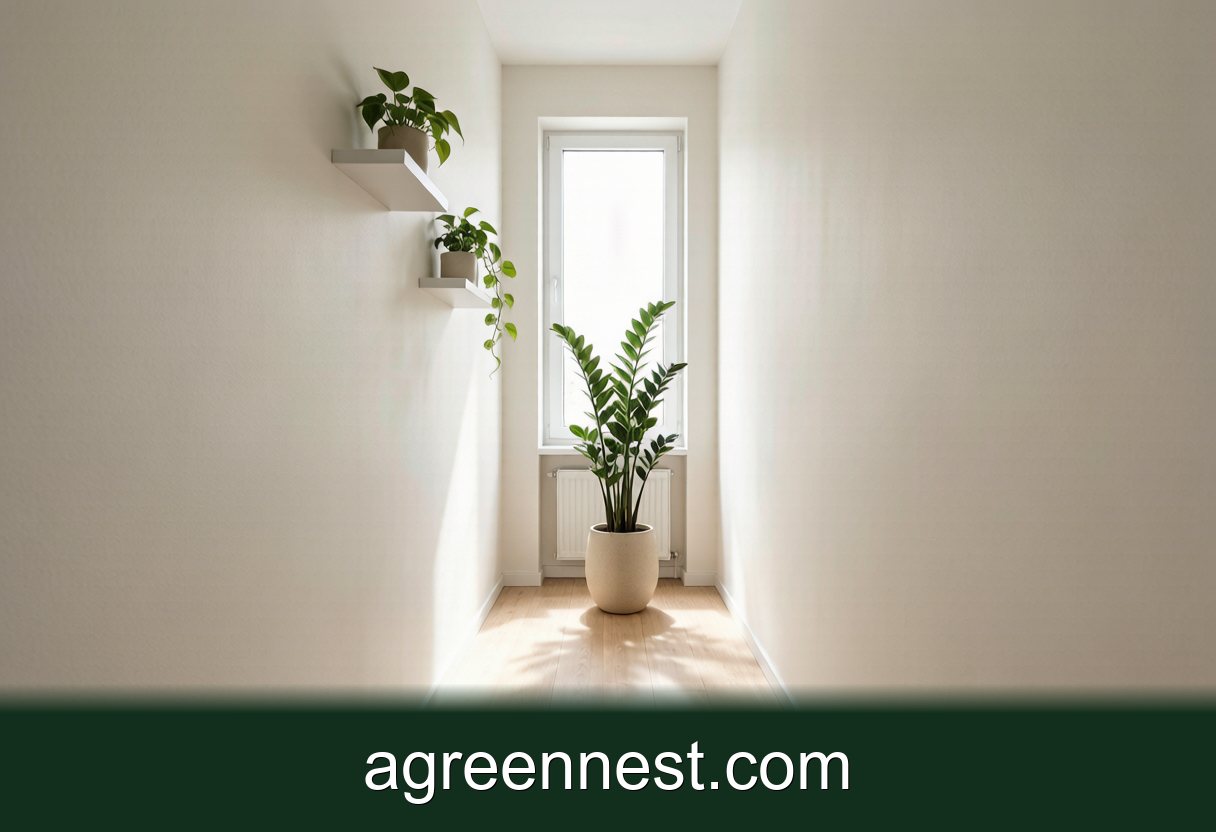
A narrow hallway needs 70 cm of clear walking width, so plants belong on the walls and above shoulder height rather than on the floor. Pick tough, tapered species such as *Zamioculcas zamiifolia* and *Aspidistra elatior*, and expect 80 to 250 lux at the darkest point.
My hallway is 96 cm wide and 5 m long, with a single window at the far end. For two years I treated it as wasted space.
Then I put a fern on a plant stand halfway down. Within a month it had lost a third of its fronds to hips, shopping bags, and a bicycle. The hallway was not hostile to plants. It was hostile to plants placed where people walk.
Why Do Hallway Plants Always Look Battered?
Because a corridor is a traffic route first and a room second, and traffic wins.
Measure your hallway before you buy anything. Building guidance puts the comfortable clear width for a single-person route at 70 to 90 cm, and anything you place has to leave that untouched. In my 96 cm hallway that leaves a 26 cm strip of usable depth, which rules out every floor pot I owned. A 25 cm nursery pot with an Aspidistra fanning out to 60 cm is not a display in that space, it is an obstacle with leaves.
There is a second, quieter problem. Doors. Hallways are lined with them, and each one sweeps an arc plus a person carrying laundry. Map the arcs, then place plants in what is left, which is usually the wall between two door frames and the space above 150 cm.
How Dark Is a Hallway, Really?
Darker than it feels, and much darker at the middle than at either end.
Take three readings with a phone lux app at 1 m height: at the window end, halfway along, and at the far end. My own numbers on a bright but overcast July afternoon were 1100 lux, 210 lux, and 85 lux. The eye adapts as you walk, so the middle feels perfectly bright. A plant experiences an 80 percent drop.
Anything under about 150 lux for most of the day is survival territory rather than growth territory. Plants there hold their shape for months but will not push new leaves, and they need proportionally less water because they are barely photosynthesising. The full method for taking these readings is in the lux test for dark homes.
Two easy gains. A mirror on the wall opposite the window end can lift mid-hallway readings by 40 to 70 lux, and the styling case for it is made in styling plants with mirrors. A slim LED picture light over a wall shelf, 8 W, on a 10 hour timer, turns a dead 90 lux spot into a viable 400 lux one.
Style the Walls, Not the Floor
Three arrangements have survived in my hallway, and all of them keep the walking strip clear.
The high shelf run. Two 60 cm floating shelves at 165 cm, spaced 80 cm apart on the same wall, each holding two 12 cm pots. Above head height means nothing gets knocked, and looking up at foliage makes a corridor feel taller. Trailers work best here: Epipremnum aureum and Ceropegia woodii both hang cleanly without reaching the walking zone if you trim at 60 cm.
The picture-ledge line. A single 90 cm ledge at 150 cm with small pots, a framed print, and a couple of objects. It reads as a gallery wall that happens to include plants, which suits hallways that already carry coats and keys. The proportions are the same ones in picture ledge plant styling.
The end-of-hall anchor. One good plant at the far end, where the corridor terminates and no one walks past it. This is the only floor position I use. A 1.4 m Dracaena fragrans or Zamioculcas zamiifolia in a 28 cm pot closes the view and gives the eye a destination. Nothing else on the floor for the whole 5 m.
Keep the pots to one finish along the run. The whole hallway is seen in one glance, so the case in matching pots vs mixed pots is at its strongest here.
Species That Take a Corridor's Abuse
The shortlist is short for a reason. A hallway plant has to tolerate low light, temperature swings from the front door, and the occasional shoulder.
- Zamioculcas zamiifolia. Upright, waxy, 45 to 90 cm, holds at 100 lux and forgives three weeks without water. My end-of-hall anchor for four years. Care detail in the ZZ plant notes.
- Aspidistra elatior. Genuinely thrives in the 80 to 200 lux band and shrugs off cold draughts near a front door, which few plants do.
- Epipremnum aureum, plain green. For the high shelves. Variegated forms fade to plain in a hallway anyway, so buy plain and save the money.
- Sansevieria trifasciata. Narrow footprint, vertical line, ideal for a 20 cm deep console if you have one. Skip Calathea, Fittonia, and most ferns. They want humidity and stillness, and a hallway offers neither. Silver-marked foliage does catch what little light there is, and the candidates are gathered in silver leaf plants for low light.
Watering and Turning Without Blocking the Hall
High shelves make watering awkward, so build the routine around that rather than fighting it.
Every pot on my shelves is a 12 cm nursery pot inside a cachepot. On Sundays they come down, go into the sink for a 15 minute soak, drain for 10, and go back with a quarter turn. Eight pots take 20 minutes, and nothing gets watered in place, so no drips run down the wall.
The floor anchor gets checked with a probe rather than a schedule. At 150 lux a 28 cm pot of Zamioculcas went 24 days between waterings last winter and 16 in summer, and guessing that from the surface would have drowned it twice. The two-spot probe method is in using a moisture meter properly.
Turning matters more here than anywhere else. One-directional light down a corridor pulls every plant toward the window end. A quarter turn weekly keeps them symmetrical; leave it for two months and you get a row of plants all leaning the same way, which looks less like styling and more like a strong wind.
Frequently Asked Questions
Q: My hallway is 85 cm wide. Can I fit any floor plant at all?
A: One, at the dead end where nobody walks past it, in a pot no wider than 25 cm. Everywhere else, 85 cm minus a 70 cm walking strip leaves 15 cm of depth, which suits a wall shelf rather than a pot.
Q: Will plants survive a hallway with no window and only a ceiling light?
A: Not on the ceiling light alone. A 60 W equivalent bulb burning 4 hours in the evening gives a plant almost nothing. Add an 8 W LED bar or picture light on a 10 hour daytime timer, or rotate two Zamioculcas between the hallway and a bright room every six weeks.
Q: How do I stop my hallway plants from getting knocked by coats and bags?
A: Move them above 150 cm or below the coat hooks, never between. The 100 to 140 cm band is where shoulders, bags, and hip-height door handles all travel, and it is precisely the height most plant stands occupy.
Q: My front door opens into the hallway and it gets cold. What temperature can these plants take?
A: Aspidistra elatior and Zamioculcas zamiifolia both hold down to about 10 °C without damage, which covers a British or northern European entry hall in winter. Keep pots 40 cm clear of the door swing so cold air is not blasting directly across the foliage on every arrival.
A hallway rewards restraint. Clear 70 cm for walking, put the greenery on the walls above shoulder height, choose three or four tough species instead of eight interesting ones, and anchor the far end with a single good plant. Take your lux readings first and run them through our free light calculator so the corridor gets species that can actually hold their looks in the dim middle stretch.
Sources & further reading
GreenNest authors research and write every guide independently. The external links below are reputable references we recommend for deeper reading — they are not the sources we copied from.
- Royal Horticultural Society — Houseplant care — RHS
- Missouri Botanical Garden — Missouri Botanical Garden
- NC State Extension Plant Toolbox — NC State Extension
Recommended Tools for Plant Styling & Display Care
Free, no-signup helpers matched to this guide.
🪴 Free Tool
Bottom Watering Guide
Get the exact water depth and soak time to bottom-water any pot without risking root rot.
Free Ebooks to Explore
Downloadable handbooks — no email required.
Free Ebook
The AGreenNest Succulent Care Handbook
The complete, beginner-to-confident guide to growing fat, happy succulents — 10 chapters and a 20-plant directory.
Free Ebook
Haworthia & Haworthiopsis Care Handbook
A focused guide to the striped, forgiving Haworthia clan.
Share Your Plant Story
Grown something tricky, or found a trick that finally worked? Tell us in the comments, or see what other readers are sharing on our Community page. The best reader tips get folded back into our guides.
Join the Conversation
Have a tip or a question about Styling Plants in a Narrow Hallway That Works? Share it below — comments are saved on our server.