 AGreenNest
Succulent Care
Haworthia vs Aloe: How to Tell Them Apart
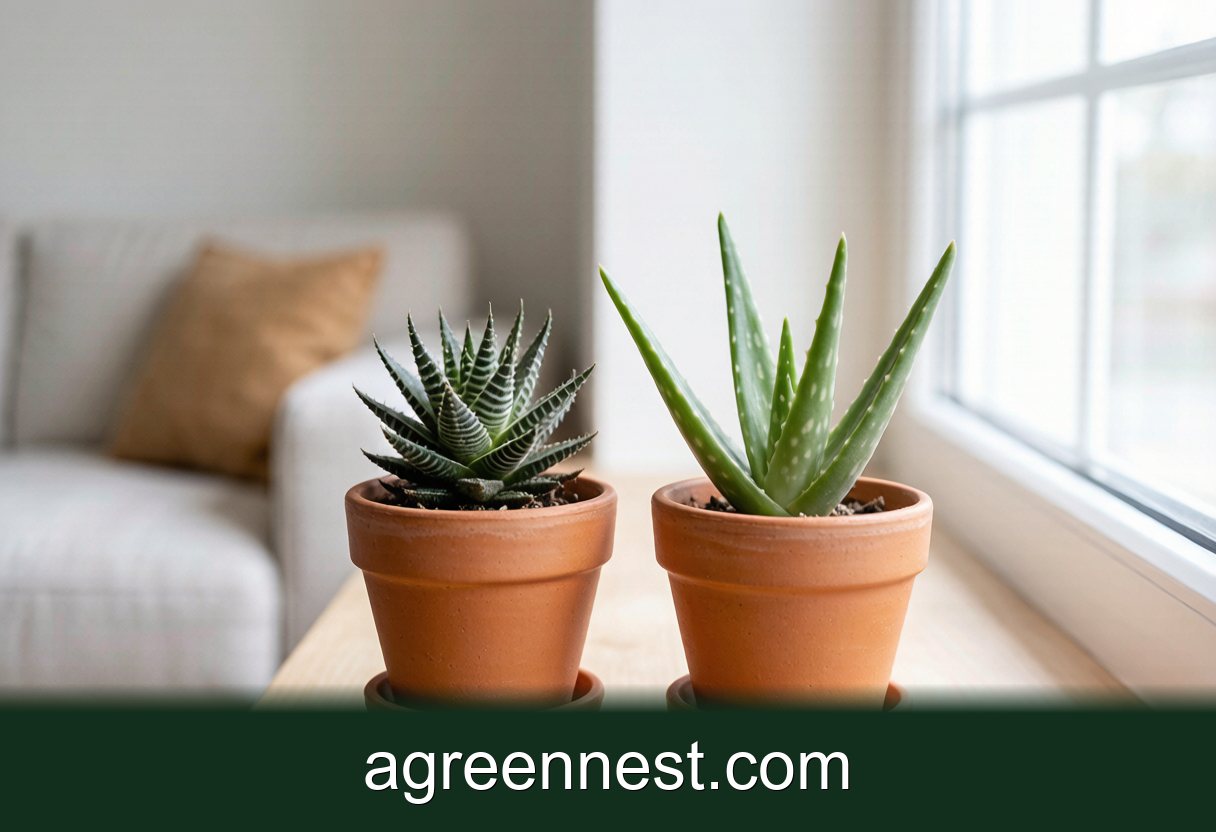
Haworthias have raised white bumps in bands on the leaf backs, stay under 15 cm, and send up thin wiry flower stalks with tiny white blooms. Aloes have flat pale spots or soft teeth, grow much larger, and flower orange or yellow on thick stalks. The care difference: aloes want direct sun, haworthias burn in it.
The little rosette I brought home years ago was labelled "Aloe mix, £3.50". It had crisp white stripes across dark green leaves and I gave it what an aloe wants: my brightest south-facing sill, hours of direct sun. Within three weeks the leaves had flushed a bruised purple-brown and the tips crisped. That plant was never an aloe. It was Haworthiopsis fasciata, the zebra plant, and it was quietly cooking on my windowsill.
Mislabels like that are everywhere, because a young aloe and a haworthia are genuinely hard to tell apart at 6 cm across. Both make stiff, pointed rosettes. Both wear white markings. Both sit in the same nursery tray. But they want different windows, so it pays to know which one you actually own.
Why Does the Mix-Up Matter?
Because light is where their needs split hardest.
Most aloes, from big Aloe vera down to the little lace aloe (Aristaloe aristata), are sun plants. Indoors they want a south or west window with 4 to 6 hours of direct light. Give them less and they stretch, flatten, and lose colour; the pattern looks a lot like what I describe in the succulent stretching guide.
Haworthias grow tucked into shade under shrubs and rock overhangs in South Africa. Bright light, yes, but hot midday sun scorches them. An east window with gentle morning sun is their happy place, and a healthy Haworthiopsis attenuata will even carry on about a metre back from a bright window. That makes haworthias one of the few succulents I recommend for a desk that never sees direct sun.
Swap their positions and both sulk: the aloe etiolates in the haworthia's spot, the haworthia turns red-brown and crisps in the aloe's. If you are not sure what your window actually delivers, our window light estimator takes the guesswork out.
Which White Markings Am I Looking At?
Flip the plant around and look at the backs of the leaves. This is the fastest tell, and it works even on tiny plants.
Haworthia markings are raised. Run a fingertip across the leaf back of a zebra plant and you feel distinct bumps, called tubercles, usually fused into neat horizontal bands. They sit proud of the surface like braille. Species such as Haworthia cooperi skip the stripes and go translucent instead, with little "windows" at the leaf tips you can almost see through.
Aloe markings are flat. The pale spots on a young aloe are painted into the leaf surface, not stacked on top of it. Your finger glides straight over them. What aloes do have is teeth: soft, pale spines along the leaf margins that become more pronounced with age. Lace aloe blurs the line with small white bumps of its own, which is why it gets mislabelled most of all, but its leaves are thinner, more numerous, and tipped with a distinctive dry thread.
Two more quick checks. Size: a mature haworthia rosette stays around 10 to 15 cm across, while Aloe vera pushes past 60 cm with thick, upright leaves. Sap: a snapped aloe leaf oozes that familiar thick translucent gel; a haworthia leaf is moist inside but has nothing like the same gel reservoir.
The Flower Test Settles Every Argument
If your plant ever blooms, the debate is over.
Haworthias send up a single wiry stem, thin as a bamboo skewer and often 30 to 40 cm tall, dotted with small white tubular flowers striped in green or brown. It looks comically oversized for such a small plant. Mine flower most reliably in late spring after a cool, fairly dry winter.
Aloes flower on a sturdy stalk with a dense cone or spike of blooms in orange, coral, or yellow. Indoors this takes serious light and a mature plant, which is why many windowsill aloes never flower at all; the plant is healthy, it just is not getting greenhouse sun.
A bonus identity clue that needs no flowers: stressed aloes shift colour across the whole leaf, blushing orange-brown in strong sun. Haworthias under stress go a duller red-purple, usually starting at the leaf tips.
Where Their Care Overlaps
The good news: below the light question, these two are nearly the same plant to look after.
Both store water in their leaves and rot in soggy soil, so both get the same gritty mix; I use roughly two parts standard potting soil to one part perlite to one part coarse grit, and a purpose-made blend works too. Both prefer an unglazed pot barely wider than the rosette.
Watering is the classic soak-and-dry routine covered in our succulent watering guide: drench, drain, then wait until the soil is fully dry, which for me means every 10 to 14 days in summer and every 3 to 4 weeks in winter. The one seasonal wrinkle is that haworthias do much of their growing in the cooler months and like to rest through high summer, so do not panic if yours sits still in July. Both handle normal room temperatures happily and neither wants to sit below about 10 °C.
Offsets are their shared party trick. Both produce pups around the base, and both separate cleanly at repotting time with roots attached. My original mislabelled zebra plant has since supplied six relatives with plants of their own.
For a deeper dive on either genus, the haworthia care guide and the aloe vera indoor care guide pick up where this comparison leaves off.
Frequently Asked Questions
Q: My "aloe" turned purple-brown on a south windowsill. What happened?
A: Almost certainly the same thing that happened to mine: it is a haworthia getting sunburned. Move it to an east window or a spot with bright indirect light. The bruised colour fades over several weeks, though badly crisped tips are permanent until new growth replaces those leaves.
Q: Can I use the gel from a haworthia leaf the way people use aloe gel?
A: No. Haworthias produce nothing like the gel in Aloe vera, and the traditional uses do not transfer. If gel is the goal, buy a confirmed Aloe vera, ideally one sold with a species label rather than a "succulent mix" tag.
Q: Is a zebra plant with smooth white stripes still a haworthia?
A: Check by touch rather than sight. Haworthiopsis fasciata and the near-identical H. attenuata both have raised bands you can feel. If the stripes are truly flat and the leaves hold thick gel, you may be holding a young spotted aloe after all.
Q: Why has my haworthia stopped growing in midsummer while my aloe keeps going?
A: That is the difference in their growing calendars. Many haworthias slow right down in summer heat and pick up again in autumn, while aloes grow happily through warm months. Water the resting haworthia less, roughly monthly, and resume normal care when nights cool.
Q: My rosette is labelled "Haworthia" but has soft teeth along the leaf edges. Which is it?
A: Marginal teeth point towards aloe, especially paired with flat leaf spots. Genuine haworthia leaf edges are smooth or finely rough, never toothed like a saw. Nursery labels are wrong often enough that the plant itself is the better witness.
Once you have felt the raised bands on a haworthia's leaf back, you will never mistake the two again, and your plants will land in the windows they actually want. If you are deciding where a new rosette should live, our free light calculator will match the spot to the plant in about a minute.
Sources & further reading
GreenNest authors research and write every guide independently. The external links below are reputable references we recommend for deeper reading — they are not the sources we copied from.
- Royal Horticultural Society — Houseplant care — RHS
- Missouri Botanical Garden — Missouri Botanical Garden
- NC State Extension Plant Toolbox — NC State Extension
Recommended Tools for Succulent Care
Free, no-signup helpers matched to this guide.
Free Ebooks to Explore
Downloadable handbooks — no email required.
Free Ebook
Haworthia & Haworthiopsis Care Handbook
A focused guide to the striped, forgiving Haworthia clan.
Free Ebook
The AGreenNest Succulent Care Handbook
The complete, beginner-to-confident guide to growing fat, happy succulents — 10 chapters and a 20-plant directory.
Share Your Plant Story
Grown something tricky, or found a trick that finally worked? Tell us in the comments, or see what other readers are sharing on our Community page. The best reader tips get folded back into our guides.
Join the Conversation
Have a tip or a question about Haworthia vs Aloe: How to Tell Them Apart? Share it below — comments are saved on our server.