 AGreenNest
Succulent Care
Why Is My Succulent Turning Red? Stress Colour Explained
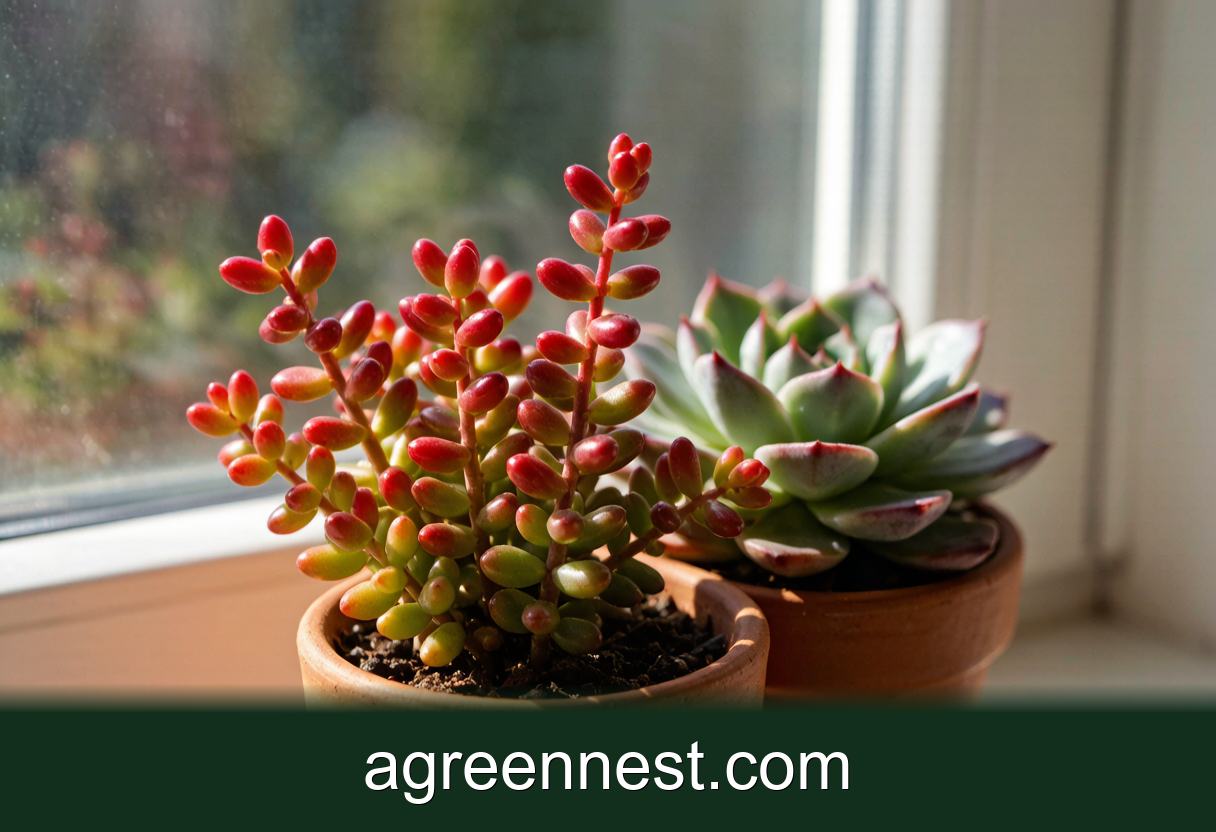
Most succulents turn red as a stress response: intense sun, cold nights, or drought trigger protective anthocyanin pigments. On species like *Sedum rubrotinctum* the blush is harmless and often prized. Watch for warning signs instead: bleached white patches, mushy leaves, or shrivelling mean sunburn, rot, or thirst rather than a healthy tan.
A customer once marched into the nursery where I worked holding a tray of jelly bean plants, convinced someone had sold her sick stock. The leaves had gone from spring green to a glowing cherry red over three weeks on her patio. She wanted a refund. I wanted her plants. That red was the best thing I had seen all week.
Red on a succulent sits in a strange place: it can be a badge of health, a sunscreen, or an alarm bell, and the plant uses the same colour for all three. Sorting out which one you are looking at takes about two minutes once you know the checks.
What Actually Makes a Succulent Turn Red?
The colour comes from anthocyanins, pigments the plant manufactures on demand when life gets intense. Chlorophyll is still there underneath, quietly photosynthesising; the red layer builds on top of it like a tint on a car window. Three triggers reliably switch the pigment factory on:
Strong light. Give a succulent 5 to 6 hours of direct sun and it starts producing anthocyanins as a light shield, usually within 2 to 3 weeks. This is the classic "sun stress" that turns Sedum rubrotinctum from green beans into red ones and pulls the deep burgundy out of Echeveria agavoides 'Ebony' leaf margins.
Cold nights. Temperatures dipping into the 5 to 10°C range, while days stay bright, produce the most saturated colour of the year. My Kalanchoe luciae paddles are politely pink-edged all summer and turn traffic-light red by late autumn on an unheated porch.
Drought. A succulent running low on water concentrates its cell contents, and colour intensifies as a side effect. Mild thirst deepens the blush; serious thirst moves on to wrinkling, which I cover below.
Genetics decides the ceiling. A Haworthia in the same conditions goes bronze-brown at best, while a Crassula ovata 'Hummingbird' rims every leaf in scarlet. If a naturally green species like a Gasteria suddenly reddens hard, read that as a louder stress signal than the same colour on a sedum.
Is the Red a Good Sign or a Warning?
Both, and the plant's posture tells you which. Here is the two-minute check I use:
- Feel a coloured leaf. Firm and plump means the plant is coping; the red is cosmetic. Soft, translucent, or mushy means trouble that has nothing to do with pigment.
- Look at the colour's edges. Healthy stress colour grades smoothly, strongest on sun-facing surfaces, tips, and margins. Damage shows as sharp-edged patches in odd places.
- Check the new growth. If the rosette centre is opening normally and the newest leaves are full-sized, the plant is stressed within its comfort zone. Stalled, shrunken new growth alongside deepening red means the stress is winning.
- Squeeze the pot schedule. If you have not watered in 4 or 5 weeks and leaves are both red and wrinkled, the colour is a thirst flag. One deep drink usually softens the shade within a fortnight.
Red plus firm leaves plus normal growth is the combination growers chase on purpose. Red plus any of the other signals deserves action.
How Do I Tell Healthy Blush From Sunburn?
This is the mix-up that costs people plants, because the fix for one is the opposite of the fix for the other.
Healthy blush develops slowly, over 2 to 3 weeks, and stays within the red-to-purple family. The leaf surface underneath remains smooth and alive. Move the plant to gentler light and the colour fades back to green over a month or two, no harm done.
Sunburn happens fast, often in a single afternoon. A plant moved straight from a dim shelf to full summer sun can scorch in 2 to 4 hours. The tell is colour that has left the red family: bleached beige, papery white, or brown patches, always on the most sun-exposed spots, and permanently dead. Those patches never green up again; the plant has to outgrow them. I keep a side-by-side photo guide in sunburn vs pest damage, and the recovery steps live in how to deal with sunburn.
The rule that prevents nearly all of it: change light in steps. When I move succulents to their bright summer spot, they get direct morning sun for 1 hour the first few days, then 2, stretching to full exposure over about two weeks.
Can I Stress My Succulent Red on Purpose?
You can, and half the pots on my own windowsill are proof that I do. The trick is applying one stressor at a time and keeping the plant otherwise comfortable.
Light is the safest lever. A south or west sill with 5 or more hours of direct sun will colour most sedums, crassulas, and echeverias by itself. Under grow lights, colour starts appearing at roughly 400 to 600 µmol/m²/s, which for a typical full-spectrum panel means hanging it 15 to 30 cm above the rosettes; our notes on how far to hang grow lights walk through the distances per wattage.
Cool nights are the second lever. An unheated porch or a sill behind a curtain that drops to 8 to 12°C at night, while days stay bright, builds colour deeper than light alone. Just keep the plants dry when it is cold; wet soil plus single-digit temperatures is how you trade a pretty blush for rot.
What I do not recommend is starving plants of water for months to force colour. Mild thirst is fine. Chronic drought shrinks the plant, drops lower leaves, and leaves you with a red but ragged specimen. And keep fertiliser lean while stressing: high nitrogen pushes soft green growth that resists colouring, a balance I explain in fertilizing succulents the safe way.
One caution in the other direction: a red succulent that is also stretching, with widening gaps between leaves, is getting strong colour cues but not enough total light, often on a hot but brief windowsill. That combination is covered in succulent stretching and pale, and it means the plant needs more hours of light, not more intensity.
Frequently Asked Questions
Q: My succulent turned red in winter on a cold windowsill. Should I move it somewhere warmer?
A: Not if the leaves stay firm and the soil is dry. Cold-plus-bright is the classic recipe for winter colour, and most sedums, echeverias, and crassulas handle nights down to about 5°C when dry. Move it only if temperatures fall below that, or if condensation keeps the leaves wet.
Q: The red on my jelly bean plant faded back to green indoors. Is it sick?
A: No. Anthocyanin production stops when the trigger disappears, and existing pigment breaks down over 4 to 8 weeks. Green means your indoor light is gentler than the nursery's sun, nothing more. If you want the red back, reintroduce direct sun gradually over two weeks.
Q: Why is only one side of my echeveria red?
A: That side faces the light. It is the strongest evidence that the colour is a light response rather than a disease, which would ignore compass directions. Rotate the pot a quarter turn each week if you want an even blush.
Q: My succulent is red AND the leaves are wrinkled. Which problem do I fix first?
A: Water it, once and deeply. Red-with-wrinkles is usually drought pushed past the cosmetic stage, and one thorough drink restores firmness within 3 to 7 days. If the leaves are wrinkled and mushy instead of wrinkled and leathery, check the roots for rot before adding any water.
Red is a language, and succulents speak it fluently: a slow, even blush on firm leaves says "bright life, coping well", while bleached patches, mush, or wrinkles say something else entirely. Run the two-minute check before you react, change light in steps rather than leaps, and enjoy the colour when it is the healthy kind. To find out whether your windowsill delivers enough sun to build a blush in the first place, run it through our free light calculator.
Sources & further reading
GreenNest authors research and write every guide independently. The external links below are reputable references we recommend for deeper reading — they are not the sources we copied from.
- Royal Horticultural Society — Houseplant care — RHS
- Missouri Botanical Garden — Missouri Botanical Garden
- NC State Extension Plant Toolbox — NC State Extension
Recommended Tools for Succulent Care
Free, no-signup helpers matched to this guide.
Free Ebooks to Explore
Downloadable handbooks — no email required.
Free Ebook
The AGreenNest Succulent Care Handbook
The complete, beginner-to-confident guide to growing fat, happy succulents — 10 chapters and a 20-plant directory.
Free Ebook
Haworthia & Haworthiopsis Care Handbook
A focused guide to the striped, forgiving Haworthia clan.
Share Your Plant Story
Grown something tricky, or found a trick that finally worked? Tell us in the comments, or see what other readers are sharing on our Community page. The best reader tips get folded back into our guides.
Join the Conversation
Have a tip or a question about Why Is My Succulent Turning Red? Stress Colour Explained? Share it below — comments are saved on our server.