 AGreenNest
DIY Plant Projects
Make a Wardian Case: A Sealed Box for Fussy Tropicals
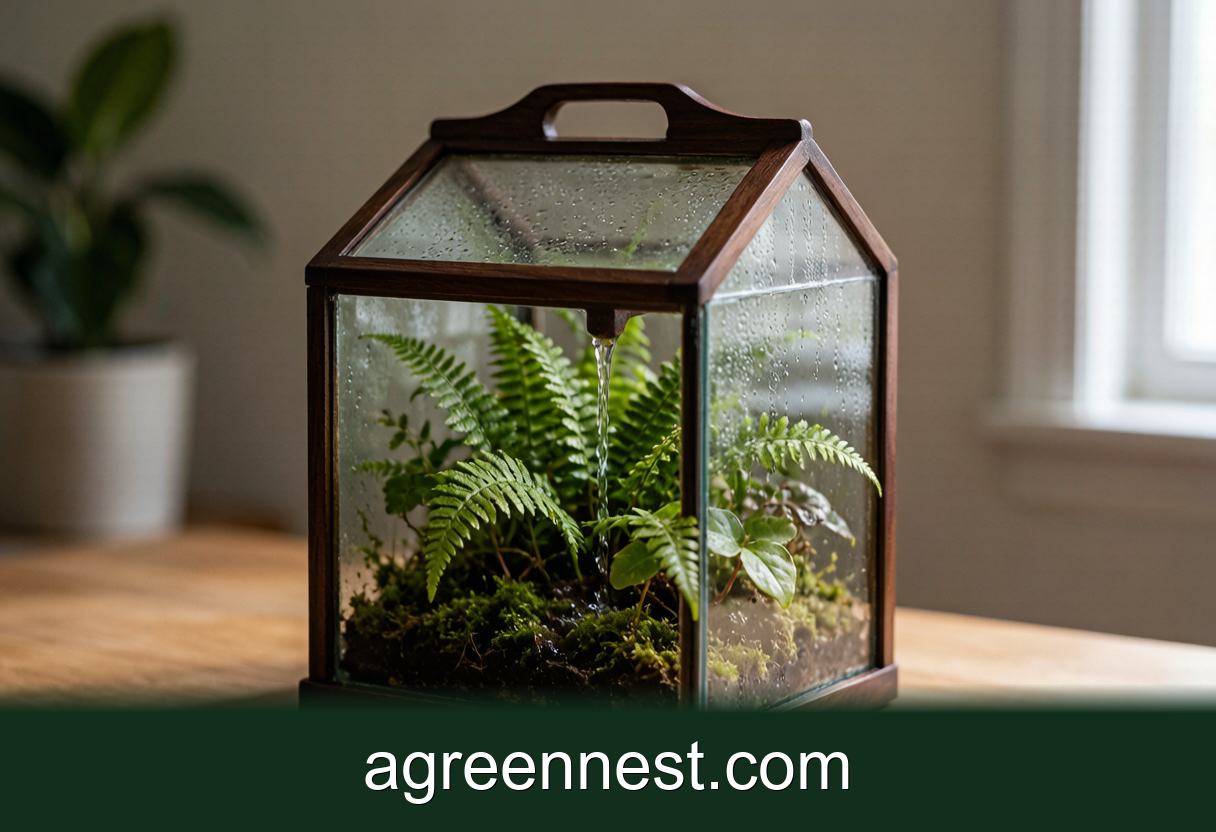
A Wardian case is a sealed glazed box that holds tropical humidity around 90 percent without daily misting. Build one from a 40 by 30 cm aquarium, an acrylic lid and a 20 mm drainage layer. Ferns, selaginella and miniature begonias thrive; succulents rot within weeks.
My first sealed case turned to grey mush in eleven days. I had planted it with an Echeveria, a Haworthia and one hopeful Fittonia, sealed the lid, and put it on a south sill. The Fittonia is still alive four years later. The other two dissolved.
That failure is the whole lesson. A Wardian case is not a decorative glass box you can fill with whatever the garden centre sold you. It is a closed water cycle, and the plant list is decided by the physics, not by taste.
What a Wardian Case Actually Is
Dr Nathaniel Bagshaw Ward stumbled on the principle in London in 1829, when a fern spore germinated in a sealed jar he was using to hatch a moth. The glass trapped moisture, the fern grew, and within a decade sealed cases were carrying live tea and cinchona plants across oceans on deck.
The mechanism is simple. Water evaporates from the substrate, condenses on the cool glass, runs back down. In a properly sealed case that loop repeats indefinitely, and you may not add water for six months. My oldest case was last watered in February.
The difference from an open terrarium matters. An open bottle garden exchanges air with the room and sits nearer 60 percent humidity. A sealed case holds 85 to 95 percent, which is heaven for a Selaginella and a death sentence for anything with thick water-storing leaves. If you want the open version instead, making a bottle terrarium is the gentler starting point, and a succulent terrarium is the deliberately dry cousin.
Materials and Cost
I build these from cheap tanks rather than buying purpose-made cases at four times the price.
- The box. A 40 x 30 x 30 cm glass aquarium, about $18 used. Rimless looks better; rimmed is fine.
- The lid. 4 mm clear acrylic cut 2 mm undersize on each edge, roughly $9. Glass fogs identically but is heavy and sharp.
- Drainage media. 2 litres of 8 to 16 mm LECA, $6.
- Horticultural charcoal. 500 ml, $5.
- Mesh. A square of fibreglass insect screen to separate layers.
- Substrate. 4 litres. My mix is 5 parts coco coir, 3 parts fine orchid bark, 2 parts perlite, 1 part worm castings.
- Sphagnum moss, a handful, damp.
Total is around $40 including plants, and the case runs on nothing afterwards.
Building It, Layer by Layer
Layer one, drainage: 20 mm of LECA. This is the reservoir. Without it, the substrate base sits permanently saturated and roots suffocate. Twenty millimetres in a 30 cm tall case is the ratio I keep coming back to; 40 mm wastes planting depth and 10 mm floods.
Layer two, charcoal: 5 mm, scattered not packed. Charcoal adsorbs the volatile compounds that make a closed case smell sour by month three. It is not a filter in the aquarium sense, and it does not prevent mould. It buys you odour control.
Layer three, mesh. Cut it to the internal footprint and press it flat. Skip this and fine coir migrates down into the LECA within a month, and your reservoir becomes mud.
Layer four, substrate: 60 to 80 mm, sloped. Build it 80 mm at the back and 50 mm at the front. The slope reads as depth through the glass, and it drains toward the front where you can see standing water and react.
Wet the substrate to just damp before planting. Squeeze a fistful: it should hold shape and release no more than one or two drops. This is the single most common failure point. A case built with soggy substrate cannot be dried out again without unsealing it for a week.
Planting: What Lives and What Dissolves
Everything here wants constant moisture at the root, high humidity at the leaf, and no direct sun.
Reliable in a sealed case
- Fittonia albivenis — the workhorse, and it tells you when something is wrong by wilting first.
- Selaginella kraussiana — spikemoss, thrives at 90 percent and dies at 50.
- Pilea glauca — fine trailing texture over the front edge.
- Peperomia prostrata — slower, but tolerates the humidity well.
- Begonia rex hybrids, miniature forms only.
- Ficus pumila 'Quercifolia' — will need pruning twice a year.
- Cushion moss, collected legally or bought.
Never
Succulents, cacti, Sansevieria, Zamioculcas, most Hoya. Anything with a thick cuticle evolved to hold water is adapted to losing water slowly, and in saturated air it simply cannot transpire. Rot starts at the base and is invisible until the plant tips over.
Set plants in shallow wells, firm gently, and leave at least 20 mm between the tallest leaf and the lid. Contact with condensation running down the glass causes brown patches within a fortnight.
Sealing, Venting and the First Month
Seal the lid the day you plant, then watch the glass. This is the diagnostic.
Even light misting across the glass that clears by midday — correct. Leave it alone.
Glass permanently opaque with running condensation — too wet. Prop the lid open 10 mm for two hours daily until it settles. This usually takes four to six days.
No condensation at all after 48 hours — too dry or the lid does not seat. Mist twice, reseat, wait another day.
I vent a settled case for ten minutes once a fortnight. That is not for the plants, which are content, but for me — it lets me smell it. A healthy case smells like woodland floor. A failing one smells like a drain, and that means the drainage layer has flooded.
Light. Bright indirect only. My cases sit 1.5 m back from an east window, around 900 lux. Direct sun through glass turns a sealed case into a 45 °C oven in twenty minutes and cooks everything. If you have never metered your rooms, the light calculator is quicker than guessing.
Mould. White fuzz on bark or leaf litter in weeks two to four is normal and passes. Springtails, added once for $6, eat it and settle the case permanently. Grey fuzz on a stem is botrytis: remove that plant immediately.
Where It Sits, and What It Replaces
A sealed case earns its space because it needs nothing. No misting, no pebble humidity tray, no running a humidifier for one fussy plant. If you have been chasing humidity around a dry flat, a case solves it for those species completely, and the humidity calculator will show you how far off your room air actually is.
It also handles the plants that never quite work loose in the house. A Fittonia on an open shelf is a weekly disappointment. In a case it is a weed.
Frequently Asked Questions
Q: How often do I water a sealed Wardian case?
A: Typically once or twice a year, and only when condensation stops forming overnight or the substrate pulls away from the glass. Add 50 ml at a time with a syringe, wait three days, and reassess. Overwatering a closed case is far harder to reverse than underwatering it.
Q: Can I keep a sealed case if my flat gets no direct sun at all?
A: Yes, and it is often better. These plants want bright indirect light, roughly 800 to 1,500 lux for eight hours. A north window at 1 m works. A 9 W LED bar on a timer works too, and avoids the overheating risk entirely.
Q: My glass is so fogged I cannot see the plants. Is that bad?
A: It means the substrate went in too wet. Prop the lid 10 mm for two hours a day until the fog clears by midday. Persistent full fog for over two weeks usually means the drainage layer has flooded and the case needs rebuilding.
Q: Do I need springtails, or is that an aquarist affectation?
A: Not strictly needed, but they make a sealed case low-maintenance rather than merely closed. They consume surface mould and decaying leaf litter, so you are not opening the lid to pick out fuzz every fortnight. One culture lasts the life of the case.
Q: Can I put a Wardian case in a bathroom?
A: You can, though it is redundant — the room already supplies the humidity the case would create. Better to use the bathroom for open pots of the species listed in bathroom humidity plants and keep the sealed case somewhere dry, where it does something the room cannot.
Build the case around one principle: it is a closed water cycle, not a display cabinet. Get the substrate to just damp and the drainage layer to 20 mm, plant only species that want saturated air, and then leave the lid shut. The failures I have had were all impatience — too much water at the start, or a succulent I liked the look of. The cases I left alone are the ones still running years later.
Sources & further reading
GreenNest authors research and write every guide independently. The external links below are reputable references we recommend for deeper reading — they are not the sources we copied from.
- Royal Horticultural Society — Terrariums and Bottle Gardens — Royal Horticultural Society
- Missouri Botanical Garden — Plant Finder — Missouri Botanical Garden
- UF/IFAS Extension — Gardening Solutions — University of Florida IFAS
Recommended Tools for DIY Plant Projects Care
Free, no-signup helpers matched to this guide.
Free Ebooks to Explore
Downloadable handbooks — no email required.
Free Ebook
The AGreenNest Succulent Care Handbook
The complete, beginner-to-confident guide to growing fat, happy succulents — 10 chapters and a 20-plant directory.
Free Ebook
Haworthia & Haworthiopsis Care Handbook
A focused guide to the striped, forgiving Haworthia clan.
Share Your Plant Story
Grown something tricky, or found a trick that finally worked? Tell us in the comments, or see what other readers are sharing on our Community page. The best reader tips get folded back into our guides.
Join the Conversation
Have a tip or a question about Make a Wardian Case: A Sealed Box for Fussy Tropicals? Share it below — comments are saved on our server.