 AGreenNest
DIY Plant Projects
Build a Vertical Succulent Frame That Lasts
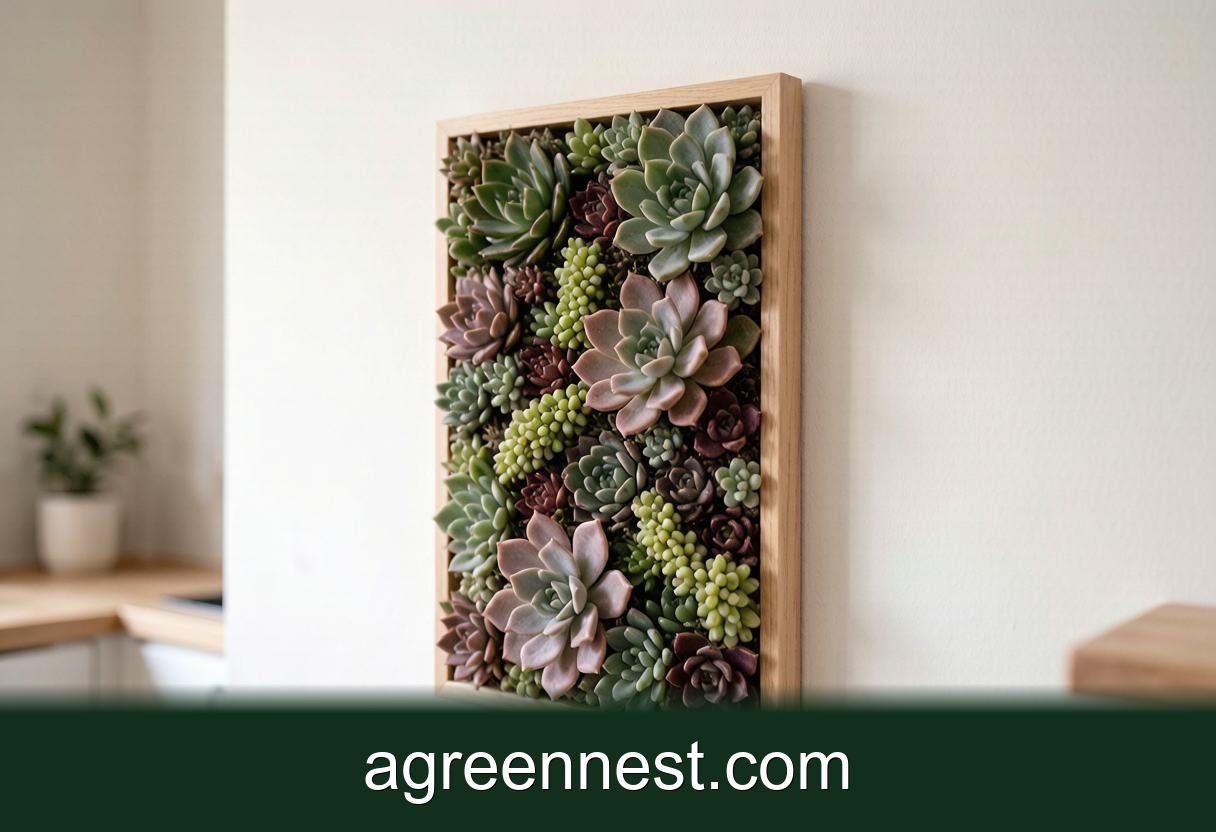
A vertical succulent frame needs at least 5 cm of interior depth, 1.3 cm galvanised mesh over a 2 cm sphagnum layer, and a gritty mix that is 60 percent pumice or perlite. Plant it flat, leave it flat for 4 to 6 weeks while roots grip, then hang it on hardware rated for 10 kg.
My first succulent frame dropped eleven cuttings onto a tile floor about six hours after I hung it. The mesh was right. The mix was right. I had hung it the same afternoon I planted it, and roots take weeks, not hours.
Built with a bit of patience, a frame is one of the few plant projects that gets better every year. Mine has been on a kitchen wall for three seasons and now reads as one dense mat of Sempervivum tectorum and Sedum rubrotinctum, with no visible soil at all.
What a Frame Costs and What Goes In It
For a 30 by 40 cm frame, the outside dimension most shadow boxes come in:
- A shadow box or deep picture frame, interior depth 5 cm minimum. Anything shallower holds under 1.5 litres of mix and dries out in three days. Depth 6 to 7 cm is better.
- Galvanised hardware cloth, 1.3 cm mesh, cut 2 cm larger than the opening on all sides. Chicken wire flexes and lets the mix slump.
- Plywood back panel, 6 mm, plus eight 15 mm screws.
- Sphagnum moss, about 60 g dry, for a 2 cm liner behind the mesh.
- Gritty mix, roughly 4 litres. My blend is 60 percent 3 to 6 mm pumice, 20 percent coir, 20 percent coarse sand. The gritty soil recipe covers ratios in more detail.
- Cuttings, 55 to 75 of them. Free if you have a collection, or one tray from a nursery.
- Two D-rings and wall hardware rated for 10 kg.
Budget runs 35 to 60 if you buy the frame, near nothing if you build the box from offcuts.
Why Do Most Succulent Frames Fail?
Four reasons, in the order I see them.
It was hung too early. Cuttings sit in the mix by gravity alone until roots knit through the moss. That takes 4 to 6 weeks at 18 to 24 °C. Hang it at week one and you get my kitchen floor.
The box is too shallow. A 3 cm interior gives each cutting less than a teaspoon of root room. Plants stall at the size you planted them and the whole panel needs water twice a week.
The mix holds too much water. Standard potting compost against a vertical mesh stays wet at the bottom and bone dry at the top. Rot starts in the lower third, usually in September, and spreads sideways.
It gets watered on the wall. Pouring water into a hanging frame runs it straight down the inside of the glass and out the bottom edge onto the plaster.
Building It in an Afternoon
- Strip the frame. Remove glass and backing board. Keep the glass for something else, it never goes back in.
- Cut the mesh 2 cm oversize, snip the corners, and fold the edges down so it sits like a shallow tray inside the frame lip.
- Staple the mesh to the inside of the frame every 4 cm. Pull it taut as you go. A slack panel bows out under 4 kg of wet mix.
- Soak the sphagnum for 10 minutes, squeeze it to the wetness of a wrung cloth, and press a 2 cm layer against the back of the mesh. This is the layer that stops mix falling through and gives new roots something to grab.
- Fill with gritty mix, pressing firmly with your palm as you go. Firm is the word. Loose mix settles 1 to 2 cm in the first month and leaves a gap at the top.
- Screw the plywood back on with the frame face down, then drill four 6 mm drainage holes through the plywood at the lower corners and centre.
- Fit the D-rings at one third down from the top edge on both sides. A soaked 30 by 40 cm frame weighs 5 to 6 kg, so use wall plugs, not a picture hook. Hanging hardware ratings are worth two minutes of reading before you drill.
How Many Cuttings Fit a 30 by 40 cm Frame?
Between 55 and 75 if you want full coverage within a season, spaced 2 to 3 cm apart.
Let the cuttings callus for 3 to 5 days first, cut end dry and dull, exactly as in leaf and stem propagation. Then push each one through a mesh square with a chopstick or a pencil, 2 cm deep into the mix.
What works on a wall is species that stay flat and clump. Sempervivum tectorum and Sempervivum arachnoideum are the backbone, since they spread by offsets and hold on hard. Sedum spurium, Sedum rubrotinctum and Graptopetalum paraguayense fill the gaps fast. Echeveria elegans rosettes make good focal points at 8 to 10 cm across, planted in odd numbers of three or five.
Skip anything tall or heavily trailing. A Crassula ovata becomes a lever arm and pulls itself out by year two, and long Senecio rowleyanus strands shade everything underneath.
Light is the other half of it. A frame on a wall 2 m from a south window may sit at 800 to 2,000 lux, which is a slow etiolation sentence for Echeveria. Mine runs an LED bar 30 cm off the surface for 12 hours a day. The light and temperature guide has the thresholds.
How Do You Water a Frame Once It Is Vertical?
Take it down. That is the whole trick.
Lay the frame flat in a shallow tray or a bath, water the surface until it runs from the drainage holes, and let it drain flat for 30 to 45 minutes before rehanging. Water pooling behind the plywood for an hour is what rots the bottom row.
Interval indoors at 20 to 23 °C: every 14 to 21 days in summer, every 4 to 6 weeks from November to February. Rather than counting days, weigh it once. Note the weight soaked and the weight bone dry, and water when it hits the dry number. My frame goes from 5.4 kg wet to 3.1 kg dry, and I water at about 3.4 kg.
Feed at quarter strength twice a year, in April and July. Any more and Sempervivum rosettes stretch and lose their tight form.
Frequently Asked Questions
Q: Can I hang the frame outside?
A: Yes, if it is under an eave and your winter lows stay above minus 5 °C, which suits Sempervivum better than Echeveria. Untreated pine swells and splits after two wet winters, so seal the outside of the wood with an exterior finish and leave the interior bare.
Q: My cuttings pulled out when I hung the frame at week five. What went wrong?
A: Almost always temperature. Rooting slows to a crawl under 15 °C, so a frame that cured in a cool hallway may need 8 to 10 weeks. Tug one rosette gently before hanging. Resistance means roots, no resistance means wait.
Q: Do I need the sphagnum layer if I use fine mesh instead?
A: Fine mesh keeps the mix in but roots struggle to cross it, and it clogs with salts within a year. Moss behind 1.3 cm mesh performs better on both counts and costs less.
Q: How long before the frame looks full?
A: With 60 cuttings at 2 to 3 cm spacing and decent light, coverage is convincing at 4 to 5 months and dense at 12. Planting closer speeds it up and makes future thinning harder.
Q: Can I grow the same way in a terrarium instead?
A: Different problem. Closed glass traps humidity, which succulents hate, so a succulent terrarium has to stay open and shallow. The frame is the better format for dense coverage.
The build takes an afternoon. The part people skip is the 4 to 6 weeks flat on a table, and that is the part that decides whether you own a living wall panel or a pile of cuttings on the floor. Check the wall spot before you commit to it with our free light calculator, because a frame in a dim corner will stretch out of shape long before it drops anything.
Sources & further reading
GreenNest authors research and write every guide independently. The external links below are reputable references we recommend for deeper reading — they are not the sources we copied from.
- Michigan State University Extension — Gardening — Michigan State University
- NC State Extension Plant Toolbox — NC State Extension
- University of Minnesota Extension — Container and soil basics — U Minnesota Extension
Recommended Tools for DIY Plant Projects Care
Free, no-signup helpers matched to this guide.
Free Ebooks to Explore
Downloadable handbooks — no email required.
Free Ebook
The AGreenNest Succulent Care Handbook
The complete, beginner-to-confident guide to growing fat, happy succulents — 10 chapters and a 20-plant directory.
Free Ebook
Haworthia & Haworthiopsis Care Handbook
A focused guide to the striped, forgiving Haworthia clan.
Share Your Plant Story
Grown something tricky, or found a trick that finally worked? Tell us in the comments, or see what other readers are sharing on our Community page. The best reader tips get folded back into our guides.
Join the Conversation
Have a tip or a question about Build a Vertical Succulent Frame That Lasts? Share it below — comments are saved on our server.