 AGreenNest
DIY Plant Projects
Build a Window Plant Shelf: Two Versions
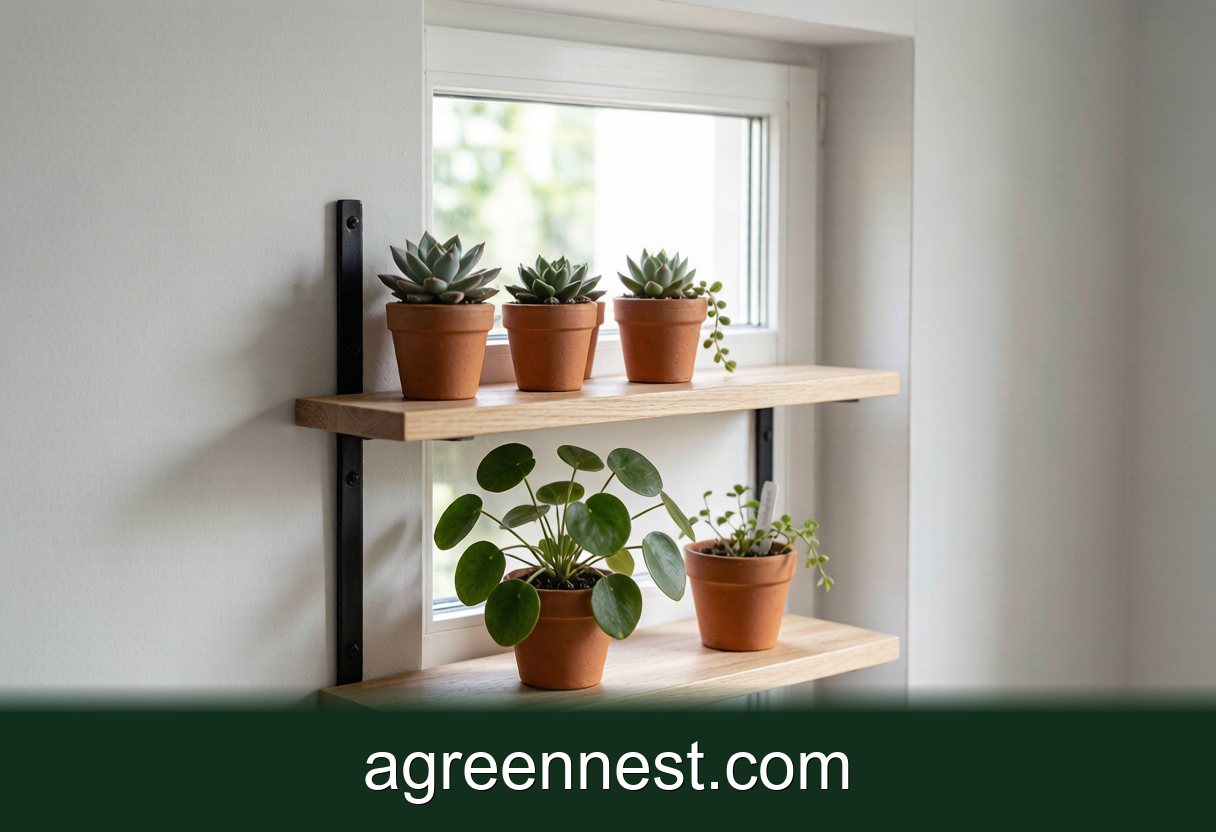
A window plant shelf puts extra tiers of pots in the brightest 30 cm of a room. A tension rod pair with 5 mm acrylic suits renters and carries about 3 kg; screwed pine cleats under a 20 mm board hold 12 kg. Leave 30 cm between tiers so the lower plants keep their light.
The rod let go somewhere after midnight. I found out at 06:40: two Echeveria, a sheet of 5 mm acrylic, and roughly 3 kg of gritty mix spread across the bedroom floor. The rod was rated to 9 kg and was carrying 4. The rating was never the issue. Friction was.
Here are both builds, with the numbers that decide which one you should make.
Why Build a Shelf Across the Window Instead of Using the Sill?
Most flat windowsills are 12 to 16 cm deep, which fits a 10 cm nursery pot and nothing else. The window plane itself, though, is the brightest real estate you own, and light falls away from it faster than people believe.
On a clear July morning I metered my east window at 6,800 lux against the glass, 1,900 lux at 1 m into the room, and 480 lux at 2 m. Two shelves across a 90 x 120 cm window add about half a square metre of space in that first, richest band, and moving a Crassula ovata up there can multiply its light by four without buying a single watt. If you have never measured your own rooms, the lux test for how dark your home really is takes ten minutes and changes what you build.
Build One: The $22 Tension Rod Shelf
This is the renter's version. No holes, no landlord conversation, and it comes down in a minute.
Materials
- Two spring tension rods sized to your reveal. Mine is 88 cm wide, so I use rods with a 75 to 115 cm range.
- One sheet of 5 mm clear acrylic, cut to reveal width minus 5 mm, by 140 mm deep. A plastics merchant will cut it for about $12.
- Four self-adhesive rubber bumpers.
- One drip tray, 30 x 15 cm.
Method
Measure down from the head of the frame at both ends, not from the sill, since sills are often out of level. Set the first rod at your mark, then the second rod 100 mm behind it at the same height. Twist each rod until the end caps compress hard against the reveal. Stick a bumper on the acrylic where it meets each rod, then lay the sheet across.
The part that failed on me
A spring rod holds by friction between a rubber cap and the wall. Glossy paint, dust, or a slightly bowed reveal all cut that friction. Wipe both contact points with isopropyl alcohol, add a 40 mm disc of rubber shelf liner behind each cap, and cap the load at 3 kg. Two 13 cm pots of dry succulent mix sit inside that budget. A single 20 cm pot of wet soil does not.
Build Two: A Cleat Shelf That Carries 12 kg
If you can drill, build this instead. It costs about $16 in timber and holds four times as much.
Cut list
- Two cleats: 18 x 18 mm pine, each cut to shelf depth minus 20 mm. For a 180 mm shelf, that is 160 mm.
- One shelf board: 20 mm pine or birch ply, 880 x 180 mm.
- Four 40 mm screws for the cleats, with 2.5 mm pilot holes.
- Two 30 mm screws down through the board into each cleat.
Method
Mark a level line across both sides of the reveal with a 60 cm spirit level. Hold each cleat to the line and drill through into the jamb. Solid timber jambs take the screws directly. Plasterboard reveals need a self-drilling anchor rated to 25 kg per fixing, and old crumbly plaster needs the screw to reach the timber behind it, so drill a test hole first and watch what colour dust comes out.
Seal the board on all six faces with two coats of water-based varnish. Condensation runs down that glass every winter morning, and bare pine cups within a season.
Span and load. A 20 mm board on end cleats over an 880 mm span deflects visibly past about 12 kg. Keep to that, or add a third cleat at the midpoint and screw it to the wall below the window head. My kitchen shelf carries 9.5 kg of terracotta and has not moved in two years.
How Much Light Do the Plants Below Lose?
This is the question people skip, then wonder why the sill plants stall in October.
I metered a south window before and after fitting a 180 mm opaque shelf. A plant sitting 40 cm below the new shelf went from 5,200 lux to 1,500 lux. That is a real demotion, and it will show up as stretched growth within about six weeks.
Three fixes, in order of effect:
- Keep shelves shallow. At 140 mm deep, the shadow is narrow enough that midday light still reaches past it.
- Stagger the tiers 30 to 35 cm apart and offset the upper shelf 40 mm toward the glass, so morning and evening light rake underneath.
- Match the plant to the tier. Anything on the bottom row should tolerate a dim spot anyway, and the shortlist in the best low-light plants for a north window works well down there.
What Actually Thrives on a Window Shelf
Top tier, hard against the glass. Echeveria, Haworthiopsis attenuata, Crassula ovata, and small herbs. Watch summer temperature: my south pane hit 44 °C at 15:00 last August, so keep leaves 5 cm off the glass and never leave a magnifying-glass gap between plant and pane.
Middle tier. Pilea peperomioides, Peperomia obtusifolia, Chlorophytum comosum. Trailers work here too, and the growth habits worth choosing are covered in trailing plants for shelves.
Winter caution. Single glazing at -2 °C outside sits between 4 and 8 °C at the pane. Tropicals go off the shelf in December. Succulents in dry compost handle it.
Every pot needs drainage, and a shelf 1.5 m above a wooden floor is a bad place for the first exception. If you have a favourite cachepot with no hole in it, drilling drainage holes in ceramic pots is a 15 minute job. Then set a tray under each pot, because water on varnished pine finds the join every time. For arranging what sits where once the shelf is up, plant shelf styling has the layout rules.
Frequently Asked Questions
Q: My window reveal is uPVC, not plaster. Will a tension rod grip it?
A: Less well than painted timber, because the surface is slick. Clean it with alcohol, add rubber liner discs behind the caps, and drop your load limit from 3 kg to about 2 kg.
Q: Will a shelf across the window make condensation or mould worse on the frame?
A: It can, by blocking the air that normally moves down the pane. Leave a 20 mm gap between the back edge of the shelf and the glass, and wipe the sill on cold mornings. A varnished board with sealed end grain will not swell.
Q: How do I stop 5 mm acrylic from bowing under two pots?
A: Move the rear rod so the two rods sit 100 mm apart rather than 60, which shortens the unsupported overhang. Past a 90 cm span, step up to 8 mm acrylic or switch to the cleat build.
Q: Can I hang a grow light from a window shelf for the winter?
A: Yes, if it is the cleat version. A 15 W LED bar weighs about 400 g and screws to the underside of the board, which puts it 30 cm above the tier below. Do not hang anything from a tension rod shelf.
Build the tension rod version first if you are renting or unsure, and treat 3 kg as a hard ceiling rather than a guideline. Build the cleat shelf when you know the window is worth it, because 12 kg of capacity changes which plants you can grow indoors. Before you decide what goes on which tier, run the numbers through our free light calculator so the bottom row does not spend winter in the shade of the top one.
Sources & further reading
GreenNest authors research and write every guide independently. The external links below are reputable references we recommend for deeper reading — they are not the sources we copied from.
- Michigan State University — College of Agriculture & Natural Resources — Michigan State University
- NC State Extension Plant Toolbox — NC State Extension
- University of Minnesota Extension — U Minnesota Extension
Recommended Tools for DIY Plant Projects Care
Free, no-signup helpers matched to this guide.
Free Ebooks to Explore
Downloadable handbooks — no email required.
Free Ebook
The AGreenNest Succulent Care Handbook
The complete, beginner-to-confident guide to growing fat, happy succulents — 10 chapters and a 20-plant directory.
Free Ebook
Haworthia & Haworthiopsis Care Handbook
A focused guide to the striped, forgiving Haworthia clan.
Share Your Plant Story
Grown something tricky, or found a trick that finally worked? Tell us in the comments, or see what other readers are sharing on our Community page. The best reader tips get folded back into our guides.
Join the Conversation
Have a tip or a question about Build a Window Plant Shelf: Two Versions? Share it below — comments are saved on our server.