 AGreenNest
DIY Plant Projects
I Tested 4 Ways to Seal a Terracotta Pot
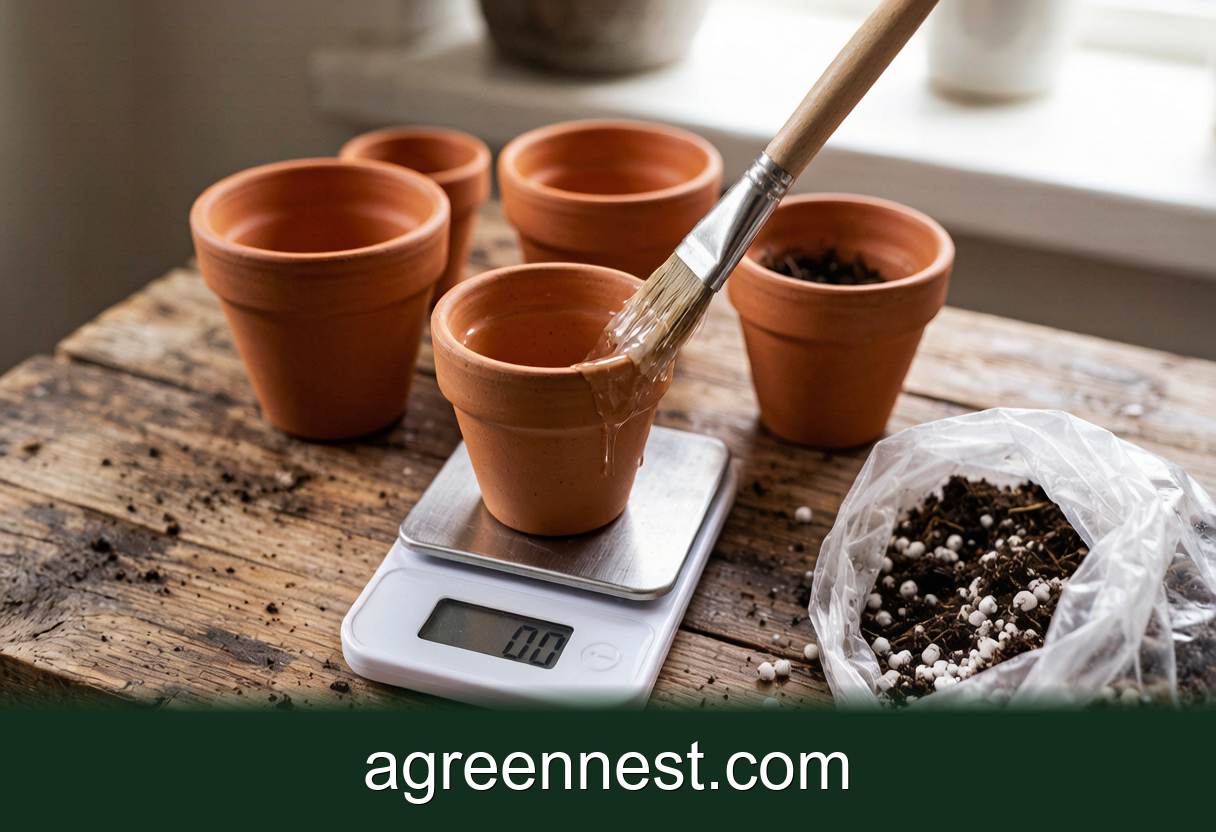
Sealing the inside of a terracotta pot with a water-based masonry sealer cut soil water loss from 41 percent to 23 percent over ten days in my test. Sealing the outside is worse than doing nothing: it traps salts under the film, which then flakes off within a season.
My Fittonia albivenis wilted twice a week in a 15 cm terracotta pot and stayed fine in a plastic one. That is not a mystery, it is physics: unglazed clay is porous, and a pot that breathes also dries.
The internet's answer is to seal the pot. Which sealant, on which face, and how much water it actually saves are questions nobody seems to have measured, so I put five pots on a kitchen scale for ten days.
How Much Water Does Bare Terracotta Actually Lose?
More than most people expect, and most of it does not leave through the soil surface.
An unglazed 15 cm pot has roughly 900 square centimetres of wall in contact with damp mix, against about 175 square centimetres of exposed surface at the top. Clay wicks water to its outer face, where it evaporates and cools the root ball by 1 to 3 °C. Terrific for an Echeveria elegans. Punishing for anything with thin leaves.
How I Ran the Test
Five identical 15 cm (1.4 litre) terracotta pots from the same batch, drainage hole open on all of them, no plants, so evaporation was the only variable.
- Each filled with 780 g of the same coir and perlite mix, watered to 1,240 g total, drained 30 minutes.
- Room held at 21 to 22 °C and 45 to 50 percent relative humidity, no direct sun, no draught.
- Weighed on a 1 g kitchen scale at 08:00 daily for 10 days.
- Sealants cured 72 hours before any mix went in.
The four treatments, against one untreated control:
- Water-based acrylic masonry sealer, interior only. Two coats, brushed, hole left clear.
- Beeswax and boiled linseed rub, interior only. Melted 1:1, wiped on warm clay, buffed.
- Acrylic sealer, exterior only. The finish most tutorials show, because it looks tidy.
- Plastic nursery pot as a liner. Not a coating, but it is what people actually reach for.
The Results After Ten Days
Percentage of the added water lost, day 7 and day 10:
- Untreated control: 38 percent by day 7, 41 percent by day 10.
- Interior acrylic sealer: 21 percent, then 23 percent.
- Beeswax and linseed, interior: 29 percent, then 31 percent.
- Exterior acrylic sealer: 34 percent, then 36 percent.
- Plastic liner inside the pot: 13 percent, then 14 percent.
Read those numbers as watering intervals and they get practical. The control needed topping up roughly every 5 days at that temperature. The interior-sealed pot went about 9 days. The liner went past 12, which is plastic-pot behaviour, because it is a plastic pot.
Beeswax underperformed for a reason I could see: the coating went on unevenly over a rough interior, and after two weeks on a south windowsill at 28 °C it had softened and migrated into the clay. Nice for a decorative outer finish. Not a moisture barrier.
The exterior coat is the interesting failure. It gained 5 points over doing nothing, and it cost me the pot.
Why Sealing the Outside Backfires
Water still enters the clay from the soil side. Sealing the outer face does not stop it, it stops the water getting out, so the wall stays saturated and the dissolved salts travel to the barrier and stall there.
By week 6, pot 3 had a chalky white band under the film at the lower third, and the acrylic had lifted at two edges where I could peel it off with a thumbnail. Fired clay also expands and contracts with moisture. Any rigid film on the outside eventually loses that argument.
There is a second cost. The evaporative cooling that makes clay good for a Crassula ovata or a rooted cutting happens at the outer face. Seal it and you have a heavy, brittle plastic pot that costs six times as much. If you want the plastic behaviour, compare the two materials honestly before you paint anything.
Should You Seal a Terracotta Pot at All?
Sometimes. My verdicts after this test:
Seal the interior for thirsty, thin-leaved species in small pots: Fittonia albivenis, Calathea orbifolia, Adiantum raddianum. Use a water-based acrylic masonry or planter sealer, two coats, 72-hour cure, and keep 2 cm around the drainage hole clear so the hole never glazes shut. Skip solvent-based products indoors.
Do not seal at all for succulents, cacti, Sansevieria trifasciata or Zamioculcas zamiifolia. The drying is the feature. Sealing one of these is how a healthy plant ends up with soft brown roots in February.
Never seal an olla. The whole buried olla waterer works because water seeps through the wall.
Use a liner instead if you like the look and want the least fuss. Grow in a 13 cm nursery pot, drop it into a 15 cm terracotta cachepot, lift it out to water. This is the cachepot method, it beat every coating in my test, and it is reversible.
Whatever you pick, sealing changes the drying curve, so your old watering habit is now wrong by several days. Check the soil rather than the calendar for the first month.
Frequently Asked Questions
Q: Can I use PVA or white school glue to seal the inside of a pot?
A: No. PVA rehydrates. Mine went milky and tacky within three waterings, and the softened film sheds into the root zone. Use an acrylic product sold for masonry or planters.
Q: Is masonry sealer safe for plant roots?
A: Water-based acrylic sealers are inert once fully cured, which takes 72 hours at 20 °C, not the 2 hours on the tin. I would still avoid any coating inside a pot growing herbs or salad you plan to eat, and I would avoid solvent-based sealers entirely indoors.
Q: Will sealing stop the white crust that forms on my terracotta?
A: Interior sealing reduces it a lot, because the salts never reach the wall. Exterior sealing hides it for a few weeks and then flakes. That crust is fertiliser and tap-water minerals, so flushing the pot with three pot-volumes of water every couple of months helps more than any coating.
Q: I sealed a pot and my succulent started rotting. What now?
A: Unpot it, check for firm white roots, cut anything soft, and let the plant callus for 3 days. Repot into unsealed clay with a gritty mix. Keep the sealed pot for a fern.
Q: Does sealing protect a pot from cracking outdoors in frost?
A: Interior sealing cuts absorption, which lowers the risk, but it does not remove it. Standing water in the saucer is what splits pots. Raise them on feet, same principle that keeps homemade concrete planters intact through winter.
The measurable result is that an interior acrylic coat roughly halves water loss and an exterior coat mostly damages the pot. The useful result is smaller: most people who want to seal terracotta actually want a plastic pot inside a clay one, and that takes ten seconds and no drying time. If you do coat a pot, recalculate the interval with our watering calculator before you drown something.
Sources & further reading
GreenNest authors research and write every guide independently. The external links below are reputable references we recommend for deeper reading — they are not the sources we copied from.
- Michigan State University Extension — Gardening — Michigan State University
- NC State Extension Plant Toolbox — NC State Extension
- University of Minnesota Extension — Soil and container basics — U Minnesota Extension
Recommended Tools for DIY Plant Projects Care
Free, no-signup helpers matched to this guide.
Free Ebooks to Explore
Downloadable handbooks — no email required.
Free Ebook
The AGreenNest Succulent Care Handbook
The complete, beginner-to-confident guide to growing fat, happy succulents — 10 chapters and a 20-plant directory.
Free Ebook
Haworthia & Haworthiopsis Care Handbook
A focused guide to the striped, forgiving Haworthia clan.
Share Your Plant Story
Grown something tricky, or found a trick that finally worked? Tell us in the comments, or see what other readers are sharing on our Community page. The best reader tips get folded back into our guides.
Join the Conversation
Have a tip or a question about I Tested 4 Ways to Seal a Terracotta Pot? Share it below — comments are saved on our server.