 AGreenNest
DIY Plant Projects
Terrarium Lighting: How Much Light a Closed Jar Really Needs
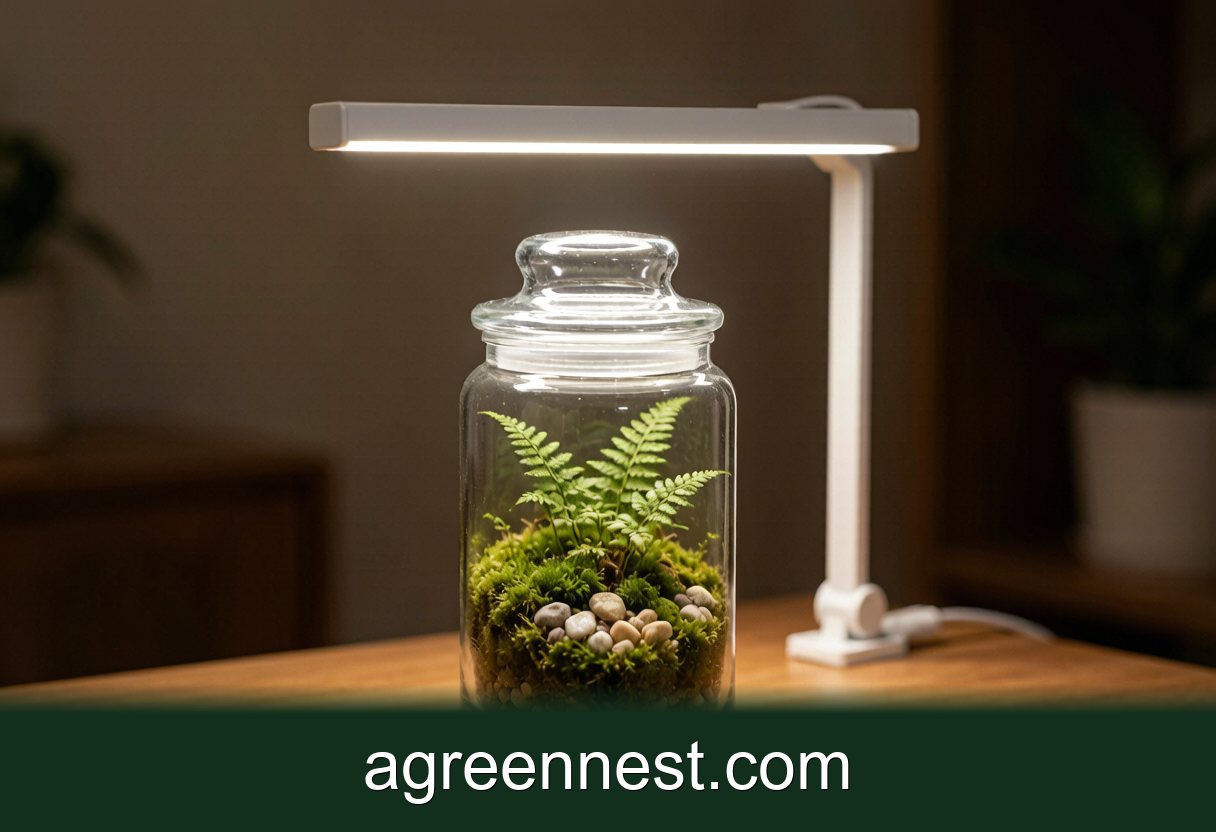
A closed terrarium wants 1,000 to 2,500 lux of bright indirect light for 10 to 12 hours daily, never direct sun. Glass traps heat, so a jar in a sunbeam can pass 40 C in under an hour and cook its plants. A 9 W LED at 30 cm is the safe default.
The first sealed jar I killed took nine days. It sat on a south windowsill because that is where the light was, and every morning it looked a little more like soup. By day nine the Fittonia had gone translucent and the moss had turned the colour of wet cardboard. I had given it plenty of light. I had also, without meaning to, built a small greenhouse and left it in an oven.
Terrarium lighting is the one variable people get backwards most often. Here are the numbers I use now.
Why Glass Changes the Rules
An open pot on a windowsill sheds heat constantly. Air moves across the leaves, water evaporates, and that evaporation carries energy away. A sealed jar does none of this. The glass passes shortwave light in, the contents absorb it and re-radiate longwave heat, and the seal stops that heat from convecting away. This is the greenhouse effect operating in a two-litre space with no vents.
I metered it. A 2 L jar on my south sill in July: room air 24 C, jar interior 41 C after fifty minutes of direct sun. The same jar 1.2 m back from the same window, out of the beam: interior 26 C, stable all afternoon. Two degrees over ambient instead of seventeen.
So the rule is not "terrariums like bright light." It is terrariums like bright light that has never touched them directly. If you have not measured what your rooms actually deliver, the lux test for how dark your home really is is worth ten minutes before you buy any hardware.
The Numbers That Matter
Three settings decide whether a terrarium thrives, stretches, or cooks.
Intensity. Aim for 1,000 to 2,500 lux at the glass. Below about 800 lux, tropical foliage stretches: internodes lengthen, leaves shrink, and Fittonia loses its pink veining. Above roughly 4,000 lux in a sealed vessel you start fighting heat rather than gaining growth. Mosses in particular bleach out above 3,000.
Duration. Ten to twelve hours a day. Longer does not compensate for weaker light in the way people hope, and running sixteen-hour days on a sealed jar mostly adds heat load. A cheap mechanical timer removes the human error entirely.
Distance. With a standard 9 W household LED bulb, 25 to 35 cm above the lid lands close to 1,500 to 2,000 lux at the substrate. Move to 15 cm and you are near 4,500 lux with a measurable warm spot on the glass. Light obeys the inverse square law, so small distance changes are not small.
| Setup | Distance | Approx. lux at glass | Verdict |
|---|---|---|---|
| North window, no beam | — | 600–1,200 | Marginal; moss fine, Fittonia stretches |
| East window, 1 m back | — | 1,200–2,200 | Ideal for most closed jars |
| South window, in beam | — | 8,000+ and 40 C | Cooks the jar |
| 9 W LED overhead | 30 cm | 1,500–2,000 | Reliable default |
| 9 W LED overhead | 15 cm | ~4,500 | Too hot for sealed glass |
Choosing a Bulb
You do not need a purple blurple panel. A closed terrarium is a low-power system and ordinary white LEDs work well.
Look for 4000 K to 6500 K colour temperature. 6500 K reads slightly blue and keeps growth compact, which suits mosses and Fittonia. 4000 K looks more natural in a living room and is perfectly adequate. Anything under 3000 K is warm enough to look yellow through glass and tends to encourage stretching.
Wattage: 7 W to 12 W for a jar up to about 5 L. Beyond that, or for a tall vessel, a small clip-on LED with an adjustable arm gives you distance control, which matters more than raw output.
Skip anything sold specifically as a "terrarium heat lamp" unless you keep reptiles. Those are designed to raise temperature, which is precisely the thing a sealed planted jar cannot tolerate.
If you would rather build the fixture than buy one, the grow light stand build scales down neatly to terrarium height and gives you a fixed, repeatable distance instead of a bulb balanced on a stack of books.
Reading the Failure Signals
Terrariums tell you what is wrong before they die, if you know the vocabulary.
Too much light or heat. Persistent heavy condensation that never clears by midday. Leaves going pale then translucent. A sour smell when you open the lid. Moss turning yellow-white from the top down. Act fast here: move it out of the beam the same day.
Too little light. Long bare stems reaching toward the brightest side. New leaves smaller than old ones. Fittonia fading from pink to plain green. Moss thinning and going leggy rather than forming a mat. This is slow and recoverable over several weeks.
Correct. A light fog on the glass in the morning that clears to mostly transparent by early afternoon, then returns overnight. Compact new growth. That daily fog cycle is the single best indicator that light, heat and moisture are balanced.
One nuance: if condensation never appears at all, the vessel is either leaking or too cool, not under-lit. Check the seal before you change the lighting.
Placement Without a Lamp
Plenty of terrariums never need a bulb.
An east-facing window is the best free option. Morning sun is weak and short, and by the time the day heats up the beam has moved off. I keep jars roughly 60 cm back from east glass.
North-facing windows in the northern hemisphere give steady low light with no beam risk. Good for moss-dominant builds, marginal for anything variegated.
South and west windows work only if you set the jar 1.5 to 2 m back into the room, or filter the glass with a sheer curtain. The beam is the problem, not the window.
Rotate a quarter turn weekly. Plants lean, and in a closed jar you cannot easily reach in and straighten them later.
The same logic applies to open vessels with standing water, which run cooler but algae faster in bright light. The tabletop water garden build covers that trade-off, and a heavily planted paludarium sits somewhere between the two, needing more light than a sealed jar because the open surface sheds heat.
What I Run Now
Three closed jars on a shelf 1.4 m from an east window, plus one 9 W 5000 K LED on a mechanical timer 30 cm above the middle jar, running 07:00 to 18:00. Measured 1,700 lux at the centre glass, 1,100 at the outer jars. Interior temperature never more than 3 C over room. No losses in fourteen months, and the moss has closed into a continuous mat.
That is the whole system. One bulb, one timer, and a deliberate refusal to put glass in a sunbeam. For the other builds that pair with it, the complete DIY projects guide is the index I work from.
Frequently Asked Questions
Q: Can a closed terrarium survive with no window light at all?
A: Yes, provided you supply artificial light. A 9 W LED at 30 cm running 10 to 12 hours daily is sufficient for mosses and Fittonia in a windowless bathroom or interior hallway. Terrariums are one of the few planted systems that run entirely on a single household bulb.
Q: How many hours of light should a terrarium get each day?
A: Ten to twelve hours. Shorter photoperiods cause stretching in tropical foliage; longer ones mainly add heat without meaningful growth benefit in a sealed vessel. Use a timer rather than switching manually, since inconsistency shows up as uneven growth within a few weeks.
Q: Why is my terrarium glass always completely fogged?
A: Constant heavy condensation usually means too much light or heat, not too much water. Move the jar out of any direct beam and check the interior temperature. A healthy closed terrarium fogs overnight and clears to mostly transparent by early afternoon.
Q: Do I need a special grow light or will a normal LED bulb work?
A: A normal white LED works well. Choose 4000 K to 6500 K and 7 W to 12 W for jars up to about 5 L. Purple full-spectrum panels are designed for high-light crops and are unnecessary here. Avoid reptile heat lamps entirely, as they raise temperature in a system that cannot vent.
Q: Can I put a terrarium on a south-facing windowsill?
A: Not on the sill itself. Glass traps heat, and a jar in a direct summer beam can exceed 40 C within an hour, which cooks the plants. Set it 1.5 to 2 metres back into the room, or filter the window with a sheer curtain so no beam ever lands on the vessel.
Terrarium lighting is a heat problem wearing a light problem's clothes. Once I stopped asking "is this bright enough?" and started asking "will a beam ever land on this glass?", the losses stopped. Bright indirect light, ten to twelve hours, nothing direct, and a thermometer inside the jar for the first fortnight. That is genuinely all of it.
Sources & further reading
GreenNest authors research and write every guide independently. The external links below are reputable references we recommend for deeper reading — they are not the sources we copied from.
- Royal Horticultural Society — Bottle Gardens and Terrariums — Royal Horticultural Society
- UF/IFAS Extension — Light for Houseplants — University of Florida IFAS Extension
- Missouri Botanical Garden — Plant Finder and Indoor Gardening — Missouri Botanical Garden
Recommended Tools for DIY Plant Projects Care
Free, no-signup helpers matched to this guide.
Free Ebooks to Explore
Downloadable handbooks — no email required.
Free Ebook
The AGreenNest Succulent Care Handbook
The complete, beginner-to-confident guide to growing fat, happy succulents — 10 chapters and a 20-plant directory.
Free Ebook
Haworthia & Haworthiopsis Care Handbook
A focused guide to the striped, forgiving Haworthia clan.
Share Your Plant Story
Grown something tricky, or found a trick that finally worked? Tell us in the comments, or see what other readers are sharing on our Community page. The best reader tips get folded back into our guides.
Join the Conversation
Have a tip or a question about Terrarium Lighting: How Much Light a Closed Jar Really Needs? Share it below — comments are saved on our server.