 AGreenNest
Plant Pests & Diseases
Does Rubbing Alcohol Kill Mealybugs? I Tested It
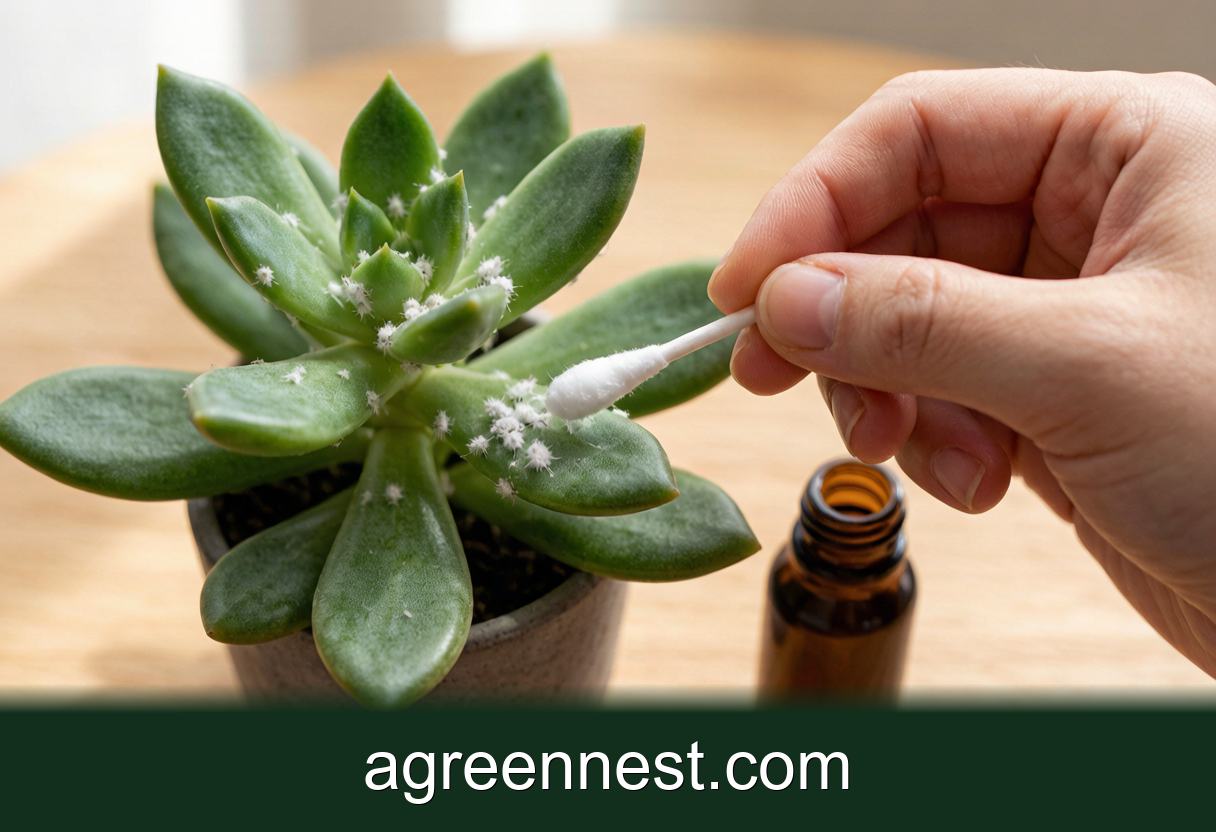
Yes, 70 percent isopropyl alcohol kills mealybugs on contact by dissolving their waxy shield and drying them out. Dab colonies with a cotton swab, or spray a one-to-three alcohol and water mix, then repeat every five to seven days for three weeks to catch the eggs the first pass always misses.
The advice is everywhere: see a white cottony bug, grab the rubbing alcohol. I have repeated it myself for years. But last spring a reader pushed back, saying she had swabbed her Hoya twice a week for a month and the mealybugs kept multiplying. So I set up a small test on my own infested plants to find out what alcohol really does, where it fails, and what the internet gets wrong.
Here is what I found.
Does Rubbing Alcohol Actually Kill Mealybugs?
Yes, and fast. When I touched a cotton swab soaked in 70 percent isopropyl alcohol directly onto a cluster of citrus mealybugs (Planococcus citri), they stopped moving within seconds and turned translucent. The white fluff went from powdery to wet and collapsed.
The reason is physical, not chemical poisoning. Mealybugs coat themselves in a waxy, water-repellent shield that lets ordinary sprays bead off and roll away. Alcohol dissolves that wax, then pulls moisture out of the soft body underneath. The insect dries out. NC State Extension lists this desiccating action as the main reason horticultural oils and alcohol solutions work on soft-bodied pests when water alone does nothing.
So the myth that alcohol "does not really kill them" is wrong. The catch is that killing the adults you can see is only part of the job, and that is where the reader's month of swabbing went sideways.
Which Concentration Works, 70% or 99%?
I compared both. Counter to what you might guess, the 99 percent bottle worked worse.
At 99 percent, the alcohol flashes off so quickly that contact time drops. It evaporated before it had fully broken down the wax on a dense colony, and I had to reapply immediately. The 70 percent version stays wet a few seconds longer, and those seconds are what dissolve the shield and reach the body. Seventy percent is the sweet spot most extension guides name, and my results matched.
Below about 50 percent, the effect faded fast. A weak hand-sanitizer mix smeared the wax without killing reliably. If your bottle is diluted or old, check the label percentage before you blame the method.
Should You Dab It or Spray It?
This is the fork that decides your success rate.
Dabbing with a swab is the most reliable kill. You get full-strength contact exactly where the bugs hide: leaf axils, the crown, the underside of veins, the lip of the pot. On a small plant with a handful of colonies, spot-dabbing every visible bug clears the outbreak faster than anything else I tried. It is slow and a little tedious, and that is the price of precision.
Spraying covers more ground but needs dilution, because full 70 percent alcohol misted over an entire plant will scorch leaves. I mix one part 70 percent isopropyl to three parts water, which lands near 17 percent, and I always test one leaf first and wait 24 hours. That strength still kills exposed crawlers on contact while being gentle enough for most foliage. For a heavily infested Pothos or a big Philodendron, I spray the diluted mix, then go back with a swab for the stubborn crown clusters.
Why the Bugs Keep Coming Back
This is the real answer to the reader's problem, and the biggest gap in the popular advice. Alcohol has zero residual. It kills what it touches, then evaporates in under a minute and leaves nothing behind.
Mealybugs lay 100 to 200 eggs inside a cottony ovisac, and those egg masses shrug off a quick swab. The eggs hatch over the following one to two weeks. So if you treat once, you kill the adults and miss the next generation entirely, and two weeks later the plant looks reinfested. It is not resistance. It is timing.
The fix is a schedule, not a stronger bottle. I treat on day 0, then every 5 to 7 days for at least three weeks, sometimes four for a bad case. Each pass kills the crawlers that hatched since the last one, and after three cycles the reproducing adults are gone. This is the same logic behind the calendar approach in our pest control myths piece, and it is non-negotiable with mealybugs.
One more hiding spot people forget: the roots. If bugs reappear with no sign on the foliage, you may have root mealybugs (Rhizoecus species), a different pest living on the root ball that no leaf spray will ever reach. Our root mealybug guide covers the soil-drench approach those need instead.
Which Plants Get Burned by Alcohol?
Most tolerate the diluted spray. A few do not, and I learned some of these the hard way.
Ferns and thin-leaved tropicals like Calathea and maidenhair (Adiantum) scorch at even the diluted spray strength, so I swab those rather than spray. Succulents with a powdery farina coating, such as many Echeveria, are a special case: alcohol strips that protective bloom permanently, leaving shiny blotches that never recover their matte look. On those, I dab only the bug and keep the swab off the clean leaf surface.
Whatever the plant, treat out of direct sun and never in a hot window. Alcohol plus strong light raises the burn risk, the same way it does with the oils in our neem oil application guide. Evening treatment is safest.
My Verdict After the Test
Rubbing alcohol earns its reputation, with two honest caveats. Use 70 percent, not 99. And treat on a repeating schedule, because a single pass will always leave eggs behind. For a light outbreak caught early, swab-dabbing every 5 to 7 days clears it inside a month. For anything heavier, pair the diluted spray with a proper follow-up product from our mealybug removal guide.
Frequently Asked Questions
Q: Will 91 percent alcohol work if that's all I have?
A: It will, but dab quickly and expect faster evaporation. Add a splash of water to slow it down and improve contact time. Around 70 percent effective strength is the target.
Q: Do I need to rinse the plant after treating?
A: Not for a spot dab. After a full diluted spray, a light rinse the next morning removes dead wax residue and lets you spot survivors more clearly.
Q: How do I know it's mealybugs and not something else white?
A: Mealybugs move slowly and leave sticky honeydew; powdery mildew is a dry, flat film that wipes off as dust. Our pest identifier tool sorts the two from a few photos.
Q: Can alcohol kill eggs at all?
A: A direct, saturating dab on an ovisac damages some eggs, but coverage inside the fluff is unreliable. Assume eggs survive and let the repeat schedule handle them.
Alcohol is a genuinely good mealybug tool, as long as you respect the two rules the popular version leaves out: 70 percent, and a three-week repeat cycle. Skip either and the bugs win by outbreeding your effort. Start by confirming what you are dealing with using our pest identifier tool, then commit to the calendar.
Sources & further reading
GreenNest authors research and write every guide independently. The external links below are reputable references we recommend for deeper reading — they are not the sources we copied from.
- US EPA — Safer Pest Control — US EPA
- NC State Extension — Plant Toolbox — NC State Extension
Recommended Tools for Plant Pests & Diseases Care
Free, no-signup helpers matched to this guide.
🔍 Free Tool
Pest & Problem Identifier
Pick the symptoms you see and get the likely culprit plus a fix.
Free Ebooks to Explore
Downloadable handbooks — no email required.
Free Ebook
The AGreenNest Succulent Care Handbook
The complete, beginner-to-confident guide to growing fat, happy succulents — 10 chapters and a 20-plant directory.
Free Ebook
Haworthia & Haworthiopsis Care Handbook
A focused guide to the striped, forgiving Haworthia clan.
Share Your Plant Story
Grown something tricky, or found a trick that finally worked? Tell us in the comments, or see what other readers are sharing on our Community page. The best reader tips get folded back into our guides.
Join the Conversation
Have a tip or a question about Does Rubbing Alcohol Kill Mealybugs? I Tested It? Share it below — comments are saved on our server.