 AGreenNest
Hydroponic Growing
Airstone vs No Airstone in DWC: 28-Day Test
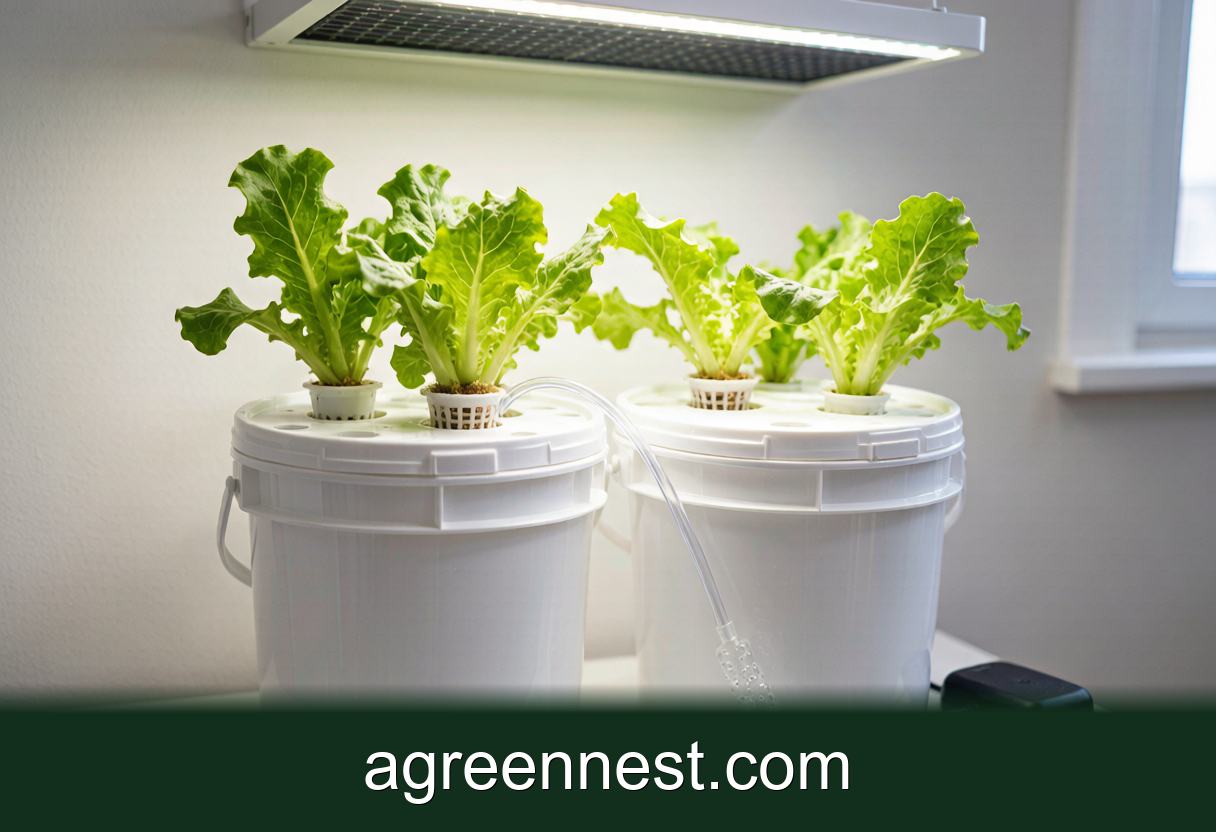
In a 28-day side-by-side test, DWC lettuce with an airstone finished 42 percent heavier than an identical bucket without one, and the still bucket's roots browned by week 3. If your reservoir is topped up and roots sit half-exposed Kratky-style, you can skip the pump; in true full-immersion DWC you cannot.
Forum wisdom says a deep water culture bucket without an air pump is a death sentence. Kratky growers say the opposite: their lettuce grows in still water every day. Both camps quote the same dissolved-oxygen numbers at each other, so I stopped reading and ran the test.
Two identical 10 L buckets, four lettuce seedlings each, 28 days on the same shelf. One bucket got a 4 W air pump and a golf-ball airstone. The other got nothing. Here is exactly what happened, with weights.
The Setup, So You Can Repeat It
Both buckets ran the same recipe: 8 L of nutrient solution at 1.2 EC and pH 5.8, mixed from the same two-part concentrate on the same day. Same seedlings too, Lactuca sativa 'Salanova', started in rockwool and transplanted at the two-true-leaf stage into net pots punched through each lid.
Water level at transplant sat 1 cm above the bottom of the net pots in both buckets, standard practice for young DWC plants. Light was a 24 W LED panel giving both buckets roughly 200 µmol at canopy, 16 hours a day. Room temperature held between 20 and 23 °C, which matters, because oxygen dissolves better in cool water; the relationship is laid out in hydroponic water temperature.
The one variable: bucket A had the airstone running around the clock, bucket B sat still. If you want the baseline system tour first, start with deep water culture explained.
What Happened by Week
Week 1: no visible difference. Both sets of seedlings doubled in size. Early on, young plants sip oxygen slowly, and the top of a fresh reservoir carries enough from the mixing and pouring.
Week 2: the gap opens. Bucket A's roots turned into the white waterfall you want in DWC. Bucket B's roots grew too, but thinner and sparser, and its leaves ran a shade paler. Canopy width: 24 cm vs 19 cm.
Week 3: bucket B's roots started browning. Not the slimy, smelly brown of full-blown rot, but a dull tan creeping up from the tips, with two rusty patches. Growth visibly slowed while bucket A kept stacking leaves. A slimy version of that picture is covered in hydroponic root rot, and bucket B was one warm weekend away from it.
Week 4: harvest. Bucket A yielded 388 g of trimmed lettuce across four heads; bucket B managed 273 g. That is a 42 percent advantage for the airstone, from a device that costs about 12 dollars and burns 4 W.
Why Didn't the Still Bucket Just Die?
Because still water is not zero-oxygen water; it is low-and-falling-oxygen water. Fully aerated water at 21 °C holds roughly 8 to 9 mg/L of dissolved oxygen. Lettuce roots run happily above 5 mg/L and start to struggle below 3 to 4. A still reservoir slides down that curve over days while the plant's demand climbs, which is why week 1 looked fine and week 3 did not. The full chemistry is in dissolved oxygen in hydroponics.
The still bucket also had a partial rescue built in: as the water level dropped 4 cm over the month, a band of upper roots ended up hanging in moist air. Air roots absorb oxygen directly. That is not an accident of my design; it is the entire operating principle of the Kratky method, where the falling water level deliberately creates that moist air gap. Bucket B was drifting toward being a badly configured Kratky bucket, and the Kratky method guide shows what it looks like done on purpose, including why you never top the reservoir back up.
So the honest answer to "do you need an airstone?" is: it depends which system you are actually running. Full immersion with a stable water level, you need the pump. Falling level with an air gap, you are running Kratky and the pump is optional.
Is a Bigger Air Pump Worth It?
Past the minimum, mostly no. Once dissolved oxygen approaches saturation, extra bubbling cannot push it meaningfully higher; you are just making noise and mist. My rule for lettuce-scale DWC: about 1 L/min of pump output per 10 L bucket, through a stone that throws fine bubbles rather than marbles. Fine bubbles carry far more gas-exchange surface per litre of air.
Placement: centre of the bucket floor, directly under the net pot cluster, so the bubble column rises through the root mass and circulates nutrients past it. Stones clog with salt crud in 2 to 3 months; soak them in a 1:1 white vinegar and water bath for an hour, rinse, done. Line the pump with a check valve if it sits below the waterline, or a power cut will siphon your reservoir onto the floor. A basic kit with pump, line, valve, and stone is the cheapest insurance in hydroponics.
One upgrade that beat a bigger pump in my testing: topping off with plain water instead of letting EC creep, since a saltier solution holds slightly less oxygen and stresses roots on two fronts at once. The top-off logic is worked through in top off with plain water or nutrients.
What This Means for Your Bucket
Three configurations, three verdicts from this test:
- Classic DWC, roots fully submerged, level topped up: airstone required, full stop. The 42 percent yield gap is the polite version; a warm week would have turned bucket B's browning roots into rot.
- Kratky, level falling by design: skip the pump. Leave a growing air gap, size the reservoir so it lasts the crop, and do not disturb the air roots.
- Hybrid, pump on a timer: works, and cuts noise at night. In separate runs I saw no measurable loss with 15 minutes on, 45 off, for lettuce at this scale. Fruiting crops are hungrier for oxygen; I would not timer-throttle tomatoes.
If your still-water bucket already shows tan roots and slowed growth, treat it as an oxygen problem first: add a pump, drop the water 2 to 3 cm to expose upper roots, and recheck in a week before reaching for peroxide.
Frequently Asked Questions
Q: My airstone died over a long weekend and the roots went brown. Can they recover?
A: Usually, if the brown is dull tan and odourless. Restore aeration, lower the level to expose 2 to 3 cm of upper root, and new white root tips should appear within 4 to 6 days. If the roots smell sour or slough off when touched, you are past oxygen starvation and into rot; trim and treat.
Q: Can one air pump run two DWC buckets?
A: Yes, with a T-splitter or a dual-outlet pump, but check the output. A pump rated 4 L/min feeding two 10 L buckets gives each 2 L/min, which is plenty. Add inline valves so you can balance the two stones; the shallower stone always hogs the air.
Q: Do bubbles from the airstone raise my pH?
A: Aeration off-gasses dissolved CO2, which nudges pH upward over the first day or two; my aerated bucket drifted from 5.8 to 6.3 in 48 hours while the still one barely moved. It is normal. Check pH twice a week and correct gently, as covered in pH for hydroponics.
Q: Would an air gap plus an airstone beat both my buckets?
A: Probably, and that is close to how commercial rafts run: aerated solution with root shoulders in humid air. At home, running DWC with the level 2 to 3 cm below the net pots after roots are established gives you most of that for free.
A 12-dollar pump bought 42 percent more lettuce; a still bucket survived on a technicality by accidentally imitating Kratky. Match the aeration to the system you are really running, not the one the forum assumed. To size the rest of the setup, run your numbers through our fertilizer calculator before mixing the next reservoir.
Sources & further reading
GreenNest authors research and write every guide independently. The external links below are reputable references we recommend for deeper reading — they are not the sources we copied from.
- Michigan State University — College of Agriculture & Natural Resources — Michigan State University
- University of Minnesota Extension — U Minnesota Extension
Recommended Tools for Hydroponic Growing Care
Free, no-signup helpers matched to this guide.
Free Ebooks to Explore
Downloadable handbooks — no email required.
Free Ebook
The AGreenNest Succulent Care Handbook
The complete, beginner-to-confident guide to growing fat, happy succulents — 10 chapters and a 20-plant directory.
Free Ebook
Haworthia & Haworthiopsis Care Handbook
A focused guide to the striped, forgiving Haworthia clan.
Share Your Plant Story
Grown something tricky, or found a trick that finally worked? Tell us in the comments, or see what other readers are sharing on our Community page. The best reader tips get folded back into our guides.
Join the Conversation
Have a tip or a question about Airstone vs No Airstone in DWC: 28-Day Test? Share it below — comments are saved on our server.