 AGreenNest
Hydroponic Growing
Kratky vs DWC: I Grew Basil in Both for 42 Days
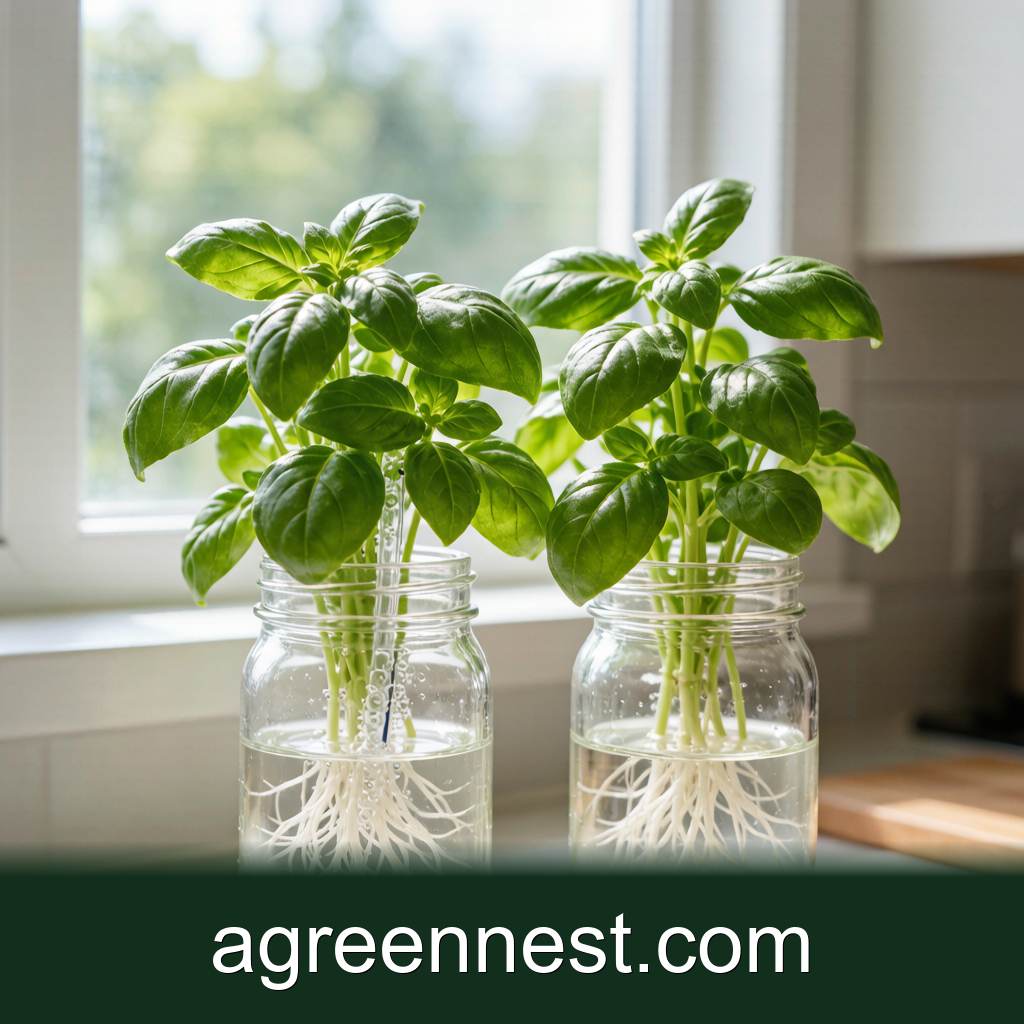
In a 42-day side-by-side basil test, DWC with an air pump produced 41 percent more harvested leaf than passive Kratky (168 g vs 119 g), but Kratky cost nothing to run and needed zero maintenance for the first 3 weeks. For a windowsill herb jar, Kratky wins on effort; for maximum yield, DWC.
Every hydroponics forum has the same argument running on a loop: the air pump crowd insists roots need bubbles, and the Kratky crowd replies that their lettuce never met a pump and grew fine. Numbers are usually absent from both sides.
So I ran it. Two identical 3.8 L wide-mouth jars, two 'Genovese' basil (Ocimum basilicum) seedlings from the same seed tray, transplanted at 14 days old with matched root length (4 cm, give or take a few millimetres). Same south-east window plus a 20 W LED on 14 hours. Same nutrient mix at EC 1.6, pH adjusted to 5.9 at the start. One difference only: jar A got a cheap 2 W air pump and a golf-ball air stone, jar B ran pure Kratky method, lid sealed, no electricity.
Forty-two days, a kitchen scale, and a weekly log. Here is what actually happened.
How Do Kratky and DWC Actually Differ?
Both are still-water hydroponics: roots hang from a net cup into nutrient solution. The split is oxygen strategy.
Deep water culture keeps the water level high and bubbles air through it constantly, so submerged roots get dissolved oxygen around the clock. Kratky starts with the water 2 to 3 cm below the net cup and never tops it up; as the plant drinks, the falling level exposes a growing band of "air roots" that handle oxygen while the tips stay submerged and feed.
On paper, DWC delivers more dissolved oxygen (a running air stone holds a jar near saturation, roughly 8 to 9 mg/L at 20 °C) while a sealed Kratky jar drifts along at whatever diffusion provides. The question is what that gap is worth in leaves.
What Did 42 Days of Data Show?
Week by week, the jars told a clear story:
| Day | Kratky height | DWC height | Notes |
|---|---|---|---|
| 7 | 11 cm | 12 cm | No visible difference |
| 14 | 17 cm | 21 cm | DWC roots already twice the mass |
| 21 | 24 cm | 31 cm | First harvest both jars |
| 28 | 29 cm | 38 cm | Kratky water down 1.9 L |
| 42 | 36 cm | 47 cm | Final cut, scale time |
Total harvested leaf over three cuts: 119 g from Kratky, 168 g from DWC. That is a 41 percent yield gap in DWC's favour.
The gap opened between days 10 and 21, exactly when the plants shifted from establishing roots to building canopy. Early on, both had ample oxygen because both root systems were small. Once the basil hit its stride, the pumped jar grew faster every single week. Nothing dramatic on any given day; a steady 1 to 1.5 cm per week advantage that compounded.
Root inspection at the end was the most visual difference. DWC roots came out bright white, dense, like a wet wig. Kratky roots were cream coloured, sparser, with the distinct two-zone structure the method is famous for: dry-ish upper roots, wet lower ones. Neither jar showed slime or the sulphur smell of hydroponic root rot, though my water sat at 22 to 24 °C through the test, near the top of the safe range.
Where Kratky Won Anyway
The scale says DWC, but the logbook says it is not that simple.
Effort. Kratky received literally zero interventions for the first 21 days. No topping up, no pH checks after the initial set, nothing. The DWC jar needed a top-up on day 16 and again on day 30, plus a pH correction on day 24 when it had crept to 6.8. If you mix nutrients ahead, storing the concentrate properly matters more for DWC because you keep coming back to it.
Cost. The pump draws 2 W continuously: about 2 kWh over six weeks, plus the pump (mine cost 12 euros), airline and stone. Trivial for one jar, real money at ten jars. Kratky's running cost is zero.
Noise and placement. The pump hums. My kitchen windowsill is next to where I drink coffee, and I noticed it every morning. Kratky is silent and cordless, which means it can live anywhere light exists, including shelves with no socket in reach.
Failure modes. A power cut kills DWC slowly (roots deplete oxygen in hours in warm water); Kratky does not care. On the other hand, Kratky cannot be topped up meaningfully without wrecking the air-root zone, so a fast-drinking plant in a small jar can strand itself. My 3.8 L jar had 0.4 L left on day 42; a 2 L jar would have run dry by week four.
Taste, for the record: no detectable difference. I ran a blind smell-and-chew test on two housemates. Both shrugged.
Which One Should You Run?
My verdict after doing both side by side:
- One to three jars of herbs on a windowsill: Kratky. The 41 percent yield penalty on basil still left me with more than 100 g of leaves from one jar, which is several rounds of pesto. Zero effort is worth more than extra basil I would not finish. Start with a proper Kratky setup sized at 3 to 4 L per basil plant.
- A dedicated grow corner chasing yield, or thirsty fruiting plants: DWC. Tomatoes and peppers drink too fast and demand too much oxygen for sealed jars; they want the pump.
- Warm rooms above 26 °C: DWC, reluctantly. Warm water holds less oxygen, and Kratky has no way to compensate. The pump becomes insurance.
Whichever you pick, the nutrient side is identical: EC 1.2 to 1.6 for basil, pH 5.8 to 6.2, and a proper two-part feed beats generic all-purpose fertiliser.
Frequently Asked Questions
Q: My Kratky basil grew fine for a month and then suddenly wilted in a week. What happened?
A: Check the water level first. Once the reservoir drops below the last 10 percent, EC concentrates sharply as the plant drinks water faster than nutrients, and the roots burn right at the finish line. In my test the EC in the Kratky jar rose from 1.6 to 2.4 by day 42 with 0.4 L remaining. Bigger container, or harvest the plant whole when the level gets low.
Q: Can I convert my Kratky jar to DWC halfway through a grow?
A: Yes, and it works better than the reverse. Top the reservoir back up to 2 cm below the net cup, drop in an air stone, and the exposed air roots adapt within days. Going DWC to Kratky mid-grow risks drowning roots that never developed the two-zone structure.
Q: Does the air stone need to run 24/7 or can I put it on a timer?
A: In a small jar at room temperature, 15 minutes on and 45 off maintained dissolved oxygen well enough in my follow-up tinkering, but the savings are pennies and the risk of a stuck timer is a dead plant. I run mine continuously. If noise is the issue, move the pump, not the schedule.
Q: Would the 41 percent gap hold for lettuce too?
A: Probably smaller. Lettuce finishes in 30 to 35 days and never builds the root mass or canopy that basil does by week six, so it spends less time in the oxygen-limited zone. Kratky was literally invented around lettuce. For anything harvested young, expect the methods to run much closer.
The bubbles are real: 168 g versus 119 g is not forum folklore, it is my kitchen scale. But a 41 percent yield gap bought with a pump, a cable, a hum and two top-ups is a trade, not a win, and for a windowsill herb jar I would take the silent one that never asks for anything. Size your jar right and check your numbers with our free fertilizer calculator before you mix the first reservoir.
Sources & further reading
GreenNest authors research and write every guide independently. The external links below are reputable references we recommend for deeper reading — they are not the sources we copied from.
- Michigan State University — College of Agriculture & Natural Resources — Michigan State University
- University of Minnesota Extension — U Minnesota Extension
- NC State Extension Plant Toolbox — NC State Extension
Recommended Tools for Hydroponic Growing Care
Free, no-signup helpers matched to this guide.
Free Ebooks to Explore
Downloadable handbooks — no email required.
Free Ebook
The AGreenNest Succulent Care Handbook
The complete, beginner-to-confident guide to growing fat, happy succulents — 10 chapters and a 20-plant directory.
Free Ebook
Haworthia & Haworthiopsis Care Handbook
A focused guide to the striped, forgiving Haworthia clan.
Share Your Plant Story
Grown something tricky, or found a trick that finally worked? Tell us in the comments, or see what other readers are sharing on our Community page. The best reader tips get folded back into our guides.
Join the Conversation
Have a tip or a question about Kratky vs DWC: I Grew Basil in Both for 42 Days? Share it below — comments are saved on our server.