 AGreenNest
Hydroponic Growing
Rockwool vs Sponge Plugs: Which Starts Seeds Better?
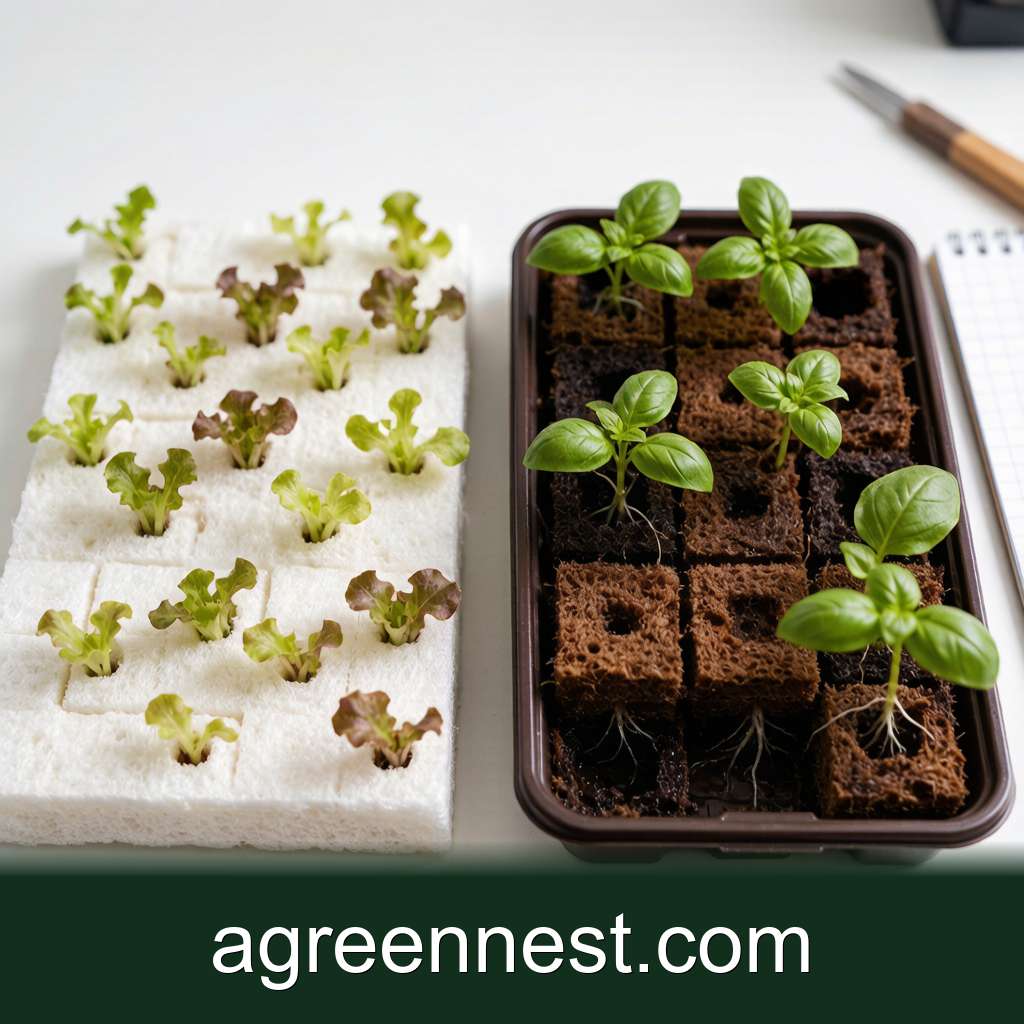
Rockwool cubes hold more water and cost roughly half as much per seedling, but they arrive at pH 7.5 to 8.0 and need a soak in pH 5.5 water before use. Sponge plugs work straight from the bag and root lettuce 2 to 3 days faster, at about double the price.
A reader sent me a photo last month of 24 rockwool cubes, every one crowned with a limp lettuce seedling, and asked what disease had struck. No disease. The cubes had gone in dry from the packet, unsoaked, and 24 seeds had tried to germinate at around pH 7.8. Lettuce wants 5.5 to 6.0. They never had a chance.
That failure is the whole rockwool-versus-sponge argument in one image. Rockwool is cheap, consistent and holds water like nothing else, but it punishes anyone who skips the prep. Sponge plugs forgive the prep and charge you for the privilege. After starting a few hundred seedlings in each, the split is clear enough to put into numbers.
What Are These Two Plugs Actually Made Of?
Rockwool (stone wool) is spun from molten basalt, the same material as loft insulation but made to a horticultural grade with a wetting agent. A standard 25 mm starter cube holds roughly 80 percent water and 15 percent air at saturation, is sterile out of the bag, and contains zero nutrition. It is also mildly alkaline by nature; fresh cubes test at pH 7.5 to 8.0, the trap my reader fell into.
Sponge plugs (the brown ones sold with most countertop gardens, plus brands sold loose in trays) are peat or coco fibre bonded with a biodegradable polymer foam. They arrive near-neutral, typically pH 5.8 to 6.5, hold slightly less water than rockwool, and have a softer, more open texture.
Both fit standard 25 mm net-cup collars and work in every system I have tried, from Kratky jars to NFT channels. The differences show up in the first 14 days.
Which Plug Germinates Seeds Faster?
I ran matched batches through both media this spring: 'Salanova' lettuce, 'Genovese' basil (Ocimum basilicum), and bell peppers, 18 seeds per medium per crop, same 22 °C heat mat, dome, and light schedule.
| Crop | Rockwool (soaked, buffered) | Sponge plug |
|---|---|---|
| Lettuce, day-7 germination | 16 of 18 | 17 of 18 |
| Basil, day-7 germination | 15 of 18 | 15 of 18 |
| Pepper, day-10 germination | 13 of 18 | 14 of 18 |
| Lettuce, roots out of plug | day 9 to 10 | day 7 |
| Basil, roots out of plug | day 11 | day 9 |
Germination rates were a wash. Prepared properly, rockwool matches sponge within a seed or two per tray, inside the noise for a home test.
Root-through speed was not a wash. Seedlings escaped the sponge plugs 2 to 3 days earlier across every crop; the looser fibre offers less resistance, and earlier root-through means earlier transplant and an earlier first harvest. For hydroponic lettuce on a tight rotation, 2 days per cycle compounds into an extra harvest per year.
The asterisk on all of this: my rockwool numbers came from cubes soaked overnight in pH 5.5 water. Unbuffered cubes would have replayed the reader's photo.
Why Does Rockwool Need a pH Soak and Sponge Does Not?
The basalt fibres are inert, but the manufacturing process leaves fresh rockwool alkaline. A dry cube dropped straight into your system drags the root-zone pH toward 7.5 for days, locking iron and manganese away from the seedling exactly when it needs them. The fix costs a bucket and patience:
- Fill a container with water adjusted to pH 5.5.
- Submerge the cubes for 8 to 12 hours (overnight is fine). Do not squeeze them, wet rockwool tears and squeezing collapses the air pores permanently.
- Lift them out, let them drain freely for a minute, and sow.
After that soak, the cube sits stable in the 5.5 to 6.5 band for the rest of its life. Sponge plugs skip this because peat is naturally acidic; manufacturers blend it to land near 6.0. Straight from bag to tray, no meter required, which is honestly the main thing you are paying for. My hydroponic pH management guide covers the full logic if drift confuses you.
Cost, Algae and the Annoyances Nobody Mentions
Cost per seedling. Loose rockwool starter cubes run 4 to 7 cents each by the sheet of 98 or 200. Brand-name sponge plugs land between 10 and 30 cents depending on how captive you are to a proprietary system; generic trays of 50 sit near the bottom of that range. Starting 20 lettuce a month, the gap is trivial. Starting 200, rockwool saves real money.
Algae. Both media grow green fuzz on any wet surface under light, but rockwool shows it worse because the cube top stays wetter longer. The fix is the same for both: keep the exposed top dry-ish by watering from below, and cover cube tops in the system. The prevention playbook in preventing algae in hydroponics applies unchanged.
Handling. Rockwool fibres itch. Not dangerously at hobby scale, but dry cubes shed dust worth not inhaling; I wet sheets before breaking cubes apart. Sponge plugs have no such issue. On disposal, sponge composts; rockwool goes to landfill, which for some growers settles the argument by itself.
Overwatering tolerance. Rockwool's water grip cuts both ways. Cubes in a constantly flooded tray sit at field capacity and invite damping off and early hydroponic root rot. Sponge plugs drain freer and shrug off a sloppy tray better. If your seedlings historically die wet, that alone points to sponge.
So Which One Should You Buy?
Buy sponge plugs if: you start fewer than about 30 seedlings a month, you do not own a pH pen yet, you compost, or you have already killed a tray of seedlings in rockwool once. The extra 10 to 20 cents per plant buys away the entire prep step and a couple of days of grow time.
Buy rockwool if: you start seedlings in volume, you already manage pH as a habit, or you need the fine size gradation rockwool offers (25 mm starters that slot into 75 mm blocks for bigger transplants, something no sponge system does as cleanly). It remains the cheapest consistent start in hydroponics, and the pH soak takes 5 minutes of actual work.
Beginners get my honest answer in the beginner hydroponics guide too: start with sponge, switch to rockwool the month the plug bill annoys you.
Frequently Asked Questions
Q: My rockwool cubes came pre-formed with a small hole. How deep do I sow in it?
A: Use the hole as-is for lettuce, basil and most greens, and drop the seed 5 to 8 mm down. For bigger seeds like cucumber or pepper, push to about 10 mm and pinch the hole loosely shut. Sowing deeper than 10 mm in a 25 mm cube delays emergence noticeably.
Q: Do sponge plugs fall apart in a Kratky jar over a long grow?
A: The bonded foam types hold together for a full lettuce or basil cycle, 60 to 90 days, without shedding. Cheap unbonded peat pellets in netting are a different product and do slump. If a plug will sit in a system past 3 months, rockwool holds its shape better.
Q: Why did algae turn my rockwool cube tops green but not the sides?
A: Algae needs light plus moisture, and only the top surface gets both. It steals little directly but hosts fungus gnats. Cover the tops with net-cup collars or foil discs, and bottom-water so the surface stays drier.
Q: Do I need to add nutrients while seeds germinate in either plug?
A: No. Seeds carry their own reserves until the first true leaves appear. Plain pH-adjusted water until that point, then quarter-strength nutrient solution, stepping to half strength a week later. Full-strength feed on a fresh sprout burns root tips in both media.
Rockwool and sponge plugs both start seeds well; they just bill you differently, one in prep time and one in cash. Match the medium to your volume and habits rather than to forum loyalty. And whichever you pick, track your seedlings against a realistic schedule with our propagation timeline tool so a slow week tells you something is off while you can still fix it.
Sources & further reading
GreenNest authors research and write every guide independently. The external links below are reputable references we recommend for deeper reading — they are not the sources we copied from.
- Michigan State University — College of Agriculture & Natural Resources — Michigan State University
- University of Minnesota Extension — U Minnesota Extension
- NC State Extension Plant Toolbox — NC State Extension
Recommended Tools for Hydroponic Growing Care
Free, no-signup helpers matched to this guide.
Free Ebooks to Explore
Downloadable handbooks — no email required.
Free Ebook
The AGreenNest Succulent Care Handbook
The complete, beginner-to-confident guide to growing fat, happy succulents — 10 chapters and a 20-plant directory.
Free Ebook
Haworthia & Haworthiopsis Care Handbook
A focused guide to the striped, forgiving Haworthia clan.
Share Your Plant Story
Grown something tricky, or found a trick that finally worked? Tell us in the comments, or see what other readers are sharing on our Community page. The best reader tips get folded back into our guides.
Join the Conversation
Have a tip or a question about Rockwool vs Sponge Plugs: Which Starts Seeds Better?? Share it below — comments are saved on our server.