 AGreenNest
Hydroponic Growing
Cloudy Hydroponic Water: 4 Causes and Fixes
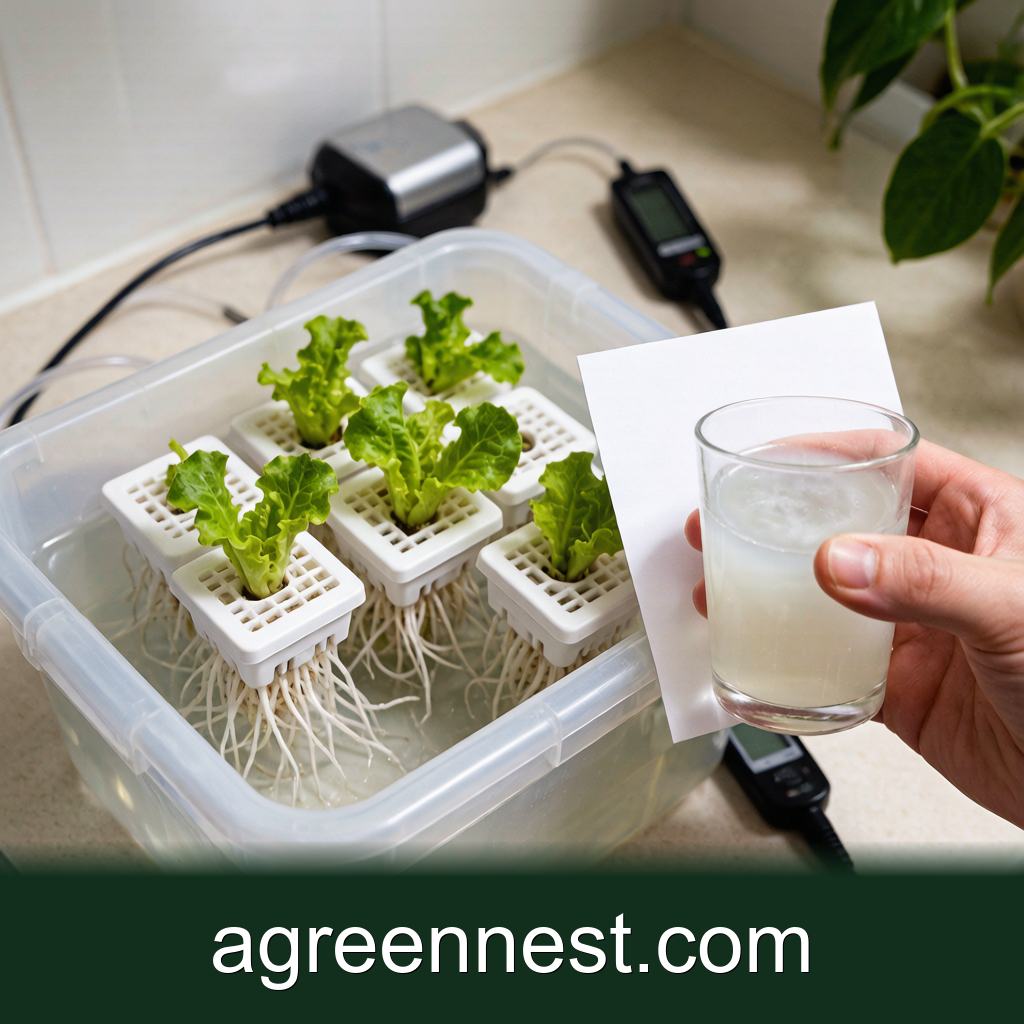
Cloudy hydroponic water has four causes you can tell apart fast: white haze with a sour smell is bacterial bloom, green tint is algae, brown murk with slimy roots is root rot, and instant milky white after adding nutrients is precipitation from mixing concentrates. Match the colour and smell, then apply the specific fix below.
Clear on Monday, milk by Friday. A reader sent me that exact timeline last month with a photo of his lettuce reservoir, and he had already done what most people do: dumped the water, refilled, and watched it cloud again in four days. Water changes alone rarely fix cloudy hydro water, because the cloud is a symptom. Something in the system is feeding it.
There are four realistic causes, and you can separate them in about five minutes with your nose, your eyes, and a pH pen. No lab needed. Here is the diagnostic, then the exact fix for each.
What Does the Colour of the Cloud Tell You?
Pull a glass of reservoir water, hold it against white paper, and smell it. Match against this table:
| Appearance | Smell | Roots | Most likely cause |
|---|---|---|---|
| White or grey haze | Sour, sulphurous | White but water feels slick | Bacterial bloom |
| Green tint or film | Earthy, pond-like | Usually fine | Algae |
| Brown or tan murk | Rot, swampy | Brown, slimy, shedding | Root rot (Pythium) |
| Milky white minutes after mixing | None | Fine | Nutrient precipitation |
The timing matters as much as the colour. Cloud that appears within 30 minutes of adding nutrients is chemistry, not biology; nothing grows that fast. Cloud that builds over 3 to 5 days is a living population doubling.
Why Did the Water Turn Milky Right After Adding Nutrients?
You mixed the concentrates together, or dosed them too close in sequence. Calcium nitrate reacting with sulphate and phosphate salts forms insoluble calcium sulphate and calcium phosphate: fine white particles that never dissolve back. That is the entire reason two-part A and B formulas exist as separate bottles.
The fix is procedural. Fill the reservoir with water first, add part A, stir for 30 seconds or let the air pump circulate for 2 minutes, then add part B. Never pour A into B undiluted, not even a splash in the measuring cup. If you already have precipitation, drain and remix; the fallen-out calcium and sulphur are no longer plant-available, so the solution is now deficient in exactly the elements you cannot see. My guide to A/B/C nutrient formulas covers mixing order in detail, and if you pre-mix stock solutions, store them separately.
Hard tap water above roughly 200 ppm CaCO3 makes this worse because you are starting with extra calcium. If your water is hard and every batch hazes slightly, compare tap versus RO water before blaming the fertiliser.
Is White Haze With a Sour Smell Always Bacteria?
In my experience, yes, and the trigger is nearly always organic matter plus warmth. Heterotrophic bacteria eat dead root fragments, algae corpses, and organic additives, and their population doubles roughly every 20 to 30 minutes in warm nutrient solution. A reservoir at 26 °C can go from clear to opaque in 48 hours. At 18 to 20 °C the same population takes over a week to become visible.
Fix it in this order:
- Drain fully and scrub the reservoir walls with a brush; the slick biofilm on the plastic reseeds the next batch. Rinse with a 1:10 bleach solution, then rinse twice with plain water.
- Trim dead root material hanging loose in net pots.
- Cut the water temperature. Target 18 to 21 °C. Move the reservoir off warm floors, shade it, or freeze two water bottles and rotate them in daily. Every degree below 24 °C slows the bloom measurably; my water temperature guide lists cooling options by cost.
- Drop organic additives. Molasses, fish emulsion, and kelp in a warm reservoir are bacteria food. Switch to a fully mineral formula until the system runs clear for two weeks.
A bacterial haze is not automatically killing your plants, but it strips dissolved oxygen fast. If your air pump is small, upgrade the airflow; dissolved oxygen management is the difference between a haze that passes and roots that suffocate.
Green Water: Where Is the Light Getting In?
Algae need light, water, and nutrients. You control exactly one of those, so light-proofing is the whole fix. Green water means photons are reaching solution, full stop. The usual entry points, in the order I find them: translucent reservoir walls, the gap around net pots, uncovered inspection holes, and clear airline tubing that acts as a light pipe.
Wrap translucent bins in black-and-white poly film or aluminium tape, black side out is fine but reflective white keeps the water cooler. Cap net pot gaps with foam collars or clone collars. A reservoir that passes the test shows no glow when you shine a torch inside the closed lid in a dark room. Long-term prevention tactics are in my algae prevention guide.
One warning: a dying algae population after you light-proof becomes bacteria food, so expect a brief white haze afterward. Run the air pump hard, and do one extra water change a week after sealing.
Brown Murk and Slimy Roots: How Bad Is It?
Bad. Brown cloud plus roots that feel like wet tissue paper and shed when touched is Pythium, water mould, and it spreads through a shared reservoir to every plant. Healthy hydro roots are white to cream and firm; the smell test is definitive, because Pythium rot smells like a swamp.
Act the same day. Remove affected plants, trim every brown root section back to firm tissue with sterilised scissors, drain and disinfect the whole system, and restart with cool, heavily aerated solution. The full protocol, including survival rates I have seen at each stage, is in my hydroponic root rot rescue. Plants that keep 30% or more of their root mass usually recover; seedlings with full brown-out rarely do.
Prevention circles back to the same two numbers: solution at 18 to 21 °C and dissolved oxygen kept high with an air stone rated for at least your reservoir volume.
Frequently Asked Questions
Q: My water clouds within a day of every full change. What am I missing?
A: Biofilm. Bacteria coating the reservoir walls, pump, and tubing reseed each fresh batch instantly. Do a full teardown: scrub every surface, run 1:10 bleach water through the pump and lines for 10 minutes, rinse twice, then refill. If it still clouds, check water temperature; above 24 °C the cycle restarts regardless.
Q: Is cloudy water from beneficial bacteria products like hydroguard normal?
A: A slight temporary haze in the first 24 hours after dosing is normal and settles. A haze that thickens over days, or any sour smell, means opportunistic bacteria outcompeted the beneficial strain, usually because the reservoir is too warm.
Q: Can I just add hydrogen peroxide to clear cloudy water?
A: It clears the symptom for 2 to 3 days, then the cloud returns, because peroxide oxidises everything including beneficial microbes and breaks down within hours. It also does nothing about the heat, light, or organic matter feeding the bloom. Use it as a reset during a teardown, not as maintenance.
Q: Do I need to toss lettuce grown in a reservoir that went cloudy?
A: No. A bacterial or algal bloom in the root zone does not contaminate the leaves. Wash harvested leaves normally. The exception is severe root rot; harvest what is edible now, because the plant will decline.
Q: My Kratky jar clouded but there is no pump to blame. Same causes?
A: Same four, but Kratky skews toward algae (glass jars leak light badly) and bacterial bloom (no aeration, warmer water). Paint or wrap the jar and keep it out of direct sun. Passive systems have less oxygen buffer, so they cloud faster once anything starts.
Cloudy water is the reservoir reporting a specific problem: chemistry if it is instant, algae if it is green, bacteria if it smells sour, rot if it is brown. Match the symptom, apply the one fix that targets it, and stop paying for water changes that treat nothing. If slimy roots are part of your picture, grade the damage with our root health checker.
Sources & further reading
GreenNest authors research and write every guide independently. The external links below are reputable references we recommend for deeper reading — they are not the sources we copied from.
- Michigan State University — College of Agriculture & Natural Resources — Michigan State University
- University of Minnesota Extension — U Minnesota Extension
- NC State Extension Plant Toolbox — NC State Extension
Recommended Tools for Hydroponic Growing Care
Free, no-signup helpers matched to this guide.
Free Ebooks to Explore
Downloadable handbooks — no email required.
Free Ebook
The AGreenNest Succulent Care Handbook
The complete, beginner-to-confident guide to growing fat, happy succulents — 10 chapters and a 20-plant directory.
Free Ebook
Haworthia & Haworthiopsis Care Handbook
A focused guide to the striped, forgiving Haworthia clan.
Share Your Plant Story
Grown something tricky, or found a trick that finally worked? Tell us in the comments, or see what other readers are sharing on our Community page. The best reader tips get folded back into our guides.
Join the Conversation
Have a tip or a question about Cloudy Hydroponic Water: 4 Causes and Fixes? Share it below — comments are saved on our server.