 AGreenNest
Succulent Care
How to Behead and Regrow a Leggy Succulent
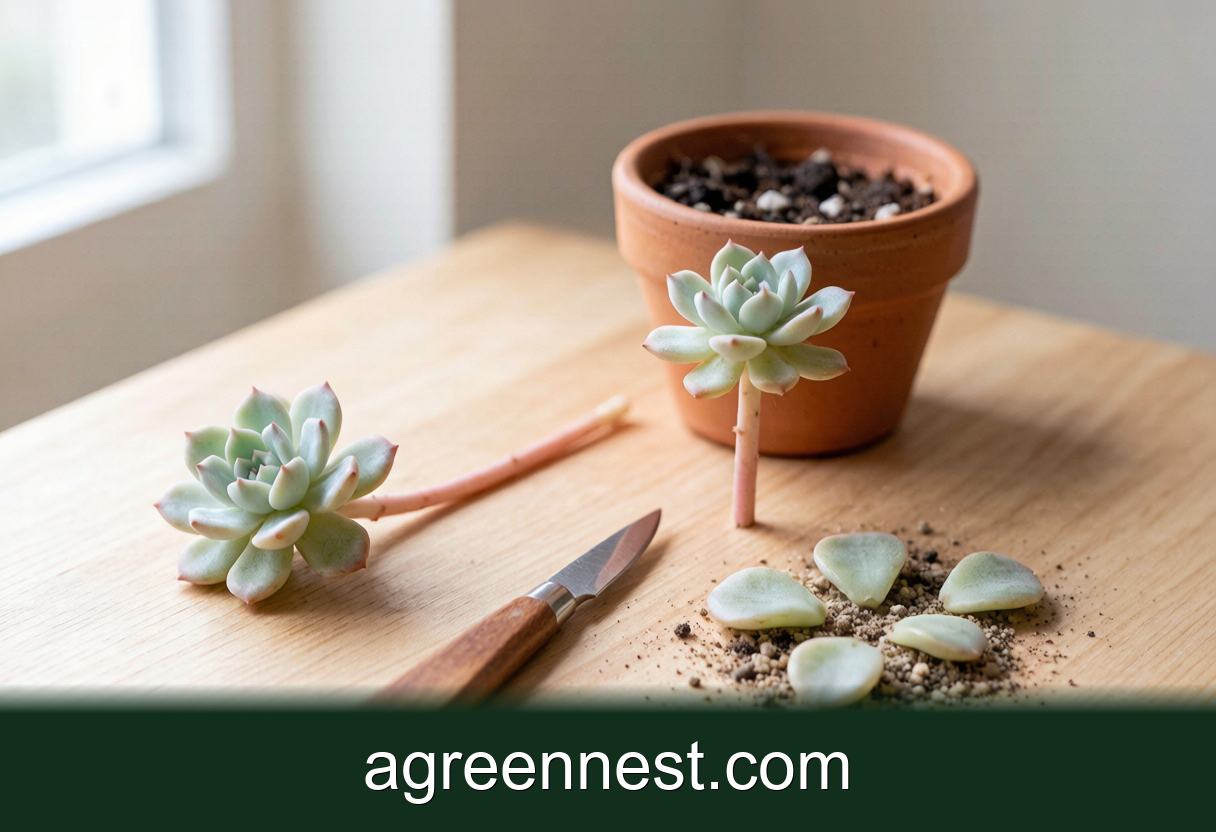
Beheading a leggy succulent means cutting the rosette off with 3 to 5 cm of stem, letting the cut callus for 4 to 7 days, then setting it on dry gritty mix to root. Roots appear in 2 to 4 weeks. The old stump usually pushes 2 to 5 offsets rather than dying.
My first Echeveria elegans spent a winter on a north sill and came out looking like a pale green lollipop. Eight centimetres of naked pink stem, a rosette the size of a plum tipped sideways at the top, and daylight showing between the bottom leaves.
I kept it like that for months, hoping it would fill back in. It never does. Stretched stem tissue is permanent, and the only way back to a tight rosette is a knife.
Why Does a Succulent Go Leggy in the First Place?
Not enough light, and the plant is doing exactly what evolution told it to do.
When a succulent receives less light than it needs, it puts its energy into vertical growth to reach for more. The internodes, the gaps between leaf attachment points, stretch from 2 or 3 mm out to 10 or 15 mm. The rosette opens up. Colour drains toward pale green, because the plant drops the red and purple pigments it only produces under strong light.
Most rosette succulents want 6 or more hours of direct or very bright light, somewhere in the 10,000 to 25,000 lux range. A typical north-facing sill in winter delivers 800 to 2,000 lux. That is not a small shortfall, it is a factor of ten. I go through the full diagnosis in why succulents stretch and turn pale, and the etiolation guide lays out the tell-tale signs side by side.
Is Beheading the Right Fix, or Just Drastic?
It sounds brutal. It is the standard propagation method for rosette succulents, and the plant handles it better than you will.
Behead when:
- The stem is bare for 3 cm or more and the rosette sits at an angle.
- The plant has toppled or is about to.
- Internodes near the top are still wide, meaning the stretching is ongoing.
Do not behead when:
- The plant is a Haworthiopsis attenuata or Gasteria, which grow from a compact crown and produce offsets at the base instead. Divide those.
- The plant is in the middle of a heat-stalled summer dormancy, common in Aeonium arboreum from July to August. Wait for autumn.
- The stem has soft, brown, or squashy patches. That is rot, not stretch, and it needs a different rescue.
Timing matters less than people fear. Spring and early autumn root fastest, but I beheaded an Echeveria in November under a grow light and had roots in 19 days.
Where Exactly Do You Cut?
Leave more stem than feels necessary. That is the one instruction I wish someone had shouted at me.
Sterilise a thin blade with 70 percent isopropyl alcohol. A craft knife or a clean pair of snips both work, secateurs crush the tissue on anything under 1 cm thick.
Cut straight across the stem 3 to 5 cm below the lowest healthy leaf of the rosette. That length gives you something to bury later, and it keeps the cut surface well away from the leaf bases where rot likes to start.
Now strip the lower leaves, leaving 2 to 3 cm of clean stem. Hold each leaf at its base and rock it sideways until it releases with a small click. A clean break takes the growth point with it, so every leaf can become a new plant. A torn leaf will not root.
Set the cutting somewhere dry, bright, and out of direct sun for 4 to 7 days at 18 to 24 °C. The cut end dries into a pale, firm scab. Skip this step and you are planting an open wound into damp soil, which is how most beheading attempts fail.
How Do You Root the Cutting?
Dry mix first, water later. That order is the whole trick.
Fill a 7 or 8 cm pot with a gritty blend, my usual is 2 parts potting soil to 2 parts pumice or coarse perlite to 1 part fine bark. If you would rather buy it ready-mixed, the best soils for succulents roundup covers what to look for on the bag.
Sit the callused stem on the surface, or push it in 1 cm at most. Do not water. Put the pot in bright indirect light for the first fortnight, then move it into a few hours of gentle morning sun.
Roots usually appear at 2 to 4 weeks. Give the cutting a light tug: resistance means it has anchored. Now water properly, soaking the mix until it drains, then leave it alone until the soil is dry through. My rooted Graptopetalum paraguayense cuttings drink about every 12 days at 21 °C in a 7 cm terracotta pot.
A mistake I repeated three times: daily misting does nothing useful. It keeps the callus damp and invites fungus. The cutting lives off the water in its own leaves for weeks.
What Happens to the Stump?
This is the part that surprises people. The stump is usually the more productive half.
Leave it in its original pot, in the same bright spot, and water it lightly every 10 to 14 days. Within 3 to 8 weeks, dormant buds at the old leaf nodes wake up and push offsets. My beheaded Echeveria stumps have averaged 3 pups each, and the record was 6 on a Crassula ovata.
Let the pups reach 3 cm across before removing them, or leave them in place for a clustered look.
Meanwhile the stripped leaves propagate too. Lay them on dry mix, do not bury them, keep them out of direct sun. Roots and a tiny pink rosette appear in 3 to 6 weeks. Expect about half to take: Sedum morganianum leaves root at close to 90 percent, Kalanchoe tomentosa nearer 30 percent.
One beheading, twenty minutes of work, gave me a rooted rosette, three pups and five leaf babies.
What Keeps Them From Stretching Again?
Light, and honesty about how much your window really gives.
Move the rooted cutting into 6 hours of direct sun over 2 to 3 weeks, not overnight, or the pale winter tissue scorches. A grow light 25 to 30 cm above the rosette for 12 hours a day does the same job in a dark flat. Rotate the pot a quarter turn weekly so the rosette stays symmetrical.
Also check pot size. A cutting in a 15 cm pot sits in damp mix far too long, which softens growth again. Match the pot to the root ball, an error I see constantly in repotting mistakes.
Frequently Asked Questions
Q: My cutting has sat on dry soil for six weeks with no roots. Is it dead?
A: Probably not, if the leaves are still firm. Cold is the usual cause, since rooting stalls below 15 °C. Move it somewhere warmer and brighter. If the stem end has gone brown and dry, cut 1 cm off, re-callus for 4 days, and start again.
Q: Can I put the beheaded rosette straight into water instead?
A: You can, and it roots in about 10 days, but water roots are thin and adapt poorly to gritty mix. Around a third of mine sulked for a month after transplanting. Dry rooting is slower and less dramatic.
Q: How much stem should I leave on the stump?
A: At least 4 to 5 cm with two or three leaf nodes still attached, because those nodes are where the pups come from. A stump cut flush to the soil often has no buds left to work with.
Q: The cut end is oozing sap. Should I do anything?
A: For Echeveria and Sedum, no, it stops within an hour. Euphorbias are different: the white latex is a skin and eye irritant, so wear gloves and rinse the cut with cool water to stop the flow.
A leggy succulent is not a failed plant, it is a plant that told you about your window and got no reply. Cut it, callus it, root it, and keep the stump. Then fix the light before the new rosette repeats the story. If you are not certain your sill measures up, run it through our free light calculator first.
Sources & further reading
GreenNest authors research and write every guide independently. The external links below are reputable references we recommend for deeper reading — they are not the sources we copied from.
- Royal Horticultural Society — Houseplant care — RHS
- Missouri Botanical Garden — Plant Finder — Missouri Botanical Garden
- NC State Extension Plant Toolbox — NC State Extension
Recommended Tools for Succulent Care
Free, no-signup helpers matched to this guide.
Free Ebooks to Explore
Downloadable handbooks — no email required.
Free Ebook
The AGreenNest Succulent Care Handbook
The complete, beginner-to-confident guide to growing fat, happy succulents — 10 chapters and a 20-plant directory.
Free Ebook
Haworthia & Haworthiopsis Care Handbook
A focused guide to the striped, forgiving Haworthia clan.
Share Your Plant Story
Grown something tricky, or found a trick that finally worked? Tell us in the comments, or see what other readers are sharing on our Community page. The best reader tips get folded back into our guides.
Join the Conversation
Have a tip or a question about How to Behead and Regrow a Leggy Succulent? Share it below — comments are saved on our server.