 AGreenNest
Succulent Care
Echeveria vs Sempervivum: Which Rosette Is It?
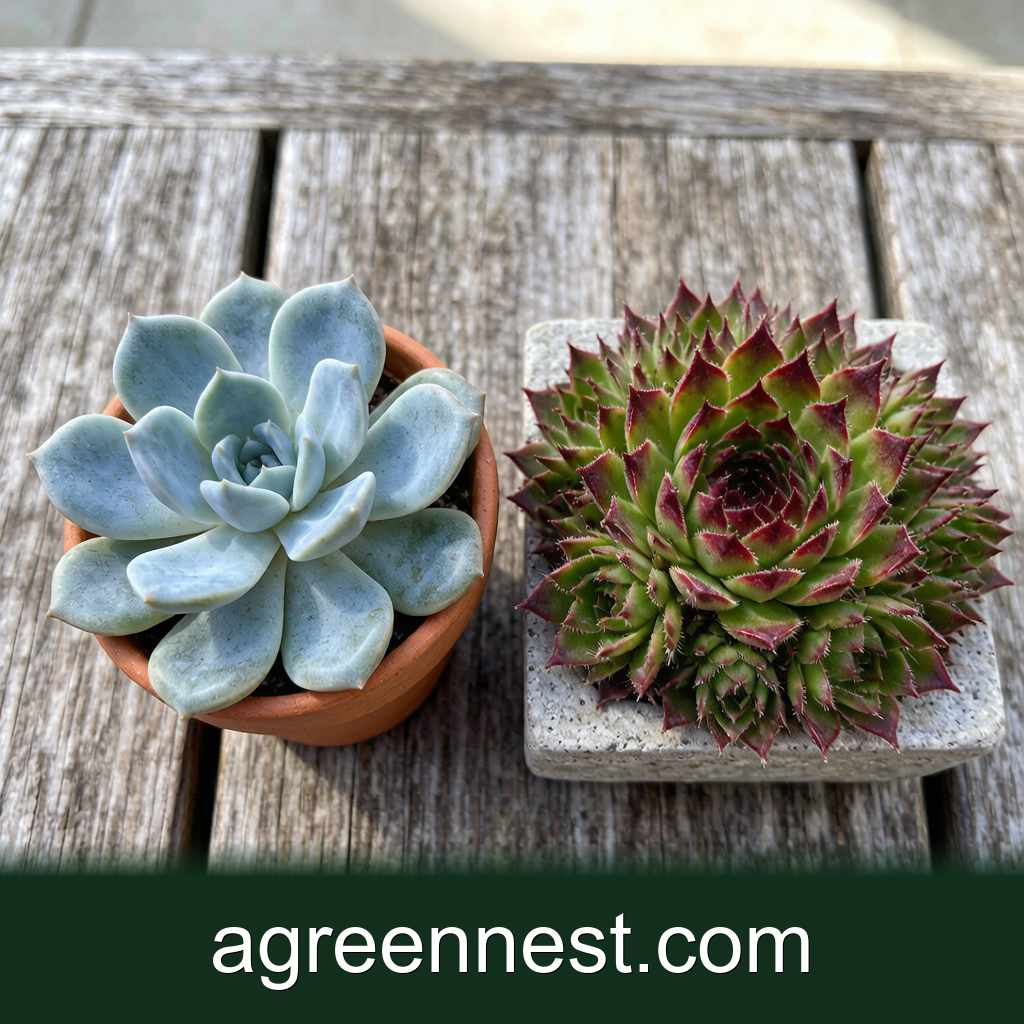
Echeverias have plump, smooth-edged leaves with a powdery coating and die below about -1°C, so they live indoors in most climates. Sempervivums (hens and chicks) have thinner leaves with tiny hairs along the edges, survive -30°C outdoors, and each rosette dies after flowering. Feel the leaf edge: fringed means sempervivum.
My neighbour once handed me a tray of rosettes over the fence in October. "Extra hens and chicks," she said, "they'll be fine on your steps all winter." Half of them were. The other half were echeverias someone had mixed into the tray, and the first hard frost in November turned them to grey mush overnight while the true sempervivums next to them sat under snow without a mark.
Same shape, same tray, opposite fates. That is the whole reason this comparison matters: these two rosettes are near-twins on a shelf and complete strangers in their tolerance for cold.
Why Do These Two Get Confused So Often?
Both grow as tight, symmetrical rosettes in the 5 to 15 cm range. Both come in dusty blues, greens, and wine reds. Both pup readily and turn up in the same "assorted succulents" trays at supermarkets, usually with no label beyond a barcode.
The confusion is baked in at the nursery level. Echeveria elegans is even nicknamed "Mexican snowball" while Sempervivum tectorum goes by "hens and chicks", and plenty of shops apply the hens-and-chicks name to both. I have seen the two genera share a single label more times than I can count.
Their homelands explain everything that follows. Echeverias come mostly from mid-altitude Mexico, mild in winter and dry. Sempervivums grow on rocky slopes in the mountains of Europe, from the Alps to the Carpathians, where winter means months under snow. One evolved for warmth, one for cold, and neither can fake the other's hardiness.
What Do the Leaves Tell You?
Pick the plant up and look closely at a single leaf. Three tells settle most identifications in under a minute.
Edge fringe. This is my favourite because it never lies. Sempervivum leaf margins carry a row of fine hairs, called cilia, that catch the light like tiny eyelashes; on the cobweb houseleek (Sempervivum arachnoideum) the hairs go further and knit a white web across the whole rosette. Echeveria margins are clean and smooth, no fringe at all.
Leaf thickness. Echeveria leaves are noticeably plumper, often 5 to 8 mm thick at the base, and snap juicily if bent. Sempervivum leaves are thinner and slightly flexible, more like stiff petals than wedges.
The powder test. Many echeverias wear farina, a silvery, powdery wax that fingerprints if you touch it (try not to; it is the plant's sunscreen). Sempervivums never carry that dusty bloom. A rosette with a ghostly pale coating is an echeveria or one of its hybrids.
Size gives a supporting clue: a big Echeveria hybrid can reach 20 cm or more across, while most sempervivum rosettes top out near 8 to 10 cm and make up for it in sheer numbers of pups.
The Flower Ends the Debate, Twice Over
If your mystery rosette blooms, you get two answers at once: its identity and, for one of them, its fate.
Echeverias send a slender, arching stem from between the leaves, hung with small bell flowers in coral, pink, or yellow. The rosette carries on afterwards, unbothered, and can repeat the show for years. Mine flower most reliably after a bright spring; the triggers are covered in getting succulents to bloom.
Sempervivums do something stranger. A rosette that is about to flower begins to elongate, the whole centre stretching upward into a thick, scaly tower topped with starry pink blooms. Then that rosette dies. Botanists call it monocarpy, and the genus name admits it: Sempervivum, "always alive", works only because the ring of pups around the dead hen carries on. New growers often mistake the pre-flowering stretch for etiolation from low light, but no amount of extra sun will stop a sempervivum that has decided to bloom.
Can They Live in the Same Pot?
For a summer, yes. Long term, no, and winter is the reason.
A sempervivum laughs at cold that would kill nearly any houseplant. Established plants of Sempervivum tectorum are hardy to roughly -30 °C and actually grow better outdoors, where they get the cool winter rest and hard light they are built for. Indoors on a warm windowsill they slowly etiolate and lose their tight form; mine always look their worst in February and their best after a summer outside. If yours must overwinter in the ground or in outdoor troughs, the overwintering succulents guide covers drainage, which matters far more than temperature for them.
An echeveria is damaged below about -1 °C and dead not far past it, as my neighbour's mixed tray proved. In most climates it is a windowsill plant from autumn to late spring: a south or west window, 4 or more hours of direct sun, and water only when the soil is bone dry, roughly every 10 to 14 days in summer and monthly in winter, in line with the succulent watering schedule.
What they do share is a hatred of wet feet. Both want a gritty, fast-draining mix, about half mineral matter by volume. Both pup generously too; sempervivum chicks root where their stolons touch soil, and echeverias multiply from offsets or even single leaves.
Frequently Asked Questions
Q: My hens and chicks survived two winters outside, but this year's new tray died in the first frost. Why?
A: Almost certainly a mixed or mislabelled tray, exactly like my neighbour's. Check the survivors for fringed leaf edges: true sempervivums have them, echeverias do not. It is also worth planting autumn purchases a month before the first frost, since even genuine sempervivums need a few weeks to root in before deep cold.
Q: The centre of my sempervivum is stretching into a cone. Is it dying from low light?
A: Feel the stretching part. If it is a thick, scaly column rising from the centre with buds forming, that rosette is flowering and will die afterwards, and nothing you change will reverse it. Leave it until the show finishes, then twist out the dead hen and let the surrounding chicks close the gap.
Q: Something rubbed the silvery coating off my echeveria's leaves. Will it grow back?
A: Not on those leaves; farina does not regenerate once rubbed away, so the fingerprints are permanent until the leaf is eventually shed. New leaves emerge fully coated. Handle the plant by the root ball or the lowest leaves, and the marks disappear from view within a season or two of new growth.
Q: Can I keep a sempervivum permanently on an indoor windowsill like an echeveria?
A: You can keep it alive, but rarely happy. After a few months indoors most sempervivums flatten, gap open, and fade in colour, because they miss the cool nights and strong ultraviolet light of outdoor life. If a windowsill is the only option, choose an echeveria for that spot and give the sempervivum the coldest, brightest place you have.
Q: Are the pups of these two produced the same way?
A: Close but not identical. Sempervivum chicks arrive on short runners (stolons) that arc away from the hen and root on contact, which is why a single plant becomes a mat. Echeveria offsets hug the mother's stem with no runner, so clumps stay tight until you separate them at repotting.
Run a fingertip along the leaf edge and you have your answer in five seconds: fringe means sempervivum and a life outdoors, smooth and powdery means echeveria and a bright windowsill. Put each rosette where its mountains or mesas trained it to live, and both become some of the least demanding plants you own. If you are choosing the window, our free light calculator will tell you whether that sill really delivers echeveria-grade sun.
Sources & further reading
GreenNest authors research and write every guide independently. The external links below are reputable references we recommend for deeper reading — they are not the sources we copied from.
- Royal Horticultural Society — Houseplant care — RHS
- Missouri Botanical Garden — Missouri Botanical Garden
- NC State Extension Plant Toolbox — NC State Extension
Recommended Tools for Succulent Care
Free, no-signup helpers matched to this guide.
Free Ebooks to Explore
Downloadable handbooks — no email required.
Free Ebook
Sempervivum (Hens & Chicks) Care Handbook
The hardy succulents that survive real winters outdoors.
Free Ebook
The AGreenNest Succulent Care Handbook
The complete, beginner-to-confident guide to growing fat, happy succulents — 10 chapters and a 20-plant directory.
Share Your Plant Story
Grown something tricky, or found a trick that finally worked? Tell us in the comments, or see what other readers are sharing on our Community page. The best reader tips get folded back into our guides.
Join the Conversation
Have a tip or a question about Echeveria vs Sempervivum: Which Rosette Is It?? Share it below — comments are saved on our server.