 AGreenNest
Succulent Care
I Bottom-Watered Succulents for 8 Weeks: Results
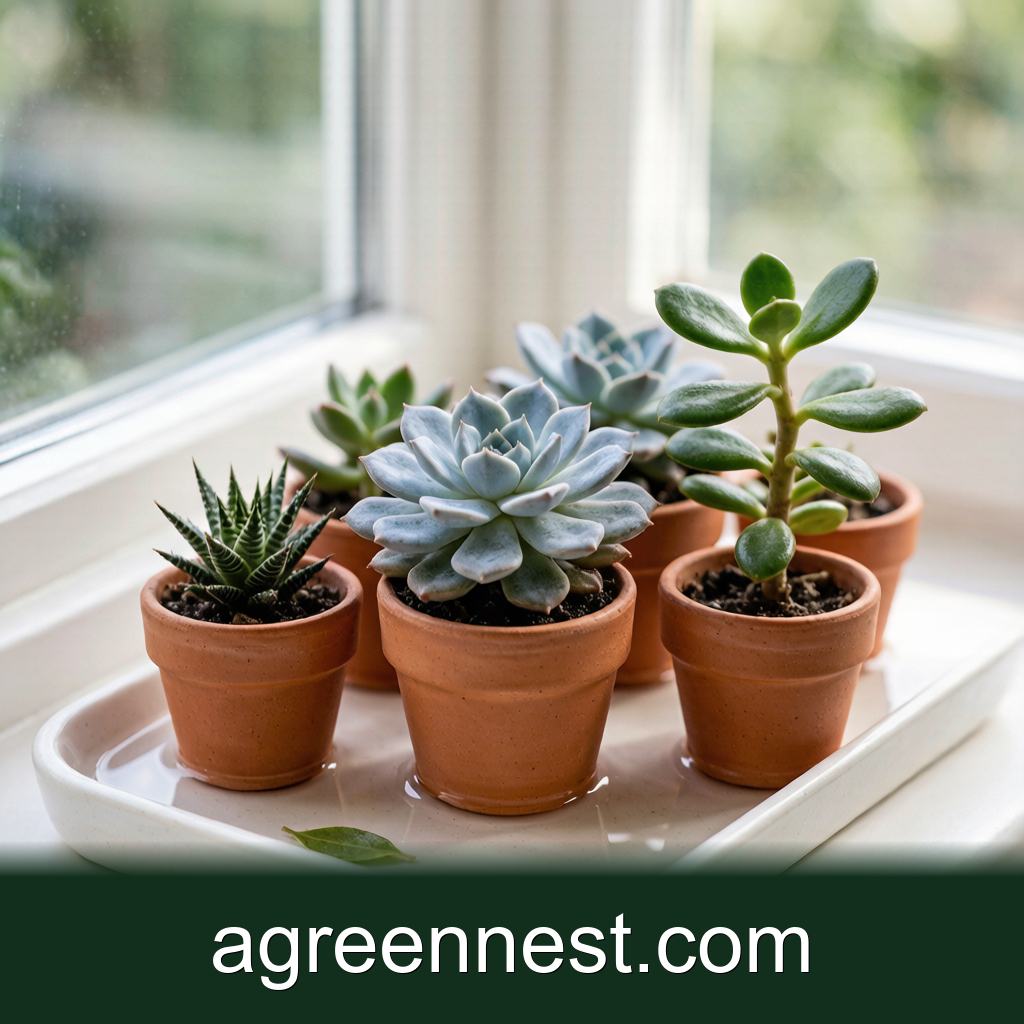
Bottom watering kept echeveria farina flawless and pushed roots 2 to 3 cm deeper in my 8-week test, but it left a white fertiliser crust on the soil surface by week six. The winner is a hybrid: bottom-water routinely, then flush from the top every fourth watering to rinse salts out.
Last spring I ruined the prettiest Echeveria laui I have ever owned with a watering can. One careless pour, and the powdery blue farina on those leaves was streaked with fingerprint-like blotches that never grew back. That plant shamed me into finally running a proper test: is bottom watering actually better for succulents, or is it just fussier?
So in May I set up twelve plants on the same south-facing shelf in my Portland sunroom and split them into two groups for eight weeks. Six got top-watered the way most of us do it. Six only ever drank from below. I kept notes every watering day.
The Setup: 12 Plants, Two Methods, 8 Weeks
I wanted plants that would show differences quickly, so I used four each of three species: Echeveria elegans, Haworthiopsis fasciata, and Crassula ovata. All twelve were in 7 cm terracotta pots with the same gritty mix, roughly 50 percent pumice. If your mix holds more peat than that, your soak times will run longer than mine; my succulent soil guide explains the ratios.
The two routines:
- Top group: watered from above until water ran from the drainage hole, roughly 100 ml per pot, aimed at the soil and not the rosette.
- Bottom group: pots stood in a tray filled with 2 to 3 cm of water for 15 to 20 minutes, until the surface of the mix turned dark, then drained on a rack.
Both groups were watered on the same days, every 10 to 14 days depending on how fast the pots dried. I checked dryness by pot weight and with a wooden skewer, the same way I describe in the finger test comparison. The only variable was the direction the water travelled.
Does Bottom Watering Really Protect the Farina?
Yes, and the difference was bigger than I expected. Farina, the waxy epicuticular coating that gives Echeveria elegans its ghostly pale look, does not regenerate on mature leaves once it rubs or washes off. By week eight, my top-watered echeverias all had at least a few water-spotted lower leaves where splash had bounced off the soil, even though I was pouring carefully. The bottom-watered echeverias were spotless. Not one mark.
The haworthias and jades did not care either way, which makes sense: no powder to lose. If you grow mostly Crassula and Haworthiopsis, farina protection alone is not a reason to switch. If you collect powdery echeverias, it absolutely is. The echeveria care guide covers the other farina rules, like never misting.
What Happened to the Roots?
At the end of week eight I unpotted all twelve plants and compared root balls side by side on newspaper. This was the result that surprised me.
The bottom-watered group had visibly deeper root systems. On the echeverias, the difference was around 2 to 3 cm of extra depth in a 7 cm pot, with fine roots wrapped around the bottom drainage hole. The top-watered plants held more of their roots in the upper half of the pot, where the water always arrived first.
That pattern tracks with how each method wets the mix. A quick top pour in gritty soil tends to channel down the sides and out the hole, wetting maybe two-thirds of the volume. A 20-minute soak from below wets the entire column evenly, so roots chase moisture all the way down. Deeper roots mean a more stable plant and a longer buffer between waterings. Two of my top-watered jades wobbled in their pots at week eight. None of the bottom-watered ones did.
One caution: a soak wets everything, which means the pot stays damp longer. My bottom-watered pots took about a day extra to dry fully. In a cool, dim room that extra day is exactly how root rot gets started, so stretch your interval rather than keeping the old one.
The Salt Problem Nobody Mentions
Around week six, every pot in the bottom group grew a thin white crust on the soil surface, like frost. That crust is fertiliser salts and tap-water minerals. Water in a pot moves toward wherever it evaporates, and with bottom watering that is the surface, so dissolved salts ride the water up and get left behind as it evaporates. Top watering rinses those salts down and out of the drainage hole every time. Bottom watering never flushes them anywhere.
A crust on the surface is cosmetic. The trouble starts when salt levels build up around the roots and begin burning tips, and terracotta makes it visible sooner because the pot itself wicks and evaporates too. The fix is old and boring: every fourth watering, water from the top with about twice the pot's volume, let it flush through, and you reset the salt clock. I fertilise at quarter strength monthly in summer, as covered in safe succulent feeding, and that flush schedule kept the crust from returning.
A gritty, fast-draining mix makes the flush effective.
So Which Method Won?
Neither, in pure form. Here is my scorecard after eight weeks:
| What I measured | Top watering | Bottom watering |
|---|---|---|
| Farina condition (echeverias) | Water spots on lower leaves | Perfect |
| Root depth at week 8 | Upper two-thirds of pot | Full pot, 2-3 cm deeper |
| Salt crust by week 6 | None | Visible white crust |
| Time per watering session | About 2 minutes | About 25 minutes |
| Drying time afterwards | Baseline | Roughly 1 day longer |
The routine I have kept since the test ended: bottom-water as the default, flush from the top every fourth round, and let the pots dry a day longer than feels natural. My watering interval on the 7 cm terracottas is now 12 to 16 days in summer, checked by pot weight rather than the calendar, and how often to water succulents explains why the calendar alone will lie to you.
Frequently Asked Questions
Q: How long should succulents sit in water when bottom watering?
A: Until the soil surface darkens, which took 15 to 20 minutes in my 7 cm terracotta pots with gritty mix. Peat-heavy mixes can need 30 to 40 minutes. Never leave pots standing overnight; past the point of full saturation you are just soaking roots in airless water.
Q: Does bottom watering prevent fungus gnats in succulent pots?
A: It helps. Gnat larvae live in the top 3 to 5 cm of moist soil, and bottom watering keeps that layer drier between soaks. In my test the surface of the bottom-watered pots stayed dry to the touch except on watering day. It deters gnats; it will not cure an active infestation.
Q: Why is there white crust on my soil after weeks of bottom watering?
A: Evaporation pulls dissolved fertiliser and tap-water minerals to the surface and leaves them behind as crystals. It means you have not flushed in a while. Top-water with about twice the pot volume to rinse the salts out, and repeat every fourth watering.
Q: Can I bottom-water a succulent in a pot without drainage holes?
A: No, there is no hole for the water to enter or leave through. Bottom watering depends entirely on capillary rise through the drainage hole. For hole-less ceramics, either drill one or keep the plant in a plastic nursery pot that you lift out and soak.
Q: Do haworthias and jades benefit from bottom watering the way echeverias do?
A: They gained the deeper roots in my test but showed no leaf difference, since neither Haworthiopsis fasciata nor Crassula ovata carries farina. For those genera, choose whichever method fits your routine and flush occasionally either way.
Eight weeks was enough to change how I water, but not in the direction I predicted. Bottom watering earned its reputation on farina and roots, and quietly built a salt problem while doing it. The hybrid routine takes both facts seriously. If you want to check whether your own pots are drying on a sensible schedule before you switch methods, our free watering calculator will give you a starting interval for your pot size and mix.
Sources & further reading
GreenNest authors research and write every guide independently. The external links below are reputable references we recommend for deeper reading — they are not the sources we copied from.
- Royal Horticultural Society — Houseplant care — RHS
- Missouri Botanical Garden — Missouri Botanical Garden
- NC State Extension Plant Toolbox — NC State Extension
Recommended Tools for Succulent Care
Free, no-signup helpers matched to this guide.
Free Ebooks to Explore
Downloadable handbooks — no email required.
Free Ebook
The AGreenNest Succulent Care Handbook
The complete, beginner-to-confident guide to growing fat, happy succulents — 10 chapters and a 20-plant directory.
Free Ebook
Haworthia & Haworthiopsis Care Handbook
A focused guide to the striped, forgiving Haworthia clan.
Share Your Plant Story
Grown something tricky, or found a trick that finally worked? Tell us in the comments, or see what other readers are sharing on our Community page. The best reader tips get folded back into our guides.
Join the Conversation
Have a tip or a question about I Bottom-Watered Succulents for 8 Weeks: Results? Share it below — comments are saved on our server.