 AGreenNest
DIY Plant Projects
Build a Paludarium: A Half-Water, Half-Land Tank
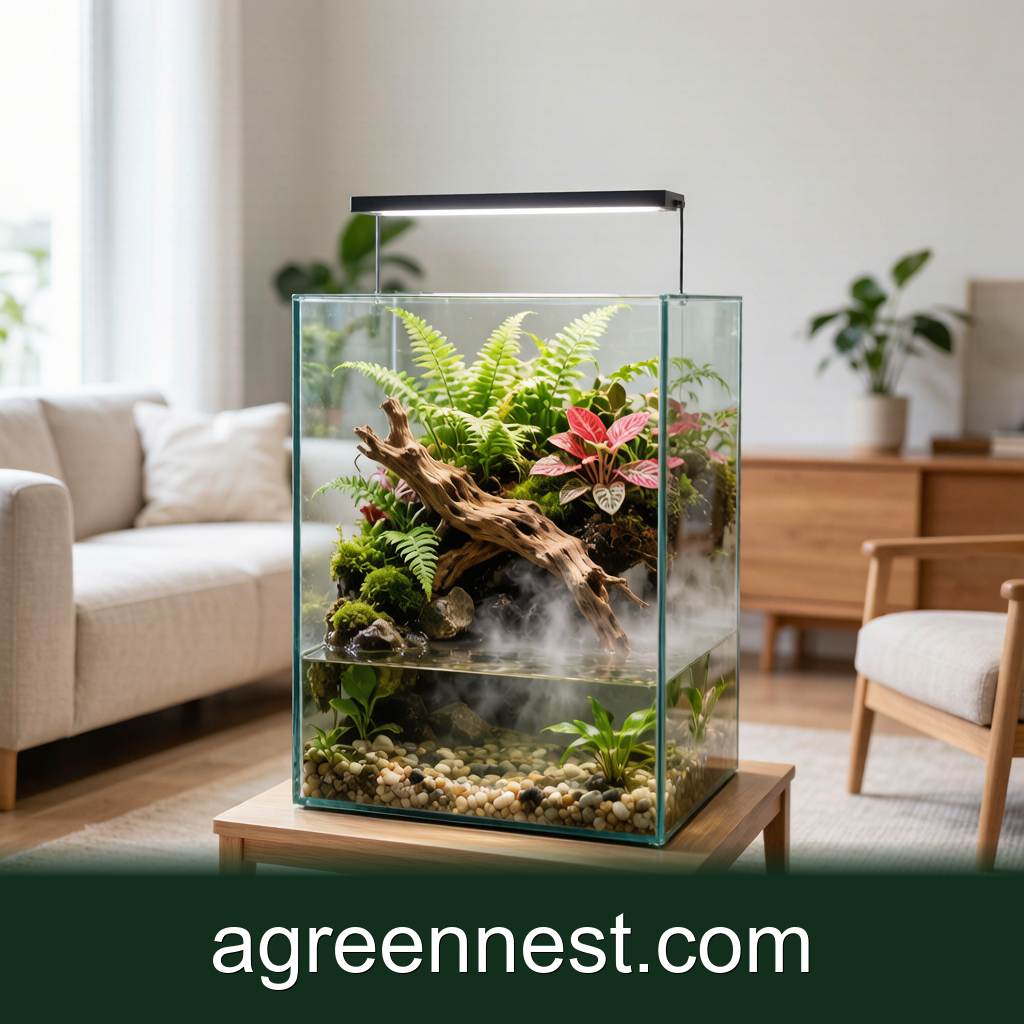
A paludarium is a sealed tank split between a water section and a land section by a sloped substrate barrier, usually 60 to 80 percent land. Pick a 38 to 75 L glass tank, build the slope with rigid foam and gravel, then plant pothos, philodendron, and peace lily on land; java fern, anubias, and cryptocoryne in water.
A paludarium is a planted tank split into two zones: a true aquatic section and a true terrestrial section, separated by a sloped barrier inside one enclosure. It is part vivarium, part aquarium, part terrarium. The build below is a fish-free version, so the water section is purely a planted sump, not livestock. That cuts about 70 percent of the maintenance cost and complexity while keeping the look.
I built my first paludarium in a 38 L ex-aquarium on a kitchen counter. It ran for 18 months with only top-offs and a quarterly trim before I had to drain it. Total parts landed around $85.
What Tank and Gear Actually Work
Skip acrylic. The waterline shows through scratches within months, and acrylic fogs under the heat of a tank lid. Use a 38 to 75 L glass aquarium, anywhere from 50 cm to 80 cm long. Tall tanks look dramatic but trap humidity unevenly; depth over 45 cm invites the lower plants to rot.
The gear list:
- Glass aquarium with a tight-fitting lid, 38 to 75 L
- Closed-cell rigid foam board, 2 cm thick, one 60 x 30 cm sheet
- Aquarium-safe silicone, one tube
- Decorative gravel, 5 to 10 mm grain, 2 to 3 L
- Aquatic plant substrate or rinsed horticultural sand, 3 to 4 L
- Activated charcoal, 200 g
- LED aquarium light or a 6500 K plant bulb on a timer, 8 to 10 hours
- Small aquarium heater, 25 W, set to 22 to 24°C, optional in winter
Skip the canister filter for a fish-free build. A small sponge filter driven by an air pump ($15 total) keeps the water moving and feeds the bacteria that break down leaf drop. Without movement, the water section stagnates within 3 weeks.
How Do You Build the Land-Water Slope That Holds?
The barrier is the part most first builds get wrong. It has to be tall enough to hold substrate above the waterline, angled so plants can root across it, and sealed so soil does not leak into the water.
- Cut the foam board to fit the tank width, then shape the top edge into a slope from one corner (about 12 cm above the tank floor) down to the opposite corner (about 4 cm above the tank floor).
- Slide the foam into position against the back glass, pressed firmly against the tank floor.
- Seal both side edges with a 6 mm bead of aquarium silicone and let it cure 24 hours before adding any substrate or water. Skipping the cure is the fastest way to a leak.
- Add a 1 cm layer of activated charcoal behind the foam. This catches soil leachate before it reaches the water.
- Slope the decorative gravel up against the front face of the foam, packing it so the angle matches the foam's top edge.
The finished barrier should look like a low beach that drops into a pond. Anything steeper than 45 degrees sheds soil into the water; anything flatter looks unnatural.
Picking Plants That Survive Both Sides
Land-side picks that tolerate wet feet:
- Epipremnum aureum (pothos): hardy, fast rooter, climbs the foam barrier in weeks
- Philodendron hederaceum: similar behavior, smaller leaves, easier to keep in scale
- Spathiphyllum wallisii (peace lily): loves humidity, blooms if light is bright enough
- Fittonia albivenis (nerve plant): low carpet, droops when dry
- Selaginella kraussiana: creeping spike moss that roots into the foam itself
Water-side picks under 25 cm:
- Anubias barteri: nearly indestructible, attaches to rocks, slow grower
- Microsorum pteropus (java fern): same attachment habit, slightly taller
- Cryptocoryne wendtii: browns in transition but rebounds once rooted
- Bucephalandra species: stays under 10 cm, foreground accent
Avoid terrestrial ferns in the water section, anything labeled "marginal" (it will outgrow a 38 L tank in three months), and Spathiphyllum in the water section (it will rot at the crown). For general houseplant trouble-shooting on the land side, our pothos troubleshooting guide catches most of the common slips.
How Much Light and Humidity Does It Need?
Light drives everything in a closed tank. Without enough, terrestrial plants stretch toward the lid and aquatic plants stall. Set a single 6500 K LED strip or a 9 W aquarium hood light on a timer for 8 to 10 hours per day. The target PAR at the land surface is roughly 80 to 120, which most aquarium hoods hit at 20 cm above the substrate. To check your real number, run our grow-light PAR estimator with your light's lumen spec.
Humidity inside a sealed lid climbs to 80 to 95 percent, which is exactly what Fittonia and Selaginella want. The trick is airflow: lift the lid 2 cm for 30 minutes every other day, or run a small USB fan aimed across the water surface for 15 minutes twice a day. Stagnant humid air grows mold on the foam barrier within a month.
What Maintenance Does a Fish-Free Paludarium Need?
Far less than a planted aquarium, more than a terrarium. The weekly contract:
- Top off evaporated water with dechlorinated tap or rainwater, 200 to 400 mL per week for a 38 L tank.
- Trim terrestrial roots diving into the water section; they crowd the aquatics within a month.
- Wipe algae off the front glass with a razor blade or magnetic cleaner every 2 weeks.
- Replace 20 percent of the water (about 7 L in a 38 L tank) every 4 to 6 weeks. Pour slowly onto a plate so you do not disturb the substrate.
- Replant aquatic stems if they melt. Cryptocoryne sheds old leaves when settled and regrows within 6 weeks.
Skip the top-off for two weeks in summer and the water section can drop 3 cm, exposing plant crowns. Set a phone reminder for the first month.
Two Failure Modes I Have Hit Personally
Mold bloom on the foam barrier. The first 3 to 4 weeks of a fresh paludarium almost always show a white fuzz on the foam or gravel at the waterline. It is harmless pioneer fungus that clears once the tank cycles. If it spreads rather than retreats after week 4, lift the lid for 1 hour daily and reduce misting.
Soil leak into the water. If the water section clouds brown within a week, the barrier is leaking soil. Drain the tank, peel back the foam, add a second silicone bead at the floor seam, and re-pack the gravel slope. Filtering cloudy water does not help; the leak keeps feeding it.
For placing the tank on furniture safely, our shelf styling guide covers weight and humidity considerations.
Frequently Asked Questions
Q: Can I build a paludarium without fish or shrimp?
A: Yes, and it is the easier starting point. Skip the livestock and the system runs on a sponge filter plus monthly 20 percent water changes. You can add cherry shrimp or a single betta later once the plants have rooted for at least 6 weeks.
Q: What is the easiest tank size for a first paludarium?
A: A 38 L long tank (about 50 x 25 x 30 cm). Smaller tanks swing in temperature and humidity too fast. Anything over 75 L needs a stronger light and a real canister filter, not a sponge filter.
Q: How do I keep terrestrial plants from rotting at the roots?
A: Match the plant to the zone. Pothos and philodendron roots tolerate wet feet; fern roots usually do not. If a plant is wilting with damp soil, it is almost always planted too deep into the water-side slope rather than the dry-side top.
Q: Do I need a heater in the water section?
A: In a heated room, no. Below 20°C ambient, add a 25 W preset heater set to 22°C. Anubias and java fern tolerate down to 18°C, but tropical picks stall below that.
Q: Will algae take over the water section?
A: Any water section under 25 percent of the total tank volume will. Keep the water section between 20 and 40 percent of the floor area, and run the sponge filter 24/7. Cutting the light from 10 to 8 hours also helps if green algae starts dusting the front glass.
A paludarium sits at the crossover between hydroponics and terrarium work, which is exactly why it pulls in visitors who would never buy a fish tank. Build it once with a real barrier, plant it with one of each zone, and let it cycle for a month before judging. The look that makes people stop and stare is two months of patient growth, not day one. If your room is dim and the build stalls, run our window light estimator before blaming the plants.
Sources & further reading
GreenNest authors research and write every guide independently. The external links below are reputable references we recommend for deeper reading — they are not the sources we copied from.
- Michigan State University Extension — Michigan State University
- NC State Extension Plant Toolbox — NC State Extension
- University of Minnesota Extension — U Minnesota Extension
Recommended Tools for DIY Plant Projects Care
Free, no-signup helpers matched to this guide.
Free Ebooks to Explore
Downloadable handbooks — no email required.
Free Ebook
The AGreenNest Succulent Care Handbook
The complete, beginner-to-confident guide to growing fat, happy succulents — 10 chapters and a 20-plant directory.
Free Ebook
Haworthia & Haworthiopsis Care Handbook
A focused guide to the striped, forgiving Haworthia clan.
Share Your Plant Story
Grown something tricky, or found a trick that finally worked? Tell us in the comments, or see what other readers are sharing on our Community page. The best reader tips get folded back into our guides.
Join the Conversation
Have a tip or a question about Build a Paludarium: A Half-Water, Half-Land Tank? Share it below — comments are saved on our server.