 AGreenNest
DIY Plant Projects
DIY Window Shade Screen to Stop Summer Leaf Scorch
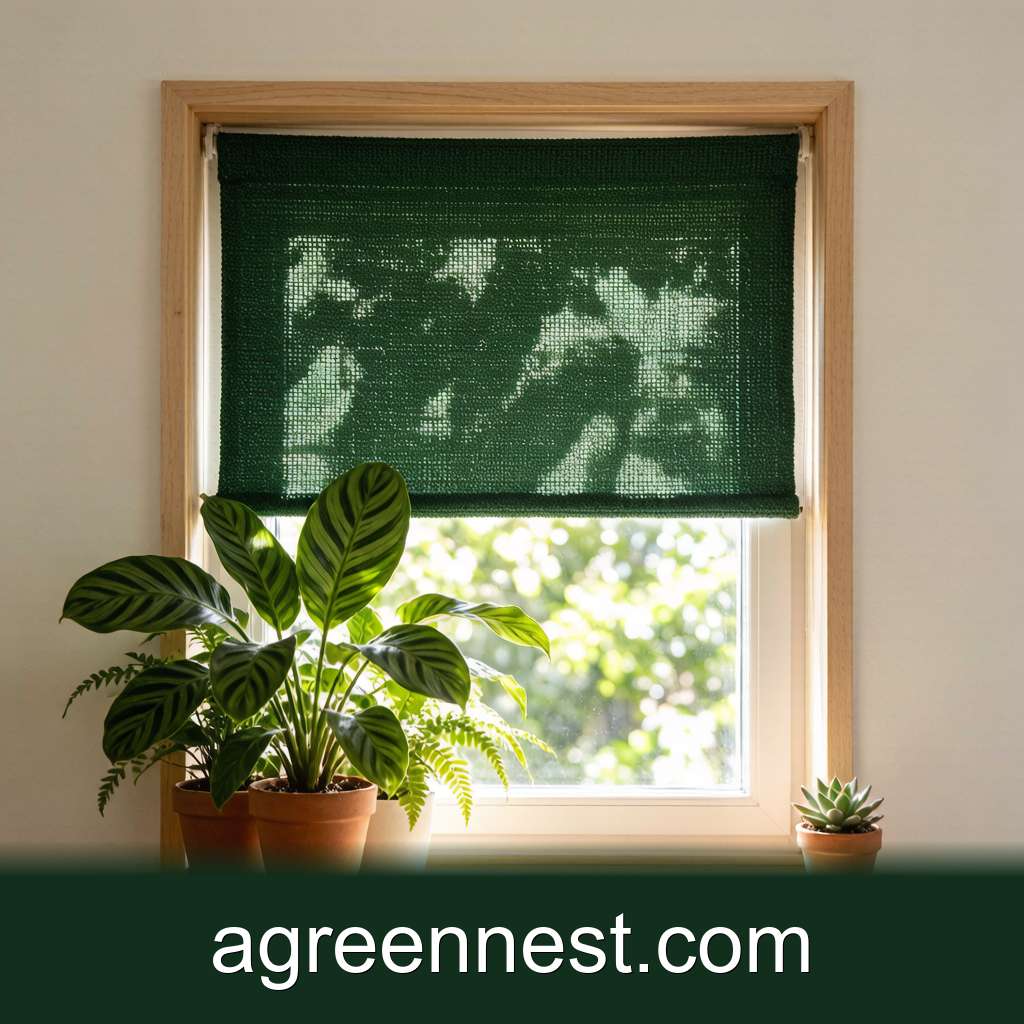
A south-facing window can hit 50,000+ lux in July, enough to bleach calatheas and cook leaf tissue through glass. A DIY screen made from 30% shade cloth stapled to a lightweight wooden frame cuts that to roughly 35,000 lux, costs about $15, and lifts out in October when the sun weakens.
Last July I measured 52,000 lux on my south windowsill at 2 p.m. For reference, most tropical foliage plants are happiest between 5,000 and 20,000 lux, and even sun-lovers rarely need more than 40,000 indoors. Two weeks of that exposure put crisp bleached patches on a Calathea orbifolia that had lived on the same sill, unharmed, since February.
The usual advice is "move the plant back from the window". Fine, except a metre back the same spot reads 8,000 lux in winter, which is too dark for half my shelf. Moving twelve pots twice a year is a bad system. A removable shade screen is a better one: the window keeps its light, the plants keep their spots, and the whole thing lifts out in October.
Here is the exact build. One hour, about $15, no special tools.
What Does Summer Sun Through Glass Actually Do to Leaves?
Glass blocks most UV-B but passes the visible light and near-infrared that do the damage. Two separate problems stack up on a summer sill:
Photobleaching. Chlorophyll gets overloaded and breaks down faster than the leaf rebuilds it. You see pale, washed-out patches that stay pale. Thin-leaved plants (calatheas, ferns, most aroids) show it first.
Thermal scorch. Leaf tissue pressed near hot glass can run 10 to 15 °C above room temperature. Cells cook, and you get brown, papery patches with a yellow halo, usually dead centre on the most sun-facing leaves. If you are not sure whether a mark is scorch or something biting the plant, sunburn vs pest damage walks through the tells, and the sunburn treatment guide covers triage for leaves already hit.
The screen attacks both at once: less radiation means less bleaching and a cooler boundary layer at the glass.
Which Shade Cloth Percentage Should You Buy?
Shade cloth is sold by the percentage of light it blocks, and the market is built for greenhouses, so a small houseplant order is cheap. My numbers from testing three grades against a bare window that read 52,000 lux:
| Cloth grade | Sill reading | Best for |
|---|---|---|
| None | 52,000 lux | Cacti, most succulents |
| 30% | ~35,000 lux | Mixed shelf, sun-tolerant tropicals |
| 50% | ~25,000 lux | Calatheas, ferns, thin-leaved aroids |
| 70% | ~15,000 lux | Too dark for a mixed sill in most homes |
I run 30% knitted polyethylene cloth on the south window. Knitted cloth is lighter than woven, does not fray when cut, and a 2 x 1 m offcut cost me $8. If your collection is mostly shade-lovers, go 50%. Skip 70% unless you are shading a west-facing greenhouse window; indoors it wastes light you will want back in September.
Measure before you commit. A $10 lux meter or a phone app is close enough for this job, and the room-darkness lux test shows how to take readings you can compare month to month.
How Do You Build the Frame?
The design is a rectangle of 20 x 20 mm pine batten with cloth stapled to one face. It stands in the window reveal by friction, so nothing screws into your window frame.
Materials:
- 20 x 20 mm pine batten, enough for the window perimeter (mine: two at 96 cm, two at 118 cm for a 100 x 120 cm reveal)
- 30% knitted shade cloth, cut 4 cm oversize each way
- 8 corner braces or 4 flat L-plates, plus 12 mm screws
- Staple gun with 8 mm staples
- Two small felt pads per side
Steps:
- Measure the window reveal, then cut battens 4 mm short in each direction. That gap is what lets the frame drop in and lift out.
- Screw the rectangle together with an L-plate at each corner. Check the diagonals match within 2 to 3 mm; a racked frame will not sit flat.
- Pull the cloth over one face and staple every 8 to 10 cm, working opposite sides in pairs (top, then bottom, then left, then right) to keep tension even. Knitted cloth needs only light tension.
- Trim the overhang with scissors and stick felt pads on the contact edges so the frame cannot rattle or mark the paint.
- Drop the frame into the reveal. Friction plus the felt holds mine through a summer of open-window gusts. If your reveal is shallow, add two neodymium magnets to the frame and two counterparts on the window frame.
Total build time for me: 55 minutes including the trip to find the staple gun. If you enjoyed this kind of build, the windowsill greenhouse project uses the same batten-frame skills for the opposite season.
When Should the Screen Go In and Come Out?
Rule of thumb for the northern hemisphere: in by mid-May, out by early October. Better rule: let the lux meter decide. When midday sill readings pass about 40,000 lux for a week, the screen goes in; when they fall back under 25,000, it comes out.
Two seasonal side effects to plan around. First, shaded pots dry slower, so your July watering rhythm loosens; check the top 3 cm with a finger or meter before watering rather than sticking to a fixed schedule. Second, remember the shade changes conditions for every plant on the sill, not just the scorch victims. My Echeveria pups stretched within three weeks behind the 50% cloth test panel, which is why the succulent shelf keeps a bare window and follows the summer dormancy playbook instead.
One thing the screen will not fix: heat trapped in a closed room. If your sill runs above 32 °C on still afternoons, crack the window or add airflow, because spider mites multiply fastest in hot, dry corners and a shaded, stagnant sill is still their kind of place.
Frequently Asked Questions
Q: Can I just tape baking paper or net curtain to the glass instead?
A: It works as a stopgap, and a plain net curtain blocks roughly 20 to 30% depending on weave. The problems are consistency and removal: taped paper yellows, blocks your view entirely, and you cannot dial the percentage. The framed cloth gives a known, repeatable reduction and lifts out in five seconds.
Q: Will a 30% shade screen make my room noticeably darker to live in?
A: Less than you expect. Human vision adapts logarithmically, so cutting 52,000 lux to 35,000 barely registers to your eye, while the drop is significant for a leaf held 5 cm from the glass all day.
Q: My window opens inward. Will the drop-in frame block it?
A: Yes, if it sits inside the reveal. For inward-tilting windows, mount the frame on the outside face of the reveal with two magnet pairs, or hinge it on one side so it swings clear before you tilt the window.
Q: Does shade cloth block the light my grow light provides in the same window in winter?
A: Only if you leave it in. The whole point of the removable frame is seasonal use: cloth in for the May-to-September sun, out before you switch the grow light timers back on for the dark months.
Q: Which plants should stay on the unshaded side of the window?
A: Desert natives. Most cacti, Echeveria, and Aloe vera want the full 40,000 to 50,000 lux a bare south window delivers, and they pay for shade with stretching. Split the sill: cloth panel on the tropical half, bare glass for the succulents.
Fifteen dollars of batten and cloth solved a problem I had been solving badly with furniture rearrangement for years. Measure your sill at 2 p.m. this week; if the meter reads over 40,000 lux, build the screen before the next heatwave, not after the leaves spot. To work out what each of your plants actually wants, run the numbers through our free light calculator.
Sources & further reading
GreenNest authors research and write every guide independently. The external links below are reputable references we recommend for deeper reading — they are not the sources we copied from.
- Michigan State University — College of Agriculture & Natural Resources — Michigan State University
- University of Minnesota Extension — U Minnesota Extension
- NC State Extension Plant Toolbox — NC State Extension
Recommended Tools for DIY Plant Projects Care
Free, no-signup helpers matched to this guide.
Free Ebooks to Explore
Downloadable handbooks — no email required.
Free Ebook
The AGreenNest Succulent Care Handbook
The complete, beginner-to-confident guide to growing fat, happy succulents — 10 chapters and a 20-plant directory.
Free Ebook
Haworthia & Haworthiopsis Care Handbook
A focused guide to the striped, forgiving Haworthia clan.
Share Your Plant Story
Grown something tricky, or found a trick that finally worked? Tell us in the comments, or see what other readers are sharing on our Community page. The best reader tips get folded back into our guides.
Join the Conversation
Have a tip or a question about DIY Window Shade Screen to Stop Summer Leaf Scorch? Share it below — comments are saved on our server.