 AGreenNest
DIY Plant Projects
Build a Plant Quarantine Tent for New Arrivals
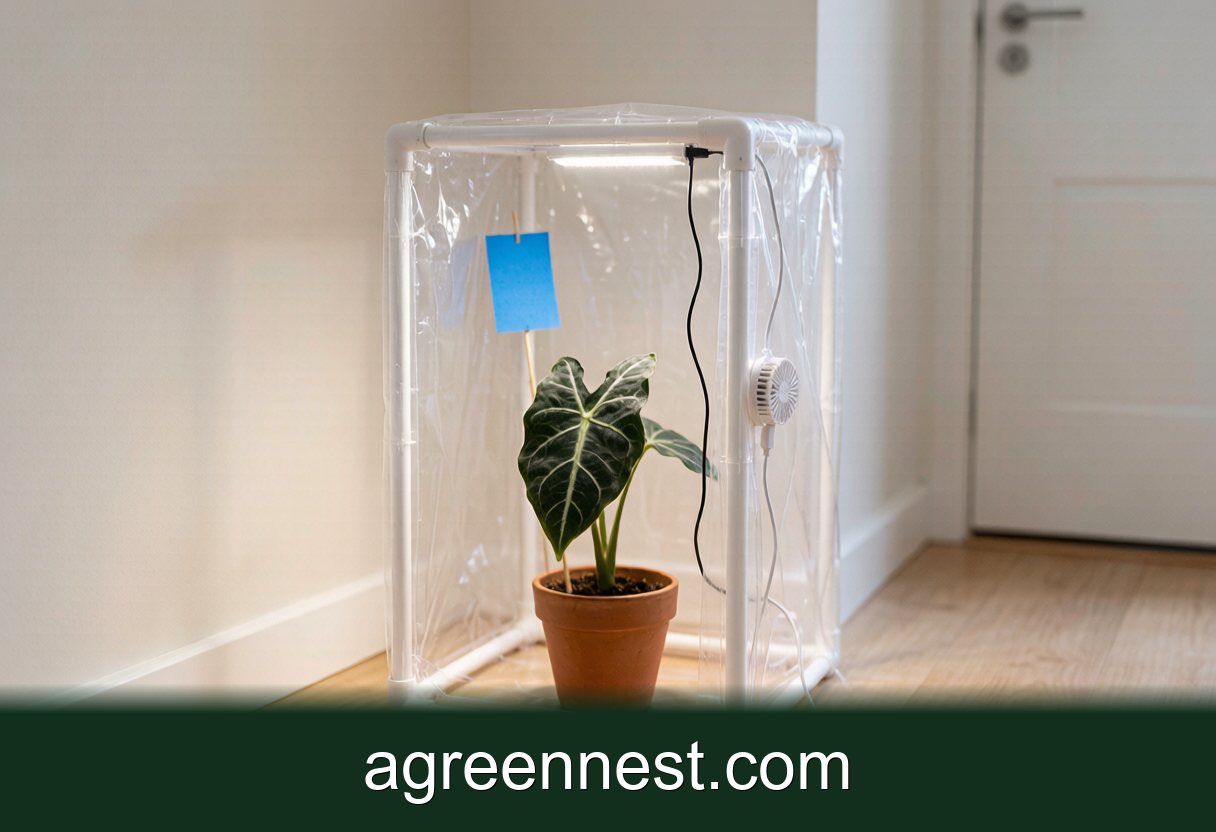
A plant quarantine tent is a zip-up grow tent or a clear bin frame that holds a new plant apart from your collection for four weeks. Keep it at least 3 m from other plants, run a small fan, hang one blue sticky trap, and inspect leaf undersides every seven days.
Thrips came into my flat inside a $12 Alocasia. I knew about quarantine. I even meant to do it. The plant sat on the kitchen counter for three days because that was where I put the bag down, and three days was enough for the first generation to walk onto a Monstera a metre away.
So I built a box. Two versions of it, actually, and both have paid for themselves several times over since.
Why Does a Quarantine Tent Beat a Spare Room?
The standard advice is to keep new plants in a separate room for a month. That advice fails for a boring reason: most of us do not have a spare room, and the ones who do keep opening the door.
A tent solves three problems a room does not.
Containment is physical, not procedural. Thrips and whiteflies fly. Spider mites travel on air currents and on your sleeve. A zipped enclosure stops both, no discipline required.
Inspection gets easy. Everything sits at chest height under one light, so the weekly check takes four minutes instead of being skipped.
Conditions stay stable. A shipped plant has spent days in a dark box, and a closed tent holds humidity around 55 to 65 percent while its roots recover.
The pests you are looking for are covered in identifying plant pests early, and the reasoning behind the whole habit sits in why quarantine new plants matters.
Build One: The Free Clear-Bin Version
If you buy one or two plants a year, do not spend money. A 60 L clear storage bin from the shed works.
Stand the bin on its long side so the lid becomes a front door. Cut two 8 cm ventilation holes near the top of what is now the back wall, and tape a square of fine mesh, an offcut of net curtain is fine, over each one from the inside. Mesh keeps the tent breathing without letting an adult fungus gnat out.
Set the plant inside on an upturned saucer so its pot never sits in condensation. Clip the lid on, leaving a 2 cm gap at the bottom for airflow.
Total cost: nothing, if you own the bin. Capacity: one plant up to 45 cm tall, and that limit is a real one.
Build Two: The $34 Zip Tent Frame
For anyone buying plants monthly, build the frame version. Mine is 60 x 40 x 90 cm, which swallows three nursery pots or one 1 m Ficus.
The cut list, in 16 mm PVC pipe:
- Four uprights: 90 cm
- Four long rails: 60 cm (two top, two bottom)
- Four short rails: 40 cm (two top, two bottom)
- Eight three-way corner elbows
Push-fit the whole cage together dry. No glue, so it comes apart flat for storage. Pipe and fittings cost me about $19.
For the skin, use a 2 x 3 m roll of clear 100 micron polythene sheet, roughly $9, taped to the frame with clear packing tape. Leave the front face as a separate flap that overlaps 10 cm at each edge and holds shut with three bulldog clips. A $6 zip is neater if you can sew.
Airflow, Light, and the Three Things That Kill Quarantined Plants
More quarantined plants die of neglect inside the tent than of the pests they came with. Three specifics fix that.
Air. A 80 mm USB fan, the kind sold for computer cases, pulls 20 to 25 CFM and costs $8. Aim it at the tent wall, not the plant, and run it 24 hours. Still, humid air inside plastic is how Botrytis starts, and the general case for moving air is in airflow for indoor plants.
Light. Polythene eats roughly 15 percent of transmitted light and a windowsill gets none of it once the tent is 2 m into the room. A 15 to 20 W LED bar clipped to the top rail at 35 cm above the canopy delivers 200 to 400 µmol on a 12 hour timer, which holds most foliage plants steady without pushing new growth you cannot yet inspect.
Water. Plants transpire less in a closed tent, so the same pot that dried in six days on the shelf may take ten inside. Check by weight or probe rather than by calendar.
What Goes In With the Plant
Four items, every time.
- One blue sticky trap at canopy height. Blue catches thrips; yellow catches gnats and whiteflies. The trade-off is spelled out in yellow vs blue sticky traps. I run one of each in a three-plant tent.
- A hand lens, 10x, parked on top of the tent so it is never missing when you need it.
- A dated label on the pot with the arrival date. Week four is easy to lose track of.
- Nothing else. No pruning shears shared with the main collection, no reused saucer.
If the plant came in bagged supermarket compost, consider a top-layer swap in week one; larvae ride in growing media more often than people expect, as pests hiding in bagged potting soil explains.
How Long Does a New Plant Really Need Inside?
Four weeks, and the number is not arbitrary. At 21 °C, a spider mite egg hatches in 3 to 5 days and reaches adulthood in about 10; thrips run a 15 to 20 day cycle through their soil-dwelling pupal stage. Four weeks covers at least one full generation of every common houseplant pest, which means anything that hatched from an egg you could not see has had time to show itself.
My schedule:
- Day 0: rinse both leaf surfaces under a lukewarm tap, inspect, log the date.
- Day 7: hand lens on leaf undersides and every node. Check the traps.
- Day 14: repeat, plus a preventive soap spray if anything at all looks suspect.
- Day 21: repeat. A clean trap at three weeks is the strongest signal you have.
- Day 28: final check, then out.
Restart the clock at day 0 if you find and treat anything. Two clean weeks after the last live pest is the minimum before release, and I would rather run six weeks than reinfest a shelf.
Frequently Asked Questions
Q: Can I keep the quarantine tent in the same room as my other plants if it stays zipped?
A: Yes, with 2 to 3 m of separation and the fan blowing away from the collection. The failure mode is not the sealed tent, it is you opening it and then handling other plants. Do the tent check last, then wash your hands.
Q: My new *Calathea* is dropping leaves inside the tent. Is that the pests or the box?
A: Almost always the box plus shipping shock. Check the substrate is not sodden, confirm the LED sits at 35 cm rather than 15, and vent the front flap for an hour a day. Goeppertia species sulk for two to three weeks after any move, and quarantine adds a second one.
Q: Do I need to quarantine a plant from a reputable nursery or just marketplace plants?
A: Both. Commercial greenhouses run tight programmes but they also grow at density, so scale and mealybugs travel out on healthy-looking stock regularly. The four-week rule costs nothing when the plant turns out to be clean.
Q: Can I quarantine a cutting jar or leca conversion in the same tent as a soil plant?
A: Yes, and the raised humidity suits both. Keep the water vessel on the tray floor so a knocked jar does not soak the soil pot, and do not share a moisture probe between them without a wipe.
A quarantine tent is 40 minutes of work that decides whether one $12 plant costs you $12 or a whole shelf. Start with the clear bin if you are unsure, then build the PVC frame once you catch yourself buying a fourth plant in a season. Before you clip the LED to the top rail, check the numbers with our free light calculator so the tent holds your new arrival steady instead of stretching it.
Sources & further reading
GreenNest authors research and write every guide independently. The external links below are reputable references we recommend for deeper reading — they are not the sources we copied from.
- Michigan State University — College of Agriculture & Natural Resources — Michigan State University
- NC State Extension Plant Toolbox — NC State Extension
- University of Minnesota Extension — U Minnesota Extension
Recommended Tools for DIY Plant Projects Care
Free, no-signup helpers matched to this guide.
Free Ebooks to Explore
Downloadable handbooks — no email required.
Free Ebook
The AGreenNest Succulent Care Handbook
The complete, beginner-to-confident guide to growing fat, happy succulents — 10 chapters and a 20-plant directory.
Free Ebook
Haworthia & Haworthiopsis Care Handbook
A focused guide to the striped, forgiving Haworthia clan.
Share Your Plant Story
Grown something tricky, or found a trick that finally worked? Tell us in the comments, or see what other readers are sharing on our Community page. The best reader tips get folded back into our guides.
Join the Conversation
Have a tip or a question about Build a Plant Quarantine Tent for New Arrivals? Share it below — comments are saved on our server.