 AGreenNest
DIY Plant Projects
Build a Soil Sifter for Better Potting Mix
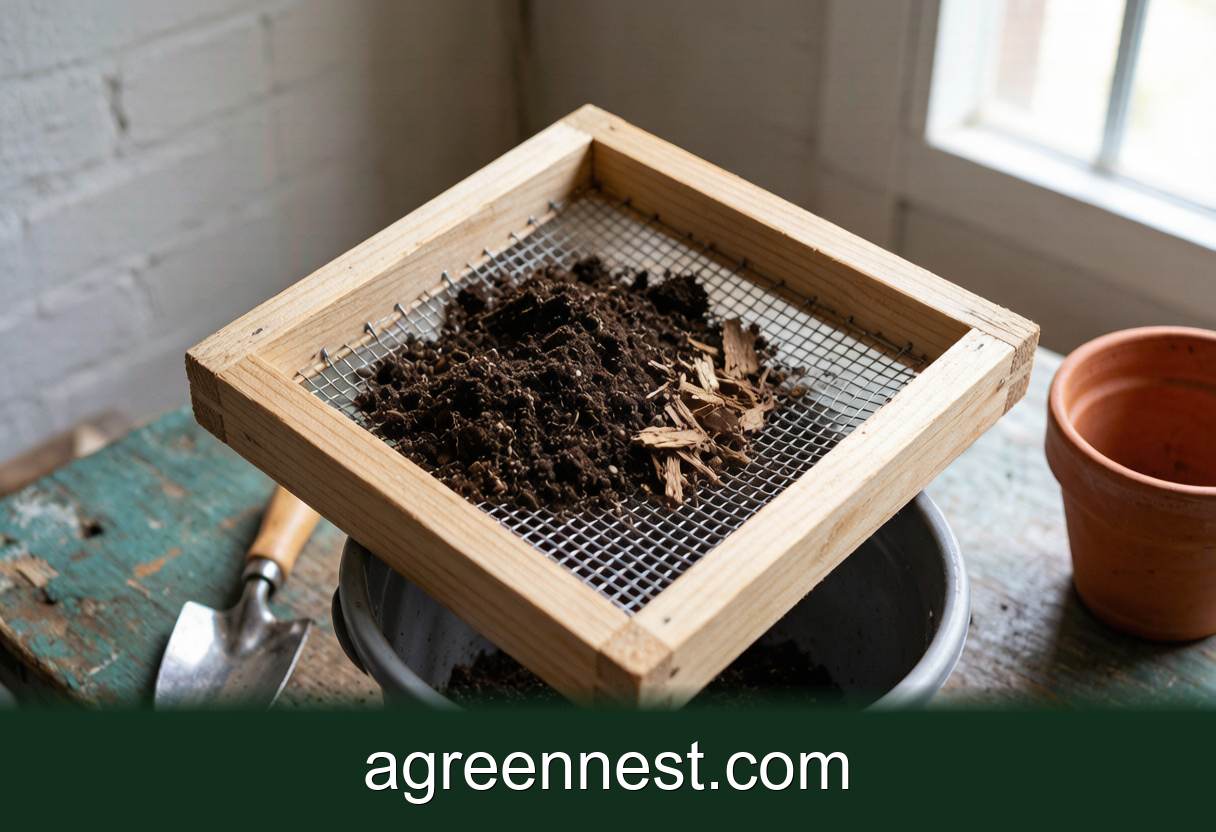
A soil sifter is a timber frame with 6 mm hardware cloth stapled across it. Pass bagged potting mix through it and you separate dust, roots, and bark chunks from the 3 to 6 mm particles succulents and aroids actually root into. The build takes 30 minutes and about $19.
I weighed it, because I did not believe the first result either. A 10 L bag of premium cactus mix, poured through a 3 mm screen, dropped 1.9 kg of dust and shredded fibre into the tray below. Nineteen percent of what I paid for was material that turns to mud the first time it gets wet.
That was the afternoon I stopped picking bark chunks out of mix by hand and built a screen instead.
What a Sifter Fixes That Buying Better Mix Does Not
Drainage is a particle size problem before it is an ingredient problem. Water clings in the spaces between grains, and when fine dust fills the gaps between your pumice and bark, that saturated layer at the bottom of the pot gets taller. In a 12 cm plastic pot filled with unsifted bagged mix I measured a wet zone about 3 cm deep two hours after watering. The same pot, same mix, sifted to a 3 to 6 mm fraction, held a wet zone closer to 1 cm.
For a Haworthiopsis attenuata or an Echeveria, that 2 cm difference is the whole argument between roots and rot.
A screen also catches what has no business being in a pot: half-composted bark slabs, wood splinters, the occasional shard of plastic, and clumps that hide fungus gnat larvae. Bagged mix is not sterile, as anyone who has read about pests hiding in bagged potting soil knows.
Third use, and the one that pays for the build: reclaiming old mix from repots instead of binning it.
The Cut List and the $19 Build
One 1.8 m length of 19 x 89 mm board makes the frame with offcuts to spare.
- Two long sides: 40 cm each.
- Two ends: 26 cm each, screwed between the long sides, giving a 40 x 30 cm outer frame.
- Mesh: a 45 x 35 cm piece of 6 mm (quarter inch) galvanised hardware cloth.
- Hardware: eight 50 mm screws, a box of 8 mm staples, and two 20 mm battens as edge covers.
Screw the box together, check it sits square, then lay the mesh over one face. Staple every 4 cm, working from the centre of each side outward so the wire stays taut. Fold the surplus wire over the frame edge, then screw the battens on top of the fold to cover the cut ends.
At 40 x 30 cm the frame rests on the rim of a standard 55 x 28 cm seedling tray or across a builder's bucket. My receipt: board $9, hardware cloth offcut $6, screws and staples $4.
A second frame with 3 mm mesh costs another $7 and turns a one-screen tool into a proper two-stage grader. Build both if you mix your own substrate.
Which Mesh Size Do You Actually Need?
The 6 mm screen takes out everything too big. The 3 mm screen takes out everything too small. Run mix through both and you keep the fraction in between, which is the part that matters.
- Gritty succulent mixes: keep 3 to 6 mm. This is the size range behind the gritty soil recipe, and it is why sifted pumice outperforms bagged pumice that arrived full of powder. The pumice and perlite comparison covers which grit to buy in the first place.
- Chunky aroid mixes: keep 6 to 12 mm. Use a 12 mm screen on top and treat the 6 mm one as the bottom cut.
- Seed and leaf propagation: the fines you rejected are the right material here, spread 5 mm deep as a top layer over firmer mix. Leaf props sit better on it, and propagating succulents from leaves works with less callus rot when the contact surface is fine and barely damp.
One myth to kill: adding grit is not the same as sifting. A mix can be 40 percent pumice by volume and still drain badly, because the peat dust between the grains fills every void the grit was supposed to open. Sift first, then blend, as in mixing your own succulent soil.
How Do You Sift Without Coating the Room in Dust?
Dampen the mix before it touches the screen. About 100 ml of water stirred into 5 L of mix, left to rest 10 minutes, gets the material to roughly 10 percent moisture, where it sifts almost clean. Bone-dry peat and coir throw a cloud you will taste for an hour; the difference between the two is set out in coir versus peat.
Do not overshoot. Past about 20 percent moisture the mix balls up and blinds the mesh, and you spend more time scraping the screen than sifting.
Shake side to side in 15 to 20 cm strokes rather than bouncing the frame up and down. Side-to-side keeps the material moving across the wire; bouncing packs it into the holes. Working over a tray outdoors, 10 L of mix goes through a 6 mm screen in about four minutes.
Wear a P2 or N95 mask for dry material regardless. Potting mixes are living compost products, and extension advice on handling them is consistent: keep the material damp, work in fresh air, wash your hands afterwards.
What to Do With the Fines and the Chunks
Nothing gets thrown away.
Fines under 3 mm go into seed trays, kokedama balls of the sort in the moss ball project, and outdoor borders. They never go back into a succulent pot.
Chunks over 6 mm become top dressing for large floor plants, or the coarse component of an aroid mix. Bark slabs bigger than 15 mm are compost.
Reclaimed mix from a repot gets dried to damp-crumbly, sifted to pull out root fragments and old fines, then blended half and half with fresh mix plus a handful of pumice. I have run the same batch of grit through four repotting seasons this way, which is the sort of maths that makes a $19 frame look cheap. The step-by-step is in repotting succulents.
Frequently Asked Questions
Q: Can I staple fibreglass window screen over the frame instead of hardware cloth?
A: For the 3 mm cut, a stiff aluminium insect mesh works. Soft fibreglass fly screen sags under 2 kg of damp mix and the sag traps material in the middle of the panel. Galvanised hardware cloth holds 3 kg across a 40 cm span without flexing.
Q: How much usable mix does a 10 L bag actually yield after sifting?
A: From my last bag of cactus mix: 7.4 L in the 3 to 6 mm keep pile, 1.7 L of fines, and 0.9 L of chunks. Budget for losing roughly a quarter of the bag volume from the fraction you want.
Q: Can I sift straight after knocking a plant out of its pot?
A: Let the root ball dry two or three days first. Wet mix with live roots in it blinds a 6 mm screen within 30 seconds, and you end up pushing mud through the wire with your thumbs.
Q: Is a bought garden riddle worth $30 instead?
A: A riddle is a single 8 mm round screen sized for garden loam. It will not give you a 3 to 6 mm band, it does not stack, and it does not sit on a seedling tray. For soil beds it is fine. For indoor substrate work, the two-frame build wins.
Sifting sounds fussy until you compare two pots side by side a month later, one in bagged mix and one in the same mix screened to 3 to 6 mm. The screened pot dries evenly, the roots run to the pot wall, and the surface stops crusting. Build the 6 mm frame first, add the 3 mm one when you start mixing your own. To work out the grit and bark ratios for the fraction you just sorted, run the numbers through our gritty soil mixer.
Sources & further reading
GreenNest authors research and write every guide independently. The external links below are reputable references we recommend for deeper reading — they are not the sources we copied from.
- Michigan State University — College of Agriculture & Natural Resources — Michigan State University
- University of Minnesota Extension — U Minnesota Extension
- NC State Extension Plant Toolbox — NC State Extension
Recommended Tools for DIY Plant Projects Care
Free, no-signup helpers matched to this guide.
Free Ebooks to Explore
Downloadable handbooks — no email required.
Free Ebook
The AGreenNest Succulent Care Handbook
The complete, beginner-to-confident guide to growing fat, happy succulents — 10 chapters and a 20-plant directory.
Free Ebook
Haworthia & Haworthiopsis Care Handbook
A focused guide to the striped, forgiving Haworthia clan.
Share Your Plant Story
Grown something tricky, or found a trick that finally worked? Tell us in the comments, or see what other readers are sharing on our Community page. The best reader tips get folded back into our guides.
Join the Conversation
Have a tip or a question about Build a Soil Sifter for Better Potting Mix? Share it below — comments are saved on our server.