 AGreenNest
DIY Plant Projects
Build an Adjustable Grow Light Stand for $28
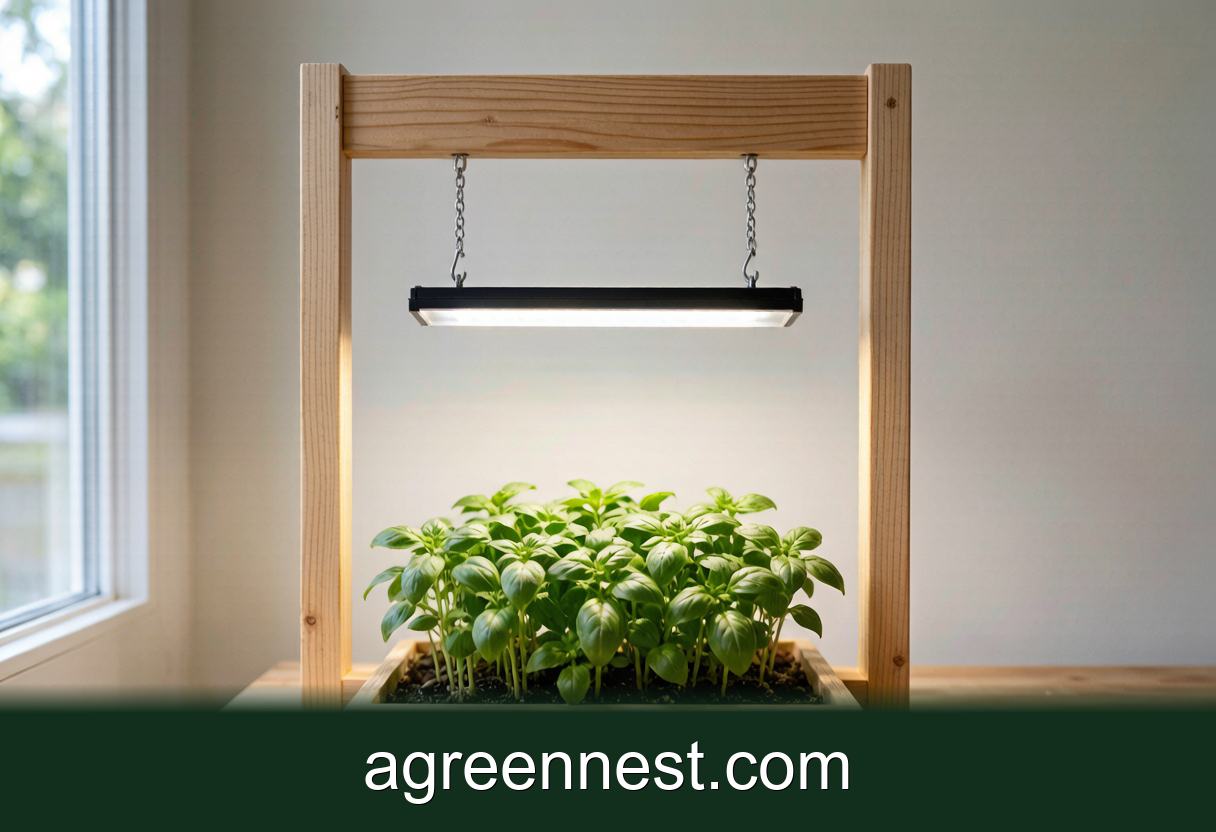
A grow light stand is a simple timber goalpost that holds an LED bar on adjustable chains above a tray. Two 90 cm uprights, one 80 cm crossbar, and $6 of chain give you height adjustment from 10 to 60 cm, which covers everything from seedlings to a mature *Peperomia* shelf.
Clamp lights fall over. That is the entire origin story of this project. I balanced a clip-on LED over a tray of basil seedlings for two weeks; it slid off the shelf edge twice, and the second time it landed lens-down in a wet tray. A $25 light, dead, for want of a frame.
The replacement frame took 55 minutes and $28 in materials, and it has carried three different lights over four years. Here is the exact build, cut list included.
What the Stand Has to Do (and What It Doesn't)
Strip the job down and a light stand has three requirements:
- Hold 1 to 3 kg dead level over a 55 x 28 cm tray, the standard 1020 seedling tray footprint.
- Adjust height in small steps. Seedlings want the light 10 to 15 cm away; a tray of rooted cuttings wants 25 to 40 cm; a full-grown foliage plant wants 45 to 60 cm. The rules behind those distances are in how far to hang grow lights.
- Stay put when you bump it. A watering can will hit an upright eventually. The base has to be wider than the crossbar is tall, or physics wins.
It does not need wheels, powder coating, or aluminium extrusion. That is how a $28 project becomes a $130 one.
The Cut List and the $28 Budget
One 2.4 m length of 44 x 44 mm pine and one 1.8 m length of 19 x 89 mm board cover the whole frame. Ask the store to make the cuts if you do not own a saw; most will do it without charging.
- Two uprights: 44 x 44 mm, cut at 90 cm each.
- One crossbar: 44 x 44 mm, cut at 80 cm.
- Two feet: 19 x 89 mm board, 40 cm each, running perpendicular to the crossbar.
- Two braces: offcuts of the 19 mm board, roughly 15 cm, screwed diagonally where each upright meets its foot.
Hardware: eight 70 mm wood screws, four 40 mm screws for the braces, two 4 mm screw eyes, 1 m of zinc chain (the #16 sash chain size, rated far beyond this job), and four S-hooks. My receipt: timber $16, chain and hooks $6, screws $4, screw eyes $2. Total $28.
Screw each foot to the bottom of an upright so the upright sits centred, add the diagonal brace, then screw the crossbar across the tops. Check the frame stands square before the last screws go in; a 2 mm lean at the base becomes a visible tilt at 90 cm.
How High Should the Light Hang?
Height adjustment is the whole reason to build rather than buy a fixed frame, and chain does it better than any ratchet cord at this scale.
Drive the two screw eyes into the underside of the crossbar, 50 cm apart for a 55 cm light bar. Hang a chain from each eye, clip an S-hook into the chain link at the height you want, and hang the light from the hooks. Each link is a 2.5 cm step, which is finer control than most commercial stands offer.
The distances I actually use under a 20 W full-spectrum bar:
- Germinating tray, no leaves yet: light parked at 40 cm, mostly to warm nothing; height barely matters until cotyledons show.
- Seedlings, first true leaves: 12 to 15 cm. Closer than most people dare, and it is the single best fix for leggy stems. Stretched, pale seedlings are covered in the etiolation guide.
- Rooted cuttings from a propagation box: 25 to 30 cm for their first two weeks in soil.
- Mature foliage plants: 45 to 60 cm, where a 20 W bar still delivers roughly 1500 lux across the tray.
Raise the light 5 cm the moment leaf edges cup downward or bleach at the centre. Lower it 5 cm when new growth spaces out along the stem. Two-link moves, either way.
Why Not Just Buy a Stand?
Fair question, since $30 buys a telescopic stand online. I own one of those too, and the differences show up in use.
The bought stand tops out at 40 cm of height range and its tripod feet straddle exactly one tray. The timber goalpost spans two 1020 trays side by side, adjusts from 10 to 60 cm, and holds a second light bar on two more screw eyes when winter cuttings pile up. Adding that second bar cost me the price of the bar and $3 of hardware. If you are still choosing the light itself, the LED vs fluorescent comparison settles it quickly; a 20 to 24 W full-spectrum LED bar is the right match for this frame.
The one thing the commercial stand does better is travel. It folds. The goalpost does not, so build it where it will live.
Wiring, Timers, and Keeping Water Off the Plug
Water and mains cables share a shelf in this project, so route with intention.
Run the light's cable along the crossbar to an upright, down the outside face, and off to the socket, secured with three cable clips. The plug and any timer sit at crossbar height or higher if the socket allows, never on the floor beside a tray you flood weekly. Loop the last 10 cm of cable below the timer so any drip that tracks along the wire falls off the loop, not into the socket. An electrician showed me that drip loop trick and it costs nothing.
Put the light on a mechanical or smart timer from day one: 14 to 16 hours for seedlings, 10 to 12 for maintenance lighting. Settings and common mistakes are in the grow light timer guide.
Frequently Asked Questions
Q: My seedlings still stretch even at 15 cm under the light. Is the stand too tall?
A: The stand is fine; the light is weak or the photoperiod is short. Confirm the bar actually draws 18 W plus from the wall (cheap "45 W" panels often pull 12), drop to 10 cm, and run 16 hours. If stems still stretch past 5 cm before true leaves, the light itself is the problem.
Q: Can the crossbar hold a T5 fluorescent twin tube instead of an LED bar?
A: Yes. A twin-tube 60 cm T5 fixture weighs about 2.5 kg, well inside what a 44 x 44 mm crossbar carries over an 80 cm span. Use both chains, check the fixture hangs level, and expect to run it closer to the canopy than an equivalent LED.
Q: How do I stop the stand walking around on a smooth shelf when I bump it?
A: Stick four rubber furniture pads under the feet. On melamine shelving the bare pine feet slide with one knock; with pads the frame stays planted. If small children or large cats share the room, add a screw through each foot into a timber shelf.
Q: Will 90 cm uprights fit under a standard shelf unit?
A: Measure first. Common wire shelving gives 35 to 45 cm between shelves, nowhere near enough. This frame is sized for a tabletop, a windowsill bench, or the top of a cabinet. For inside a shelf unit, skip the stand and screw the light straight to the shelf above, as most shelf growers do.
Q: What finish should the pine get if I water trays in place?
A: Two coats of water-based polyurethane on the feet and the lower 10 cm of each upright, which is the only zone that meets standing water. Bare pine above that is fine indoors. Skip oil finishes near seedling trays; some off-gas for weeks.
A goalpost frame, a metre of chain, and four S-hooks solve a problem that clamp lights never quite do, and the height range means one $28 build serves seedlings in spring and cuttings in winter without modification. Build it slightly wider than today's tray needs; trays multiply. To work out how much light your setup actually delivers at each chain height, run the numbers through our free light calculator.
Sources & further reading
GreenNest authors research and write every guide independently. The external links below are reputable references we recommend for deeper reading — they are not the sources we copied from.
- Michigan State University — College of Agriculture & Natural Resources — Michigan State University
- University of Minnesota Extension — U Minnesota Extension
- NC State Extension Plant Toolbox — NC State Extension
Recommended Tools for DIY Plant Projects Care
Free, no-signup helpers matched to this guide.
Free Ebooks to Explore
Downloadable handbooks — no email required.
Free Ebook
The AGreenNest Succulent Care Handbook
The complete, beginner-to-confident guide to growing fat, happy succulents — 10 chapters and a 20-plant directory.
Free Ebook
Haworthia & Haworthiopsis Care Handbook
A focused guide to the striped, forgiving Haworthia clan.
Share Your Plant Story
Grown something tricky, or found a trick that finally worked? Tell us in the comments, or see what other readers are sharing on our Community page. The best reader tips get folded back into our guides.
Join the Conversation
Have a tip or a question about Build an Adjustable Grow Light Stand for $28? Share it below — comments are saved on our server.