 AGreenNest
DIY Plant Projects
DIY Plant Fertilizer Myths: What Kitchen Scraps Do
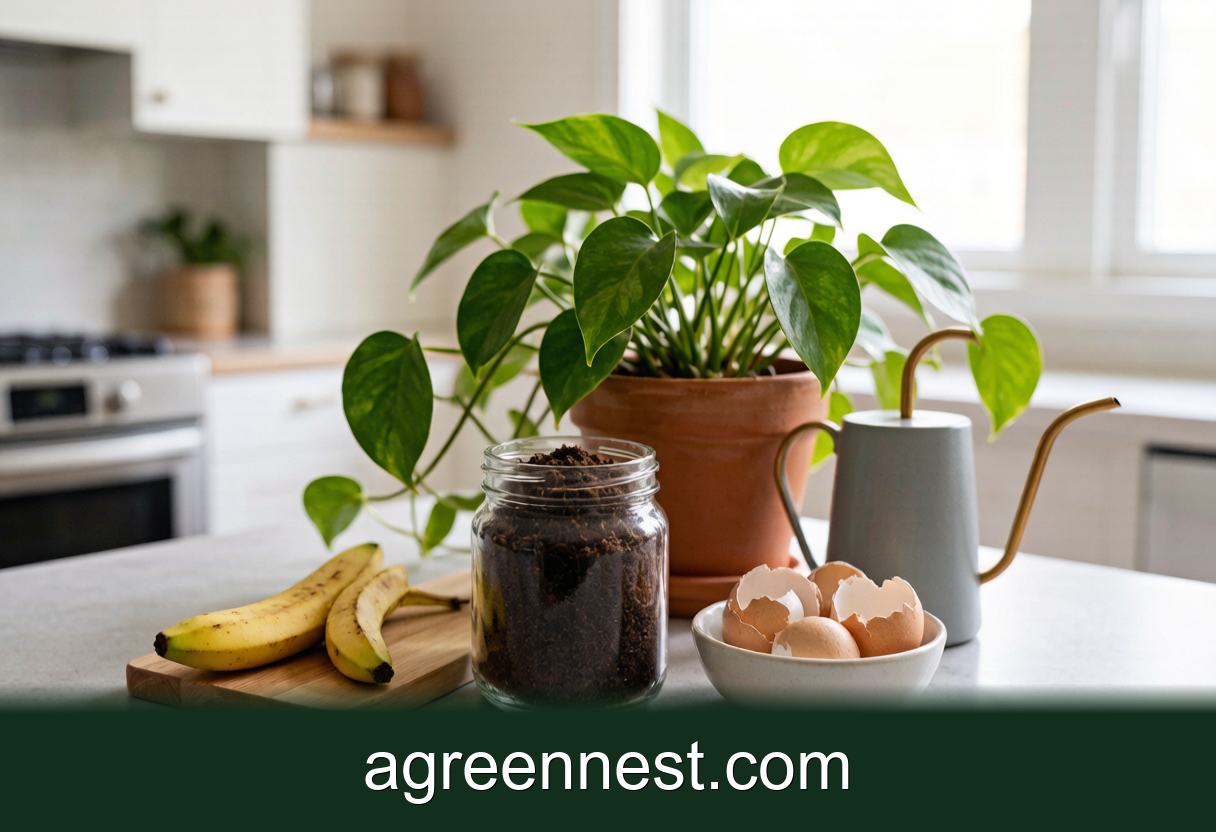
Coffee grounds, eggshells and Epsom salt do almost nothing for a potted houseplant on a useful timescale. Eggshells need 2 years to dissolve below pH 7. Banana peel water supplies potassium but no nitrogen. Diluted aquarium water is the only kitchen input that measurably feeds a plant, at roughly a quarter strength.
A reader sent me a photo last spring of a jar on her windowsill: three banana peels in cloudy water, going on day nine, with a note asking whether the smell meant it was "working." It meant the peels were rotting. That is a different thing from fertilizer, and the gap between those two ideas is where most DIY feeding advice lives.
So I ran the boring version of the experiment. Twelve weeks, four kitchen inputs, four pots of Epipremnum aureum per treatment plus a control fed 1/4 strength synthetic, all in the same mix under the same 12-hour LED. I counted new leaves and measured internode spacing every fortnight. Here is what survived contact with a ruler.
Why Don't Coffee Grounds Feed a Houseplant?
Spent coffee grounds test out at roughly 2.1% nitrogen, 0.3% phosphorus, 0.3% potassium by dry weight. That looks like a fertilizer. It is not one, for two reasons.
First, the nitrogen is locked in organic compounds. It becomes plant-available only after soil microbes break the grounds down, and grounds have a carbon-to-nitrogen ratio near 20:1. In a warm outdoor compost heap that mineralization runs in weeks. In a 15 cm pot on a shelf, with a fraction of the microbial biomass and no thermophilic phase, my grounds pots showed no growth advantage at all over the unfed control at week 12. Same leaf count, within one leaf.
Second, grounds behave badly as a physical layer. A 1 cm cap of wet grounds knits into a mat that sheds water sideways instead of letting it soak in. Two of my four grounds pots developed dry pockets at the root ball centre that I only found on repotting.
The acidity claim is wrong in the direction people assume. Fresh grounds sit near pH 5.0, but brewing strips most of the acids into your cup, so spent grounds land around 6.5 to 6.8. Close to neutral.
Do Eggshells Add Calcium Fast Enough to Matter?
Eggshell is about 95% calcium carbonate, so the raw material is genuine. The problem is dissolution chemistry, and it is unforgiving.
Calcium carbonate dissolves in acid. In a peat-based mix at pH 6.0 to 6.5, that reaction is slow. Research on shell fragments in soil puts full breakdown of crushed shell at 1 to 2 years at that pH, and above pH 7 the shell can sit inert for far longer. I buried marked half-shells in two pots in April. When I tipped those pots out in July the shells were dirty and intact, edges as sharp as the day they went in.
Grinding changes the timeline, but you have to actually grind. Not "crush in your hand." A batch run through a coffee grinder to a flour, particle size under 0.5 mm, did visibly dissolve in a vinegar test in minutes. Even then you are only supplying calcium, and calcium deficiency is rare indoors: tap water in hard-water regions delivers 40 to 120 mg/L of it every time you water.
Verdict: skip the shells, or grind them to powder and treat them as a mild liming agent rather than food. If your mix genuinely needs calcium, a proper mineral amendment costs less than the effort, and the soil-blending logic in mix your own succulent soil applies just as well to aroid mixes.
Banana Peel Water and Aquarium Water: The Two That Half-Work
These are the only kitchen inputs from my test with anything measurable behind them, and they are lopsided in opposite ways.
Banana peel water. A peel carries roughly 40 mg of potassium per gram of dry tissue, and potassium is water-soluble, so a genuine soak does leach some out. What it does not contain in any meaningful amount is nitrogen. My peel-water pots put out the same number of leaves as the control but with slightly firmer, deeper green tissue, which is what a potassium top-up does when nothing else is limiting. The catch is the jar: at room temperature an open peel soak goes anaerobic in 3 to 4 days and starts breeding fungus gnats. Soak 24 hours, strain, use it, and stop treating it as a perpetual brew.
Aquarium water. This one earned its place in my rotation. A moderately stocked freshwater tank runs 10 to 40 ppm nitrate, plus phosphate and trace elements from fish food. At 20 ppm nitrate you have something close to a quarter-strength houseplant feed that also happens to be dechlorinated and room temperature. My aquarium-water pots matched the control on leaf count and beat the unfed pots by three leaves per plant. Use water from freshwater tanks only, never a marine tank, and skip it if you dose copper-based medications.
Epsom Salt Is Not a Fertilizer, It Is a Magnesium Supplement
Epsom salt is magnesium sulfate. Two nutrients, both real, neither of them nitrogen, phosphorus or potassium. Sprinkling it on a Monstera deliciosa that is pale from a season without feeding will do nothing, because that plant is short of nitrogen, not magnesium.
Magnesium deficiency has a specific signature: interveinal chlorosis on the oldest leaves first, veins staying green while the tissue between them yellows into a herringbone. If you see that, and only if you see that, 1 teaspoon of Epsom salt per 4 litres of water once a month is a reasonable correction. Applied blindly and often, the sulfate contributes to salt buildup, and you end up flushing pots to fix a problem you created. The crusty-rim diagnosis in dealing with over-fertilisation covers what that looks like.
What I Actually Use in a DIY Setup
After the twelve weeks, my kitchen-input shortlist is short.
- Aquarium water, used fresh, roughly every second watering during growth. It replaced about a third of my liquid feed by volume.
- Banana peel water, 24-hour soak, once a month at most, as a potassium nudge for flowering plants like Spathiphyllum wallisii.
- Worm castings from a bin, 10% by volume at repotting, which is the honest destination for your coffee grounds and shells.
Everything else on the internet's scrap list is either too slow, too dilute, or too imbalanced to register on a plant that is being fed properly in the first place. The baseline routine in fertilizing houseplants basics beats any of it, and if you want the numbers behind dilution rates, using liquid fertilizer correctly has the arithmetic. For the pantry remedies I did not test here, does cinnamon help houseplants runs the same kind of check.
Frequently Asked Questions
Q: My grandmother watered her plants with coffee for 40 years and they were huge. How do I square that with your test?
A: She was almost certainly watering with leftover brewed coffee, heavily diluted, into outdoor or repotted soil with a live microbial community, and she was probably also repotting regularly. Diluted liquid coffee is mostly water with trace potassium. It does no harm at 1 part coffee to 4 parts water. The grounds themselves are the part that fails.
Q: Can I bury banana peels directly in the pot instead of soaking them?
A: You can, and you will get fungus gnats and a sour smell within a week. A buried peel decomposes anaerobically in the middle of a root ball. Soak, strain, discard the solids into a compost bin.
Q: Is any of this worth it if I already buy fertilizer?
A: Only the aquarium water, and only if you keep fish anyway. The rest costs you time and gnat risk to replicate what a 12 dollar bottle does at 5 ml per 4 litres for two years.
Kitchen-scrap feeding is not a scam so much as a category error: compost inputs being used as fertilizer inputs. Put the grounds and shells in a bin, let microbes do the conversion, and feed the pot with something already dissolved. If you want to check whether your plant is actually short of light rather than food before you feed it at all, run our free light calculator first.
Sources & further reading
GreenNest authors research and write every guide independently. The external links below are reputable references we recommend for deeper reading — they are not the sources we copied from.
- Michigan State University Extension — Home gardening and soils — Michigan State University
- University of Minnesota Extension — Houseplant care — U Minnesota Extension
- NC State Extension Plant Toolbox — NC State Extension
Recommended Tools for DIY Plant Projects Care
Free, no-signup helpers matched to this guide.
Free Ebooks to Explore
Downloadable handbooks — no email required.
Free Ebook
The AGreenNest Succulent Care Handbook
The complete, beginner-to-confident guide to growing fat, happy succulents — 10 chapters and a 20-plant directory.
Free Ebook
Haworthia & Haworthiopsis Care Handbook
A focused guide to the striped, forgiving Haworthia clan.
Share Your Plant Story
Grown something tricky, or found a trick that finally worked? Tell us in the comments, or see what other readers are sharing on our Community page. The best reader tips get folded back into our guides.
Join the Conversation
Have a tip or a question about DIY Plant Fertilizer Myths: What Kitchen Scraps Do? Share it below — comments are saved on our server.